Listen to this Post
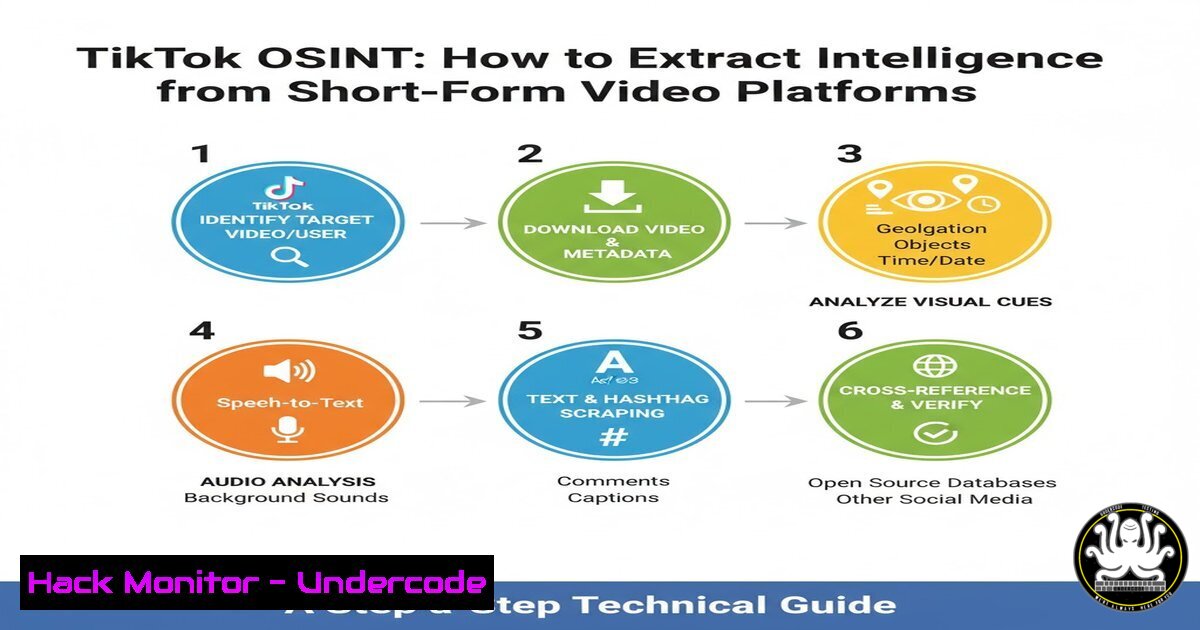
Introduction:
Open Source Intelligence (OSINT) has evolved beyond traditional social media, and TikTok—with its massive user base and rich metadata—has become a prime source for cyber investigators, threat analysts, and penetration testers. While TikTok’s public API is limited, its web interfaces and mobile endpoints leak a wealth of information that can be harvested legally and ethically. This guide provides a technical deep dive into extracting actionable intelligence from TikTok, covering URL decoding, account profiling, comment mining, and automation using standard Linux/Windows command-line tools and Python scripts.
Learning Objectives:
- Understand how TikTok’s web and API endpoints expose user data and metadata.
- Learn manual and automated techniques to extract video metadata, account details, and engagement metrics.
- Gain hands‑on experience with curl, jq, Python, and browser developer tools for OSINT collection.
You Should Know:
1. Decoding TikTok URL Metadata
TikTok video URLs contain embedded identifiers that reveal account names, video IDs, and sometimes timestamps. For example, a standard URL:
`https://www.tiktok.com/@username/video/7123456789012345678`
The `@username` is the account handle, and the numeric ID is the unique video identifier. Beyond the URL itself, the video page’s HTML contains structured data (JSON-LD) with additional metadata like upload date, description, music, and hashtags.
Step‑by‑step guide using curl and jq:
- Fetch the video page and extract the JSON-LD block:
curl -s "https://www.tiktok.com/@username/video/7123456789012345678" | grep -oP '(?<=<script id="__NEXT_DATA__" type="application/json">).?(?=</script>)' | jq .
- This outputs a massive JSON object. Focus on `props.pageProps.videoData` for video‑specific info, or `props.pageProps.userData` for account details.
- To quickly grab the video’s creation time and description:
curl -s "https://www.tiktok.com/@username/video/7123456789012345678" | grep -oP '(?<=<script id="__NEXT_DATA__" type="application/json">).?(?=</script>)' | jq '{createTime: .props.pageProps.videoData.createTime, desc: .props.pageProps.videoData.desc}'Windows users: Use `curl.exe` in PowerShell or install Git Bash for similar functionality.
2. Gathering TikTok Account Intelligence
User profiles contain public information: bio, follower/following counts, profile picture, verified status, and recent videos. This can be harvested directly from the profile page.
Step‑by‑step guide using curl and regex:
- Fetch the profile page and extract the JSON data:
curl -s "https://www.tiktok.com/@username" | grep -oP '(?<=<script id="__UNIVERSAL_DATA_FOR_REHYDRATION__" type="application/json">).?(?=</script>)' | jq .
- Navigate to `__DEFAULT_SCOPE__ > webapp.user-detail > userInfo` for structured data.
- To get a quick summary of follower count, bio, and nickname:
curl -s "https://www.tiktok.com/@username" | grep -oP '(?<=<script id="__UNIVERSAL_DATA_FOR_REHYDRATION__" type="application/json">).?(?=</script>)' | jq '.<strong>DEFAULT_SCOPE</strong>["webapp.user-detail"].userInfo'
- For a more concise output, use:
... | jq '{uniqueId: .user.uniqueId, nickname: .user.nickname, bio: .user.signature, followerCount: .stats.followerCount, followingCount: .stats.followingCount, videoCount: .stats.videoCount}'
3. Extracting Comments and Engagement Data
Comments on TikTok videos often contain valuable intelligence—user interactions, sentiment, or even leaked information. TikTok loads comments via a paginated API endpoint.
Step‑by‑step guide using browser DevTools and curl:
- Open TikTok in Chrome/Firefox, navigate to a video, and open Developer Tools (F12).
- Go to the Network tab, filter by
Fetch/XHR, and scroll down the comments. - Look for requests to
https://www.tiktok.com/api/comment/list/` with parameters likeaweme_id,cursor, andcount`. - Right‑click any such request and select Copy as cURL.
- Paste the command in a terminal, then pipe to `jq` to extract comment text, usernames, and timestamps:
curl 'https://www.tiktok.com/api/comment/list/?aweme_id=7123456789012345678&count=20&cursor=0' \ -H 'user-agent: Mozilla/5.0 ...' \ -H 'cookie: ...' \ --compressed | jq '.comments[] | {user: .user.unique_id, text: .text, create_time: .create_time}' - To paginate, increment the `cursor` parameter (usually a timestamp or offset) and repeat.
Note: Cookies and headers are required to avoid blocking. Respect rate limits—add a delay between requests.
4. Geolocation and Video Metadata Extraction
TikTok does not embed GPS coordinates in video files (EXIF is stripped), but users may reveal location in text, hashtags, or through profile information. Additionally, some videos contain location stickers or place IDs that can be cross‑referenced.
Manual techniques:
- Check video descriptions for place names or hashtags like
newyork. - Use the place ID from the video JSON (e.g., `location.created` field) and query TikTok’s internal place endpoint.
- For downloaded videos, `exiftool` can reveal if any metadata remains (rare):
exiftool video.mp4
- To programmatically search for location‑based content, use TikTok’s search API with a location keyword:
curl -s "https://www.tiktok.com/api/search/general/full/?keyword=New%20York&count=30" \
-H 'user-agent: ...' -H 'cookie: ...' | jq '.data'
5. Automating OSINT with Python (Requests + BeautifulSoup)
For large‑scale collection, Python scripts are more flexible. Below is a simple script to fetch user profile data using `requests` and parse JSON.
Python script example:
import requests
import json

def get_tiktok_profile(username):
url = f"https://www.tiktok.com/@{username}"
headers = {'User-Agent': 'Mozilla/5.0 (Windows NT 10.0; Win64; x64) AppleWebKit/537.36'}
r = requests.get(url, headers=headers)
 Extract JSON block
start = r.text.find('<script id="__UNIVERSAL_DATA_FOR_REHYDRATION__" type="application/json">')
if start == -1:
return None
start = r.text.find('>', start) + 1
end = r.text.find('</script>', start)
data = json.loads(r.text[start:end])
user_info = data['<strong>DEFAULT_SCOPE</strong>']['webapp.user-detail']['userInfo']
return user_info

if <strong>name</strong> == "<strong>main</strong>":
info = get_tiktok_profile("username")
print(json.dumps(info, indent=2))
– Install dependencies: `pip install requests beautifulsoup4`
– Add error handling and delays to avoid IP bans.
6. Leveraging the Unofficial TikTokApi Library
The `TikTokApi` Python library (by David Teather) provides a convenient wrapper around TikTok’s internal endpoints. It handles signing and parameter obfuscation.
Installation and basic usage:
pip install TikTokApi
Example script to get user videos:
from TikTokApi import TikTokApi

with TikTokApi() as api:
user = api.user(username="username")
user_info = user.info()
print(f"User: {user_info['userInfo']['user']['uniqueId']}")
print(f"Followers: {user_info['userInfo']['stats']['followerCount']}")

for video in user.videos(count=5):
print(f"Video ID: {video['id']}, Desc: {video['desc']}")
– The library mimics a mobile device; ensure you have `ms_token` or other parameters (check library documentation).
– Use with caution—excessive requests may lead to rate limiting.
7. Advanced: API Endpoint Analysis and Evasion Techniques
TikTok employs obfuscated parameters (e.g., _signature, verifyFp) to prevent automated scraping. Understanding these can help advanced OSINT practitioners.
Key points:
- Most requests require a valid `msToken` (generated by TikTok’s web SDK) and a `_signature` (a hash of parameters).
- Tools like `TikTokApi` handle signing internally, but you can also capture a valid session from a browser and reuse the cookies/headers.
- Use rotating proxies and user‑agent pools to reduce detection.
- For command‑line testing, copy the full cURL command from DevTools—it includes all necessary headers and signatures.
Mitigation considerations:
- Respect `robots.txt` and TikTok’s Terms of Service.
- Rate‑limit your requests (e.g., sleep 1‑2 seconds between calls).
- Use official APIs where possible (TikTok Research API for academics).
What Undercode Say:
- Key Takeaway 1: TikTok’s web interface and internal APIs expose extensive public data—including user profiles, video metadata, and comments—that can be harvested with basic command‑line tools and Python scripts. The information is valuable for threat intelligence, social engineering assessments, and investigative journalism.
- Key Takeaway 2: While automation is possible, it requires careful handling of anti‑scraping measures (signatures, cookies, rate limiting). Ethical boundaries must be respected; never attempt to access private accounts or violate platform policies. Always use collected data responsibly and in compliance with applicable laws.
Analysis: TikTok OSINT is a growing field because the platform’s popularity makes it a rich source of real‑time human intelligence. From tracking disinformation campaigns to identifying potential insider threats, the ability to systematically gather and analyze TikTok data gives security professionals a significant advantage. However, as TikTok continues to evolve its defenses, OSINT practitioners must stay updated on endpoint changes and adopt more sophisticated methods, such as headless browsers or mobile emulation, to maintain access.
Prediction:
As short‑form video platforms dominate social media, they will become primary targets for OSINT operations. TikTok’s parent company, ByteDance, is likely to further restrict public data access—possibly introducing stricter API controls, mandatory authentication, or paywalled endpoints—to comply with global privacy regulations and reduce scraping. This will drive OSINT researchers toward more advanced techniques, including browser automation (Puppeteer/Playwright) and machine‑learning‑based content analysis. Simultaneously, we may see the emergence of dedicated commercial OSINT tools tailored for TikTok, blending traditional intelligence gathering with AI‑powered sentiment and trend analysis.
▶️ Related Video (78% Match):
🎯Let’s Practice For Free:
IT/Security Reporter URL:
Reported By: Https: – Hackers Feeds
Extra Hub: Undercode MoN
Basic Verification: Pass ✅


