Listen to this Post
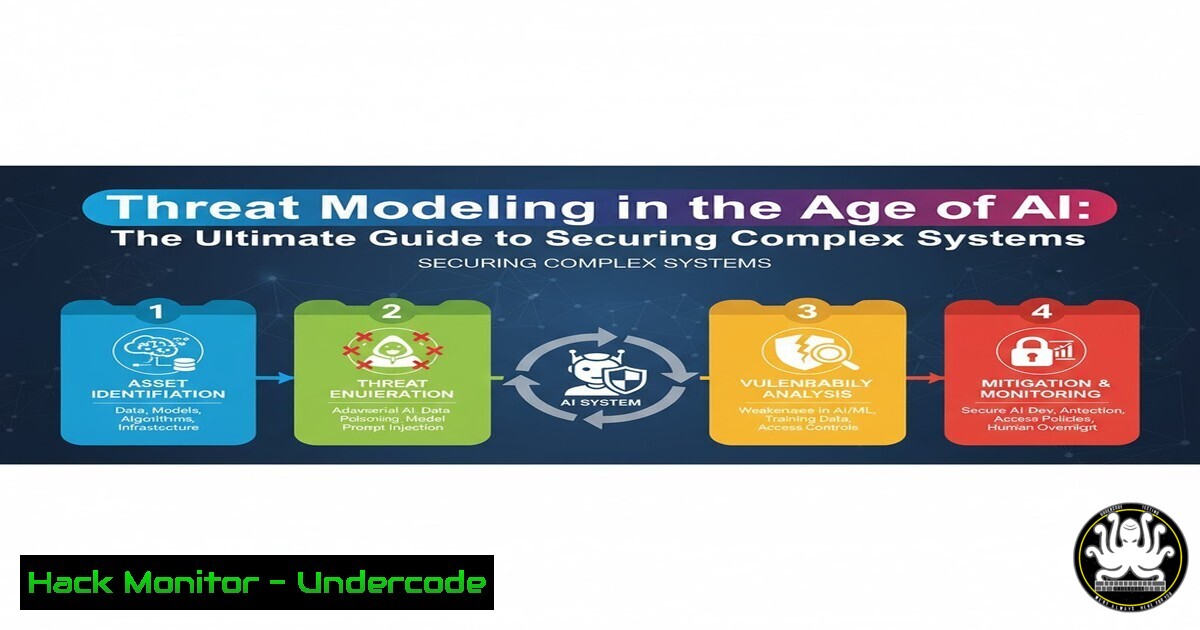
Introduction:
Threat modeling remains the cornerstone of proactive cybersecurity, providing a structured approach to identifying and mitigating potential security flaws before they can be exploited. As systems grow in complexity, integrating cloud, AI, and microservices, the principles of threat modeling must evolve to address these new attack surfaces. This guide unpacks the enduring methodologies and introduces the advanced techniques required to defend modern digital infrastructures.
Learning Objectives:
- Understand the core principles and methodologies of threat modeling, such as STRIDE and DREAD.
- Learn to construct and analyze Data Flow Diagrams (DFDs) for complex, interconnected systems.
- Gain practical skills for integrating threat modeling into the DevOps lifecycle (DevSecOps) and leveraging AI-assisted tools.
You Should Know:
1. The Foundational Principles of Threat Modeling
Threat modeling is not a single tool but a process for evaluating the security of an application or system. It involves systematically identifying potential threats, vulnerabilities, and defining countermeasures. The core concept is to “think like an attacker” but do so systematically during the design phase. Frameworks like STRIDE (Spoofing, Tampering, Repudiation, Information Disclosure, Denial of Service, Elevation of Privilege) provide a taxonomy for categorizing threats.
Step-by-step guide:
Step 1: Decompose the Application. Identify all assets, entry points, trust levels, and data flows. Use tools like Microsoft Threat Modeling Tool or OWASP Threat Dragon to create a visual Data Flow Diagram (DFD).
Step 2: Identify Threats. Apply the STRIDE framework to each element of your DFD. For example, ask “How can this data flow be tampered with?” or “How can this user be spoofed?”
Step 3: Mitigate Threats. For each identified threat, determine a mitigation strategy. This could be implementing a control (e.g., HTTPS for tampering), removing the feature, or accepting the risk.
Step 4: Validate. Continuously validate your model as the system evolves. Re-run the threat model with every significant architectural change.
2. Constructing Effective Data Flow Diagrams (DFDs)
A DFD is the visual blueprint for your threat model. It maps how data moves through your system, highlighting trust boundaries—the critical lines where data crosses from one trust zone to another (e.g., from the internet to your web server). These boundaries are prime locations for security controls.
Step-by-step guide:
Step 1: Identify External Entities. These are users, external systems, or attackers that interact with your system.
Step 2: Define Processes. These are the active components of your system (e.g., a web application, an API endpoint, a backend service).
Step 3: Map Data Stores. Where does your data reside? This includes databases, file systems, and caches.
Step 4: Draw Data Flows. Connect the entities, processes, and stores with arrows showing the direction of data movement.
Step 5: Enforce Trust Boundaries. Draw clear lines around components that share the same level of trust. Any data flow crossing this line must be scrutinized. For instance, all traffic crossing from an external user into your application server boundary should be authenticated and encrypted.
3. Integrating Threat Modeling into DevOps (DevSecOps)
For Agile and DevOps environments, threat modeling cannot be a one-time, pre-development exercise. It must be “shifted left” and integrated into the CI/CD pipeline to be effective and sustainable.
Step-by-step guide:
Step 1: Automate DFD Generation. Use tools that can automatically generate DFDs from code or infrastructure-as-code (Terraform, CloudFormation) to maintain an up-to-date view.
Step 2: Implement Security Gates. In your CI pipeline, use scripts to check for critical threats. For example, a script could fail a build if a new internet-facing component is added without a corresponding threat model update.
Example CI Check (Pseudocode): `if (git diff shows new external_endpoint) && (!threat_model_updated) then fail_build`
Step 3: Continuous Monitoring. Integrate threat intelligence feeds into your model. If a new vulnerability (CVE) is published for a component in your DFD, your security team should be alerted automatically.
- Leveraging AI to Augment the Threat Modeling Process
AI is poised to revolutionize threat modeling by automating tedious aspects and enhancing human analysis. AI can generate preliminary DFDs, suggest likely threat vectors based on system architecture, and even propose mitigations by learning from vast datasets of past vulnerabilities.
Step-by-step guide:
Step 1: AI-Assisted DFD Creation. Provide a natural language description of your system to an AI tool, which can then draft an initial DFD for your review and refinement.
Step 2: Predictive Threat Analysis. AI models can analyze your DFD and predict the most probable attack paths an advanced persistent threat (APT) might take, prioritizing your mitigation efforts.
Step 3: Dynamic Mitigation Suggestion. When a new threat is identified, an AI system can cross-reference it with your live threat model and suggest specific code patches, firewall rules, or WAF (Web Application Firewall) configurations.
Example WAF Rule Suggestion: Upon identifying a potential SQL Injection threat in a data flow, the AI could recommend: `SecRule ARGS “@detectSQLi” “id:1001,deny,status:403,msg:’SQL Injection Attempt'”`
5. Practical Commands for Validating Mitigations
Once threats are identified and mitigations are planned, you must validate them. Here are essential commands for testing common mitigations on Linux and Windows.
Step-by-step guide:
Validating TLS/Encryption (Tampering Mitigation):
Linux (OpenSSL): openssl s_client -connect example.com:443 -servername example.com. Check the certificate chain and cipher details.
Windows (PowerShell): `Test-NetConnection -ComputerName example.com -Port 443` followed by inspecting the certificate in a browser.
Testing for Information Disclosure (Directory Traversal):
Linux (curl): `curl -s “http://vulnerable-site.com/?file=../../../../etc/passwd” | grep -i “root:”`
General (Nmap NSE): `nmap –script http-enum,http-vuln- -p 80,443
Checking for Weak File Permissions (Privilege Escalation Mitigation):
Linux: `find /opt/app/ -type f -perm -o=w -ls` (Finds world-writable files in an application directory).
Windows (PowerShell): `Get-ACL -Path “C:\App\secrets.conf” | Format-List` to audit access control lists.
What Undercode Say:
- Key Takeaway 1: Threat modeling’s greatest value is in fostering a culture of security-by-design, forcing collaboration between developers, architects, and security teams before a single line of code is written. This proactive dialogue is more valuable than the final document itself.
- Key Takeaway 2: The future of threat modeling is symbiotic, not automated. AI will handle the heavy lifting of data correlation and initial analysis, but human expertise in business context, risk appetite, and creative adversarial thinking will remain irreplaceable for the foreseeable future.
The commentary from a practitioner who has used the book’s methodologies for years underscores a critical point: effective threat modeling requires deep, time-consuming engagement with system design. The hope that AI can alleviate this burden is well-founded, but it will augment, not replace, the skilled security professional. The ultimate goal is to make robust threat modeling less of a manual art and more of a scalable, integrated engineering discipline.
Prediction:
In the next 3-5 years, AI-powered threat modeling platforms will become standard in enterprise DevSecOps pipelines. These systems will autonomously update DFDs in real-time as code is committed, continuously score system risk based on the latest threat intelligence, and automatically generate and deploy targeted security controls. This will shift the security paradigm from reactive patching to predictive hardening, fundamentally reducing the attack surface of complex systems at machine speed. The role of the security professional will evolve from modeler to model validator and strategic risk advisor.
🎯Let’s Practice For Free:
IT/Security Reporter URL:
Reported By: Derek Fisher – Hackers Feeds
Extra Hub: Undercode MoN
Basic Verification: Pass ✅


