
Listen to this Post
Introduction:
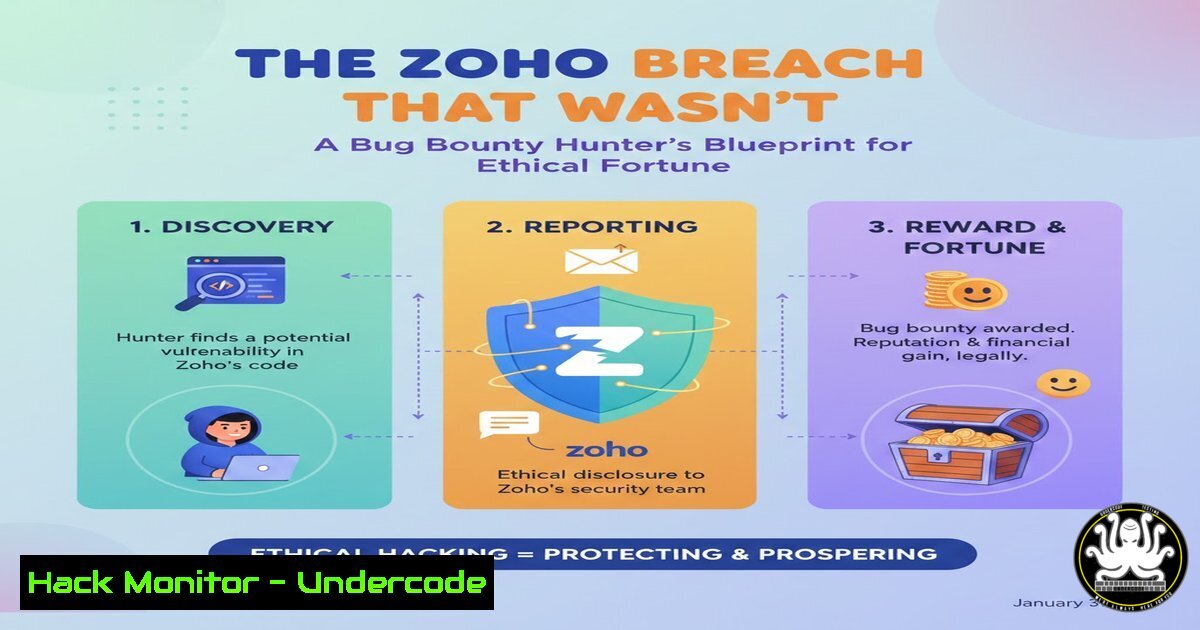
In the high-stakes arena of cybersecurity, the line between a crippling data breach and a secured enterprise often hinges on the work of ethical hackers. The recent disclosure by a security researcher regarding a patched vulnerability in Zoho underscores the critical role of structured bug bounty programs in proactive defense. This incident exemplifies a successful security feedback loop, where researchers responsibly report flaws, and organizations swiftly remediate them, transforming potential headlines about exploits into case studies in collaboration.
Learning Objectives:
- Understand the end-to-end workflow of a professional bug bounty engagement, from reconnaissance to polished report.
- Identify and utilize a modern toolkit for web application and cloud service reconnaissance and vulnerability assessment.
- Master the art of crafting a proof-of-concept (PoC) and a disclosure report that ensures clear, actionable remediation.
You Should Know:
- The Art of Intelligent Reconnaissance: Mapping the Attack Surface
Before a single test is launched, successful hunters map the target’s digital footprint. This involves discovering all associated domains, subdomains, and cloud assets. For a company like Zoho, with numerous SaaS products, this phase is crucial.
Step‑by‑step guide:
- Passive Enumeration: Use tools to find subdomains without directly touching the target’s infrastructure.
Command (Linux):
 Using amass for passive enumeration
amass enum -passive -d zohocorp.com -o subdomains_passive.txt
 Using sublist3r
python3 sublist3r.py -d zohocorp.com -o subdomains_sublist3r.txt
2. Asset Discovery: Identify related cloud infrastructure (AWS S3 buckets, Azure blobs) that might be misconfigured.
Tool: Use `cloud_enum` (https://github.com/initstring/cloud_enum) for multi-cloud enumeration.
Command:
python3 cloud_enum.py -k zoho -l zoho_cloud_assets.txt
3. Service Fingerprinting: Identify what services are running on discovered hosts.
Command (Using Nmap):
nmap -sV --top-ports 100 -iL discovered_hosts.txt -oA nmap_service_scan
2. Vulnerability Scanning & Manual Hypothesis
Automated scanners provide a baseline, but the critical findings come from manual analysis and hypothesis testing based on application logic.
Step‑by‑step guide:
- Automated Baseline Scan: Run a high-level scanner to catch low-hanging fruit.
Tool: OWASP ZAP (Zed Attack Proxy) or Burp Suite Professional.
Action: Configure the scanner against the target application scope (e.g.,mail.zoho.com) and run an active scan. Review all alerts for potential leads. - Manual Mapping & Logic Analysis: Use a proxy to manually explore the application.
Tool: Configure Burp Suite or OWASP ZAP as your system/ browser proxy.
Action: Log in, use every feature, and observe all HTTP requests. Look for parameters that control user data, access rights (uid,account_id,isAdmin), or file paths. Ask: “What if I change this `user_id` to another user’s? What if I can access this file with a different path?”
3. Exploitation & Proof-of-Concept (PoC) Development
This is where you confirm the vulnerability. A PoC must be clear, safe, and reproducible.
Step‑by‑step guide (Example: IDOR – Insecure Direct Object Reference):
1. Identify Target Endpoint: Suppose you find an API endpoint: `https://app.zoho.com/api/v1/user/exportData?report_id=12345`.
2. Formulate Hypothesis: Can we access report `12346` which belongs to another user?
3. Craft the PoC: Use `curl` to test the hypothesis.
Command (Linux/macOS):
 Test with an authenticated session cookie
curl -H "Cookie: SESSION=YOUR_VALID_SESSION_COOKIE" \
"https://app.zoho.com/api/v1/user/exportData?report_id=12346" -o potential_report.pdf
Analysis: If the command successfully downloads a report that should not be accessible, you have a confirmed IDOR. Document every step, including the exact HTTP request and response.
4. Data Sanitization & Impact Demonstration
Never exfiltrate or retain real user data. Anonymize all information in your report.
Step‑by‑step guide:
- Mask Sensitive Data: In your screenshots or response logs, use editing tools to black out or replace all personal identifiable information (PII), tokens, and internal IDs.
Example: Change `”email”: “[email protected]”` to `”email”: “[email protected]”` in your example logs. - Demonstrate Impact Clearly: Explain the worst-case scenario (e.g., “This IDOR could allow any authenticated user to download the financial reports of any other user in the system, leading to mass data leakage”).
-
The Professional Report: Your Key to a Successful Bounty
A poorly written report can lead to rejection. Clarity and actionability are paramount.
Step‑by‑step guide:
1. Use a Clear Structure:
Concise (e.g., “IDOR in /api/v1/user/exportData allows unauthorized report download”).
Summary: One-paragraph overview of the vulnerability and impact.
Affected Component: The exact URL/endpoint.
Steps to Reproduce: A numbered list, starting from an unauthenticated state. Include all steps (login, navigation, request sent).
Proof of Concept: Include sanitized HTTP requests/responses (as text) and annotated screenshots.
Impact Assessment: CVSS vector (e.g., CVSS:3.1/AV:N/AC:L/PR:L/UI:N/S:C/C:H/I:N/A:N) and business impact explanation.
Remediation Recommendation: Suggest a fix (e.g., “Implement proper authorization checks that verify the current user has permission to access the requested report_id“).
What Undercode Say:
- The Real Hunt is in the Logic: The most critical vulnerabilities are rarely found by automated tools alone. They are discovered by understanding business logic, data flows, and asking “what if” questions that a scanner cannot conceive.
- Reputation is Currency: A clean, responsible disclosure with a perfectly documented report builds your reputation far more than a dozen poorly submitted bugs. It turns you from a random finder into a trusted security partner.
Prediction:
The Zoho case is a microcosm of the future of enterprise security. Bug bounty programs will evolve from simple vulnerability payouts into integrated, continuous security partnerships. We will see the rise of AI-assisted hunting, where AI handles the massive scale of initial reconnaissance and pattern recognition, freeing human researchers to perform deep, complex logic flaw analysis. However, this will also lead to a more competitive landscape, raising the bar for report quality and the sophistication of findings. Platforms will increasingly prioritize hunters who not only find bugs but can articulate risk and remediation in the language of business, further blurring the line between researcher and security consultant.
▶️ Related Video (82% Match):
🎯Let’s Practice For Free:
IT/Security Reporter URL:
Reported By: Vishnu Das – Hackers Feeds
Extra Hub: Undercode MoN
Basic Verification: Pass ✅


