Listen to this Post
Introduction
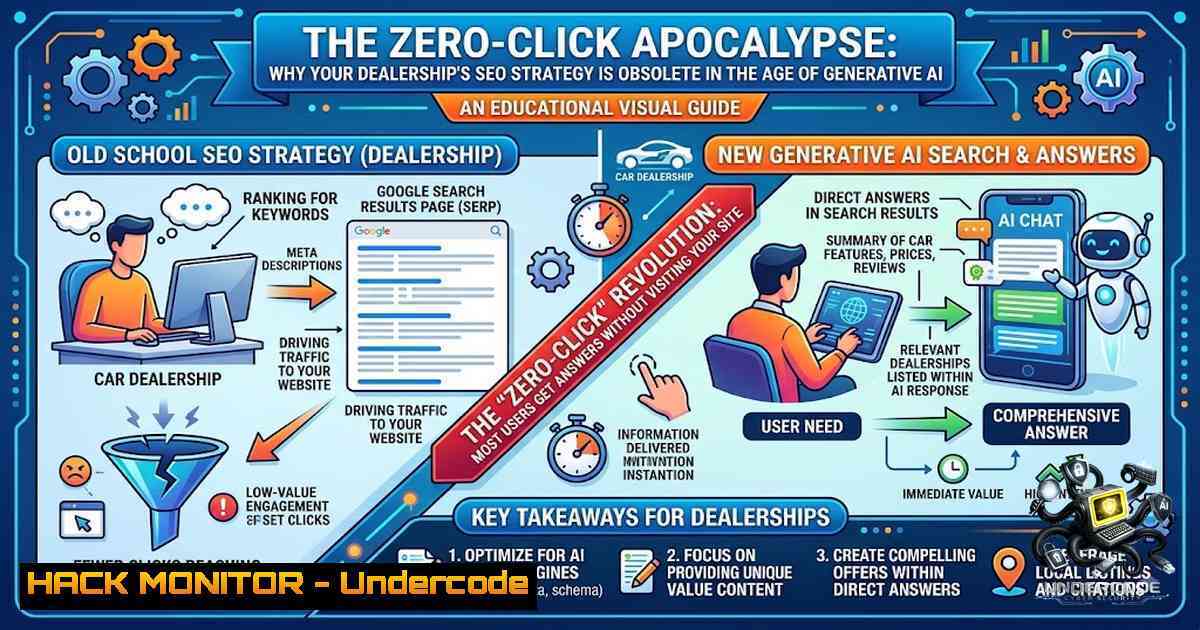
The automotive retail industry stands at a critical inflection point. Traditional search engine optimization—the practice of keyword stuffing, link building, and ranking for “best truck deal near me”—has been rendered largely ineffective by the rise of generative AI and zero-click search. Industry data reveals that 68% of all Google searches now end without a single click, and AI-powered platforms like ChatGPT, Gemini, and Perplexity are fundamentally rewriting how car buyers discover dealerships. Dealerships that continue treating AI visibility like SEO from 2012—slapping together thin blog posts, posting polished car photos, and replying to reviews with canned responses—have already lost the sale before the customer ever walks through the door. The question is no longer whether to adapt, but how quickly.
Learning Objectives
- Understand the fundamental differences between traditional SEO, Answer Engine Optimization (AEO), and Generative Engine Optimization (GEO)
- Master the technical implementation of schema markup, JSON-LD, and knowledge graph integration for automotive dealerships
- Learn to structure content for AI crawlability, citation, and zero-click visibility across LLM platforms
- Develop a comprehensive AI visibility strategy incorporating reputation management, entity optimization, and prompt visibility monitoring
- Implement technical infrastructure including server-side rendering, llms.txt, and AI-ready schema for dealership websites
You Should Know
- The Technical Foundation: Schema Markup and Knowledge Graph Integration
The first and most critical step in AI visibility is ensuring that AI systems can understand your dealership’s identity, inventory, and services without guessing. Schema markup—specifically JSON-LD structured data—is the language that tells AI crawlers exactly what your content contains, bypassing the messy HTML parsing that often confuses large language models.
Step-by-Step Implementation:
- Choose the correct schema type – For automotive dealerships, use `AutoDealer` (a subtype of
LocalBusiness) rather than the generic `LocalBusiness` type. This provides more precise category information and unlocks industry-specific rich result features. -
Deploy Organization Schema – Implement Organization schema on your homepage and about page with the following essential properties:
– @type: Organization or AutoDealer
– name: Exact legal business name
– address: Complete postal address with street, city, state, zip code
– telephone: Primary phone number
– url: Website URL
– logo: URL to business logo
– foundingDate: Date the dealership was established
– sameAs: URLs to social profiles and directory listings (Facebook, LinkedIn, Yelp, BBB)
- Implement Vehicle Inventory Schema – For each vehicle detail page (VDP), generate dynamic JSON-LD that includes:
– `Car` schema with make, model, year, mileage, color, fuel type, transmission
– `Offer` schema with price, availability, warranty information
– `Product` schema for vehicle features and specifications -
Add FAQPage and Q&A Schema – Structure frequently asked questions about financing, trade-ins, service appointments, and warranty details using FAQPage schema. This is particularly important for Answer Engine Optimization, as AI platforms can map relationships between data points directly.
-
Validate with Google’s Rich Results Test – After implementation, validate your schema using Google’s testing tool and monitor for errors in Google Search Console.
Linux Command for Schema Testing:
curl -X POST "https://search.google.com/test/rich-results" \
-H "Content-Type: application/json" \
-d '{"url": "https://yourdealership.com"}'
Sample JSON-LD for AutoDealer Schema:
{
"@context": "https://schema.org",
"@type": "AutoDealer",
"name": "Your Dealership Name",
"address": {
"@type": "PostalAddress",
"streetAddress": "123 Main Street",
"addressLocality": "City",
"addressRegion": "State",
"postalCode": "12345",
"addressCountry": "US"
},
"telephone": "+1-555-555-5555",
"url": "https://yourdealership.com",
"openingHoursSpecification": [
{
"@type": "OpeningHoursSpecification",
"dayOfWeek": ["Monday", "Tuesday", "Wednesday", "Thursday", "Friday"],
"opens": "09:00",
"closes": "20:00"
}
],
"priceRange": "$$",
"sameAs": [
"https://facebook.com/yourdealership",
"https://instagram.com/yourdealership",
"https://yelp.com/yourdealership"
]
}
- Answer Engine Optimization (AEO): Structuring Content for AI Citation
Answer Engine Optimization is the practice of structuring, formatting, and distributing content so that AI answer engines can reliably extract, trust, and cite it. Unlike traditional SEO, which optimizes for rankings and clicks, AEO focuses on being consumed, trusted, and cited by AI in generated responses.
Step-by-Step Implementation:
- Adopt an “Answer-First” Content Structure – Place direct responses to questions in the opening sentence of each page. AI models are likely to sample primarily from the beginning of a reply when making citations.
-
Map Questions by Persona and Buyer Journey Stage – Identify the exact queries AI engines are trying to answer at each stage of the car-buying journey:
– Awareness: “What SUV should I buy for a family of five?”
– Consideration: “Which dealership near me has the best service reviews?”
– Decision: “What is the out-the-door price for a 2026 Honda CR-V?”
- Use Question-Led Headings and Extractable Content Blocks – Structure content with clear H2 and H3 headings that mirror natural language questions. Include direct answers followed by supporting evidence.
-
Implement Server-Side Rendering (SSR) – Many AI crawlers cannot execute client-side JavaScript. Server-side rendering ensures AI bots see fully rendered content. For WordPress sites, consider using a headless CMS approach or caching plugins that pre-render content.
-
Create an llms.txt File – Similar to robots.txt, an llms.txt file provides AI systems with a structured index of your most important content. Place this file at the root of your domain.
Sample llms.txt:
 LLMs.txt for Your Dealership
 This file helps AI systems understand our content structure

Inventory
https://yourdealership.com/inventory/all
https://yourdealership.com/inventory/new
https://yourdealership.com/inventory/used

Services
https://yourdealership.com/service
https://yourdealership.com/service/oil-change
https://yourdealership.com/service/brake-repair

About
https://yourdealership.com/about
https://yourdealership.com/team
https://yourdealership.com/careers

FAQs
https://yourdealership.com/faq/financing
https://yourdealership.com/faq/trade-in
Windows PowerShell Command to Check Server-Side Rendering:
Invoke-WebRequest -Uri "https://yourdealership.com" -UserAgent "Googlebot"
 Check if content is fully rendered in the response
3. Zero-Click Search Mitigation: Becoming the Cited Source
Zero-click search occurs when users receive answers directly on the search results page without clicking through to any website. With 68% of Google searches now zero-click and AI Overviews appearing on a growing share of queries, dealerships must optimize to be the cited source inside the answer rather than relying on click-through traffic.
Step-by-Step Implementation:
- Optimize for Featured Snippets and Direct Answers – Structure content to answer specific questions concisely within the first 40-60 words. Use bulleted lists and tables for comparative information.
-
Monitor Prompt Visibility Across LLMs – Track how frequently and prominently your dealership appears in AI-generated replies for relevant queries. Use tools that monitor AI market share versus competitors.
-
Build Entity Connections Through Knowledge Graph – Ensure your dealership is consistently represented across all platforms with identical NAP (Name, Address, Phone) information. Use the `sameAs` property in schema to explicitly connect your website entity to your profiles on Facebook, LinkedIn, Yelp, and other platforms.
-
Generate and Monitor Reviews Actively – Large language models evaluate signals from across the web to understand your business. Strong reviews, active reputation management, and citation-worthy content reinforce positive brand sentiment.
-
Implement GEO-Optimized Schema – Beyond traditional schema, implement specialized schema types that help AI systems understand entity relationships:
– `Organization` schema for corporate structure and brand identity
– `LocalBusiness` or `AutoDealer` schema for physical locations with hours and services
– `Offer` schema for promotions and pricing visibility -
The EEAT Framework: Building Trust Signals for AI Systems
Google’s EEAT framework—Experience, Expertise, Authoritativeness, and Trustworthiness—has evolved from a “nice-to-have” editorial extra to a core ranking threshold. AI systems increasingly rely on these signals to determine which sources to cite in generated answers.
Step-by-Step Implementation:
- Build a Strong “About Us” Section – Include detailed information about dealership ownership, years in business, staff credentials, and community involvement.
-
Implement Author Authentication – Use schema markup to identify authors of blog posts and content. Include author bios with credentials, experience, and contact information.
-
Maintain Consistent, Verified Business Information – Ensure your dealership’s name, address, phone number, and hours are identical across your website, Google Business Profile, review sites, social platforms, and third-party listings.
-
Use Correct Technical Terminology – Demonstrate expertise by using accurate automotive and financial terminology, paired with clear explanations that show you understand concepts well enough to teach them.
-
Ensure Technical Security and Compliance – Implement HTTPS, clean code without malware, and correct redirects. These technical signals contribute to trustworthiness assessments.
5. Measuring and Monitoring AI Visibility
Traditional SEO metrics such as traffic and rankings no longer tell the full story. As shoppers increasingly receive answers directly from AI systems, dealerships need new ways to evaluate performance.
Key Metrics to Track:
- Citation Count – How often your dealership appears in AI-generated answers across ChatGPT, Gemini, Perplexity, and Google AI Overviews
- Brand Sentiment – What sentiment is being associated with your brand in AI responses
- Competitive Share of Voice – How your AI visibility compares to competitors
- Referral Traffic from LLMs – Traffic originating from AI platform citations
- Prompt Visibility – Frequency and prominence in AI-generated replies for relevant queries
Step-by-Step Implementation:
- Set Up AI Visibility Monitoring – Use tools that provide transparency into how dealerships appear across LLMs. Monitor AI Overview keyword strategy, citation count, and brand sentiment.
-
Conduct Regular Audits – Periodically search for your dealership across AI platforms using natural language queries relevant to your market.
-
Track Competitor Presence – Monitor which competitors are being cited and analyze what content characteristics increase their citation probability.
-
Implement Closed-Loop GEO Framework – Integrate brand intelligence analysis, optimization strategy, AI model training, knowledge management, and continuous visibility monitoring.
-
Create an AI Visibility Dashboard – Consolidate metrics from multiple sources to track progress and identify optimization opportunities.
Linux Command for Monitoring AI Crawl Activity:
 Monitor server logs for AI crawler activity
tail -f /var/log/nginx/access.log | grep -E "Googlebot|GPTBot|ClaudeBot|PerplexityBot"
6. Advanced Techniques: Prompt Optimization and Agentic AI
As AI systems become more sophisticated, dealerships must prepare for agentic AI—autonomous systems that can independently plan, make decisions, use tools, and execute multi-step tasks with minimal human oversight.
Step-by-Step Implementation:
- Develop Prompt Optimization Strategies – Identify prompts relevant to your brand and structure your content for AI readability.
-
Build Conversational Content – Create content that answers the detailed, conversational questions car buyers are now asking: “What truck should I buy to tow a boat, fit a family of three, and have storage?” rather than “F-150 for sale near me”.
-
Prepare for Agentic AI Workflows – Ensure your dealership’s data is structured so autonomous AI agents can access and use it for multi-step planning. This includes inventory APIs, pricing data, service availability, and appointment scheduling.
-
Implement API Security for AI Integration – If exposing APIs for AI access, secure them with:
– API key authentication
– Rate limiting to prevent abuse
– Input validation and sanitization
– Proper CORS configuration
– Regular security audits
Sample API Security Configuration (Nginx):
location /api/ {
limit_req zone=api_limit burst=10;
proxy_pass http://backend:8000;
proxy_set_header Host $host;
proxy_set_header X-Real-IP $remote_addr;

CORS configuration for AI access
add_header Access-Control-Allow-Origin "https://ai-platform.com";
add_header Access-Control-Allow-Methods "GET, POST, OPTIONS";
add_header Access-Control-Allow-Headers "Authorization, Content-Type";
}
What Undercode Say
- AI visibility is not SEO 2.0; it’s a fundamental paradigm shift. The old playbook of keyword optimization and link building no longer works when AI systems synthesize answers from multiple sources and present them directly to users. Dealerships must think in terms of entity optimization, structured data, and citation-worthiness rather than rankings and clicks.
-
Your digital footprint extends far beyond your website. Large language models evaluate signals from reviews, business listings, social profiles, reputation platforms, and third-party content. Consistency across all platforms is no longer optional—it’s essential for AI systems to understand and trust your dealership.
-
The zero-click reality demands a new measurement framework. With 68% of searches ending without clicks, traditional traffic metrics are increasingly misleading. Success must be measured through citation counts, brand sentiment in AI responses, and competitive share of voice across LLM platforms.
-
Technical infrastructure determines AI visibility. Server-side rendering, JSON-LD schema, llms.txt files, and proper API security are not optional enhancements—they are fundamental requirements for being understood and cited by AI systems.
-
EEAT signals are the new ranking threshold. Experience, Expertise, Authoritativeness, and Trustworthiness have moved from quality guidelines to core ranking factors. Dealerships must demonstrate verifiable expertise through author authentication, consistent business information, and technically secure websites.
-
The window for early adoption is closing rapidly. As AI search adoption accelerates, dealerships that adapt early will be better positioned to influence the answers consumers receive, strengthen trust, and remain visible throughout the shopping journey.
Prediction
+1 Dealerships that aggressively adopt GEO and AEO strategies within the next 12-18 months will capture disproportionate market share as AI-powered search becomes the primary discovery channel for car buyers.
+1 The emergence of agentic AI will create new revenue opportunities for dealerships that expose structured inventory, pricing, and service data through secure APIs, enabling autonomous AI agents to complete transactions without human intervention.
-1 Dealerships that continue treating AI visibility as an extension of 2012-era SEO will experience accelerating traffic declines, with organic website visits potentially dropping 15-25% as zero-click search dominates.
+1 AI visibility monitoring and optimization will evolve into a specialized discipline, creating new roles and services within automotive marketing and potentially spawning an entirely new category of dealership technology solutions.
-1 The complexity of managing AI visibility across multiple platforms—each with different citation criteria and ranking algorithms—will create significant operational challenges for dealerships without dedicated technical resources.
+1 Standardization of GEO metrics and measurement frameworks will emerge by late 2027, enabling dealerships to benchmark performance and optimize systematically rather than guessing at AI visibility.
-1 Dealerships that fail to implement proper schema markup, server-side rendering, and structured content will find themselves systematically excluded from AI-generated answers, regardless of their traditional SEO performance.
+1 The integration of AI visibility strategies with traditional marketing will create a more holistic, data-driven approach to dealership marketing that leverages both human and machine intelligence.
+1 Early adopters of agentic AI readiness—including API-first architectures and structured inventory data—will be positioned to benefit from the next wave of autonomous AI shopping agents.
-1 Consolidation in the automotive retail sector may accelerate as dealerships without the technical infrastructure to compete in AI-powered discovery become acquisition targets for larger, better-resourced groups.
▶️ Related Video (74% Match):
🎯Let’s Practice For Free:
🎓 Live Courses & Certifications:
Join Undercode Academy for Verified Certifications
🚀 Request a Custom Project:
Secure, high-velocity infrastructure and disruptive technological engineering. Contact our engineering team for high-tier development and proprietary systems:
[email protected]
💎 Smart Architecture | 🛡️ Secure by Design | ⭐ Trusted by Thousands
IT/Security Reporter URL:
Reported By: https://lnkd.in/p/eZZsG_D2 – Hackers Feeds
Extra Hub: Undercode MoN
Basic Verification: Pass ✅


