Listen to this Post
Introduction:
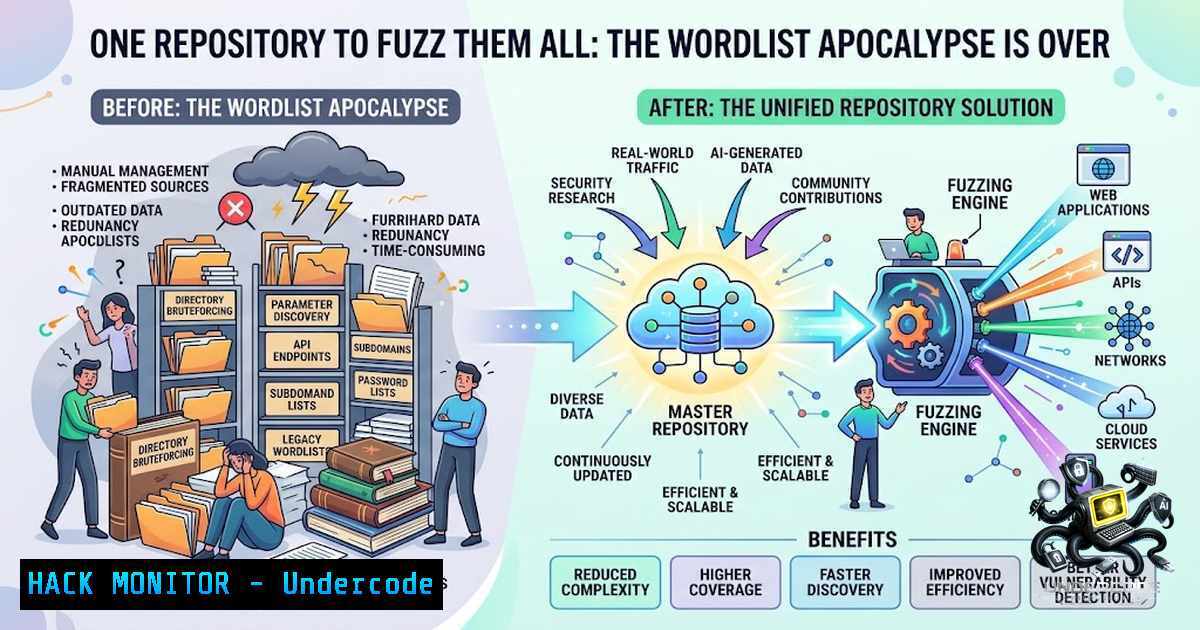
Every penetration tester knows the feeling: you’re mid-engagement, hunting for that hidden admin panel or overlooked API endpoint, and you realize the wordlist you need is scattered across five different GitHub repositories, three outdated blog posts, and a forgotten folder from your last CTF. The time wasted hunting for the right list—rather than actually testing—is a silent killer of productivity. SIVA SANKAR, a seasoned Penetration Tester (eWPTXv2, CNPen, CRTA, MCRTA), has solved this fragmentation problem with Wordlists For Everything, an open-source GitHub repository that centralizes wordlists for penetration testing, bug bounty hunting, red teaming, and security research.
Learning Objectives:
- Understand the critical role of curated wordlists in efficient web application security testing.
- Navigate and utilize the “Wordlists For Everything” repository for CMS enumeration, fuzzing, and discovery.
- Execute practical fuzzing commands using
ffuf,gobuster, and `dirsearch` with targeted wordlists. - Apply extension-based discovery and parameter mining techniques to uncover hidden endpoints and vulnerabilities.
You Should Know:
- The Centralized Arsenal: What’s Inside “Wordlists For Everything”
The repository is a thoughtfully organized collection that addresses the core pain point of wordlist fragmentation. Instead of spending time searching across multiple repositories, you can find everything in one place.
The repository is divided into several key categories:
- Vulnerability-Specific Fuzzing Wordlists: These are hand-built lists for common web application vulnerability classes, designed for use with tools like
ffuf,wfuzz, or Burp Intruder. This includes dedicated lists for XSS, SQLi, NoSQLi, LFI, Path Traversal, Command Injection, SSTI, SSRF, LDAP Injection, Prototype Pollution, XXE, CRLF Injection, File Upload Bypass, CORS Misconfigurations, and Open Redirects. -
CMS & Server Fingerprinting Wordlists: Separate path lists for identifying and enumerating common platforms. This includes platform-specific lists for WordPress, Laravel, Magento, Jupyter, Apache Tomcat, Drupal, Joomla, and Nginx, plus a `generic_common.txt` that covers cross-platform exposures like
.git,.env, admin panels, Docker/K8s configs, Spring Boot actuator, Swagger/GraphQL, and backups. -
Extension-Based Content Discovery Wordlists: A base wordlist of 4,731 curated terms combined with extensions for specific languages and platforms. This includes lists for PHP, ASP, ASP.NET, JSP, Java Struts, HTML, ColdFusion, JavaScript, JSON, XML, TXT, CGI, Perl, Python, Ruby/Rails, backups, SQL, config files, logs, includes, and archives. A combined mega-list (
wordlist_ALL_EXTENSIONS_combined.txt) with ~293K lines is also provided. -
Subdomains, Directories, and Parameters: This section includes a 5,000-entry subdomain list for fast enumeration and a 20,000-entry list for deeper discovery. A 29,999-entry directory list (
wordlist_directories_raft_medium.txt) is sourced from SecLists’ RAFT medium list. For parameter mining, there is Burp’s curated 6,453-entry list and an expanded 6,463-entry combined list with hand-added common parameter names likeid,redirect_url,callback,token,path, andcmd. A 295-entry API endpoint list is also included.
Step‑by‑step guide: Using the Repository for Targeted Fuzzing
1. Clone the Repository:
git clone https://github.com/Cyber-Siva-Sankar/Wordlists-For-Everything.git
cd Wordlists-For-Everything
- Identify Your Target Stack: Use a tool like
whatweb,wappalyzer, or simply check response headers and `/robots.txt` to fingerprint the technology. -
Select the Appropriate Wordlist: Based on the fingerprinting results, choose a platform-specific list (e.g., `wordpress.txt` for a WordPress site) or a vulnerability-specific list (e.g., `xss_fuzz_wordlist.txt` for XSS testing).
4. Execute the Fuzz:
- For directory brute-forcing on a WordPress site using
ffuf:ffuf -u https://target.com/FUZZ -w wordpress.txt -mc 200,301,302,403
- For file discovery on a Laravel application using
gobuster:gobuster dir -u https://target.com -w laravel.txt -x php
- For parameter mining using
ffuf:ffuf -u "https://target.com/page.php?FUZZ=test" -w wordlist_parameters_combined.txt -mc 200 -fs
2. Extension-Based Discovery: The Power of Combinatorial Fuzzing
One of the most powerful features of this repository is the extension-based wordlist generation. The `base_wordlist.txt` contains 4,731 raw terms. The repository then combines this base list with every extension in a specific group to create targeted lists for different technologies.
Step‑by‑step guide: Performing a Full Directory + Extension Sweep
- Identify the Technology: Determine if the target is a PHP, ASP.NET, or Java application.
- Choose the Correct Extension List: Select `wordlist_php.txt` for PHP apps, `wordlist_aspx.txt` for ASP.NET, or `wordlist_jsp.txt` for Java applications.
3. Run the Fuzz:
- Using
ffuf:ffuf -u https://target.com/FUZZ -w wordlist_php.txt -mc 200,301,302,403
- Using
gobuster:gobuster dir -u https://target.com -w wordlist_aspx.txt -x aspx,ashx
- Using `dirsearch` (which natively supports extension flags):
dirsearch -u https://target.com -w base_wordlist.txt -e php,jsp,do,aspx,html
- Combine with Directory Discovery: Pair `wordlist_directories_raft_medium.txt` with the extension-specific lists for a comprehensive sweep:
ffuf -u https://target.com/FUZZ -w wordlist_php.txt
-
API & Endpoint Discovery: Uncovering the Hidden Attack Surface
Modern web applications are API-driven, and discovering undocumented or exposed API endpoints is a goldmine for bug bounty hunters. The repository includes `wordlist_api_endpoints.txt` with 295 common REST/API path segments like v1, users, auth, and graphql.
Step‑by‑step guide: API Endpoint Fuzzing
- Identify the Base API Route: Determine the base path for the API (e.g.,
https://target.com/api/`).wordlist_api_endpoints.txt`.
<h2 style="color: yellow;">2. Select the API Wordlist: Use3. Fuzz for Endpoints:
ffuf -u https://target.com/api/FUZZ -w wordlist_api_endpoints.txt -mc 200,301,302,403
- Combine with Parameter Discovery: Once you find an endpoint like
/api/users, use `wordlist_parameters_combined.txt` to fuzz for hidden parameters:ffuf -u "https://target.com/api/users?FUZZ=test" -w wordlist_parameters_combined.txt -mc 200 -fs
- Leverage External Tools: Dedicated tools like `arjun` also accept these wordlists directly:
arjun -u https://target.com/api/users -w wordlist_parameters_combined.txt
4. Vulnerability-Specific Fuzzing: Precision Payloads
The repository shines with its hand-built vulnerability-specific wordlists. These are not generic lists; they are crafted for specific vulnerability classes, saving you from crafting payloads manually or using overly broad lists that generate noise.
Step‑by‑step guide: Testing for XSS and SQL Injection
1. XSS Fuzzing:
- Use
xss_fuzz_wordlist.txt. - Fuzz a search parameter and match for a JavaScript alert:
ffuf -u "http://target.com/search?q=FUZZ" -w xss_fuzz_wordlist.txt -mr "alert(1)"
2. SQL Injection Fuzzing:
- Use
sqli_wordlist.txt. - Fuzz a parameter and match for common SQL error signatures.
- Important: Always check the `NOTES` section at the bottom of each `.txt` file for class-specific guidance (e.g., which DBMS syntax to try first for SQLi).
3. File Upload Bypass:
- Use
file_upload_bypass_wordlist.txt. - Fuzz the filename parameter with various extensions and MIME types:
ffuf -u "http://target.com/upload" -X POST -F "[email protected];filename=shell.FUZZ;type=image/jpeg" -w file_upload_bypass_wordlist.txt -mc 200
5. CORS Misconfiguration and Host Header Injection
Modern web security testing often involves header-based attacks. The repository includes dedicated wordlists for these scenarios.
Step‑by‑step guide: Testing for CORS Misconfigurations
1. Use the CORS Wordlist: Select `cors_origins_wordlist.txt`.
2. Fuzz the Origin Header:
ffuf -u "http://target.com/api/data" -H "Origin: FUZZ" -w cors_origins_wordlist.txt -mr "Access-Control-Allow-Origin"
3. Analyze Responses: If the server reflects the `Origin` header value in the `Access-Control-Allow-Origin` response header, it may be vulnerable to CORS misconfiguration.
Step‑by‑step guide: Testing for CRLF Injection
1. Use the CRLF Wordlist: Select `crlf_host_header_wordlist.txt`.
2. Fuzz the Host Header or Query Parameters:
ffuf -u "http://target.com" -H "Host: FUZZ" -w crlf_host_header_wordlist.txt -mr "evil.com"
6. Operational Security and Best Practices
Before you start fuzzing, it is crucial to follow operational security best practices. The repository includes a comprehensive `wordlist_manual.html` with full usage commands and worked examples.
Step‑by‑step guide: Safe Fuzzing Practices
- Replace Placeholder Domains: Always replace placeholder domains like `evil.com` or `trusted.com` with your own controlled test domain (e.g., a Burp Collaborator or `interact.sh` endpoint) for out-of-band confirmation.
- Test with Harmless Payloads First: Confirm blind or destructive payloads (command injection, SQLi, SSTI RCE gadgets) with harmless commands like
id,whoami, or `sleep 5` before using anything that modifies data. - Rate-Limit Your Scans: Against production-like environments, use rate-limiting to avoid unintentional denial of service:
ffuf -p 0.1 -t 5
- Authorization is Non-1egotiable: These wordlists are provided for educational purposes and authorized security testing only. Running these payloads against systems you do not own or have explicit written authorization to test is illegal in most jurisdictions and may violate laws such as the U.S. Computer Fraud and Abuse Act (CFAA) or the UK Computer Misuse Act.
What Undercode Say:
- Key Takeaway 1: The fragmentation of wordlists across the internet is a significant drain on penetration testing efficiency. Centralized repositories like “Wordlists For Everything” are not just convenient—they are essential for maintaining focus and speed during engagements.
- Key Takeaway 2: The true power of this repository lies not just in the collection, but in its organization. By categorizing wordlists by vulnerability type, CMS, and file extension, it enables testers to move from reconnaissance to exploitation with minimal friction.
Analysis: This repository represents a pragmatic solution to a common problem. It is not a novel research tool, but a force multiplier for existing workflows. The inclusion of a manual (wordlist_manual.html) with worked examples lowers the barrier to entry for junior testers while providing a quick reference for veterans. The emphasis on authorized testing and the inclusion of operational security guidance (rate-limiting, harmless payloads first) demonstrates a mature approach to security tooling. The repository’s structure, with its clear tables and categorized lists, makes it easy to integrate into automated pipelines. This is the kind of project that, while seemingly simple, has a profound impact on the day-to-day effectiveness of the security community.
Prediction:
- +1 The trend towards centralized, community-driven wordlist repositories will continue, with more specialized lists emerging for niche technologies (e.g., GraphQL, gRPC, serverless frameworks).
- +1 We will see tighter integration of these curated wordlists into automated CI/CD security pipelines, enabling developers to catch misconfigurations and vulnerabilities earlier in the software development lifecycle.
- -1 The ease of access to such comprehensive wordlists may lower the barrier to entry for less skilled adversaries, potentially increasing the volume of automated, noisy scanning against public-facing assets. This will place a greater emphasis on the importance of robust WAF rules and rate-limiting at the infrastructure level.
▶️ Related Video (86% Match):
🎯Let’s Practice For Free:
🎓 Live Courses & Certifications:
Join Undercode Academy for Verified Certifications
🚀 Request a Custom Project:
Secure, high-velocity infrastructure and disruptive technological engineering. Contact our engineering team for high-tier development and proprietary systems:
[email protected]
💎 Smart Architecture | 🛡️ Secure by Design | ⭐ Trusted by Thousands
IT/Security Reporter URL:
Reported By: Siva Sankar – Hackers Feeds
Extra Hub: Undercode MoN
Basic Verification: Pass ✅


