Listen to this Post
Introduction:
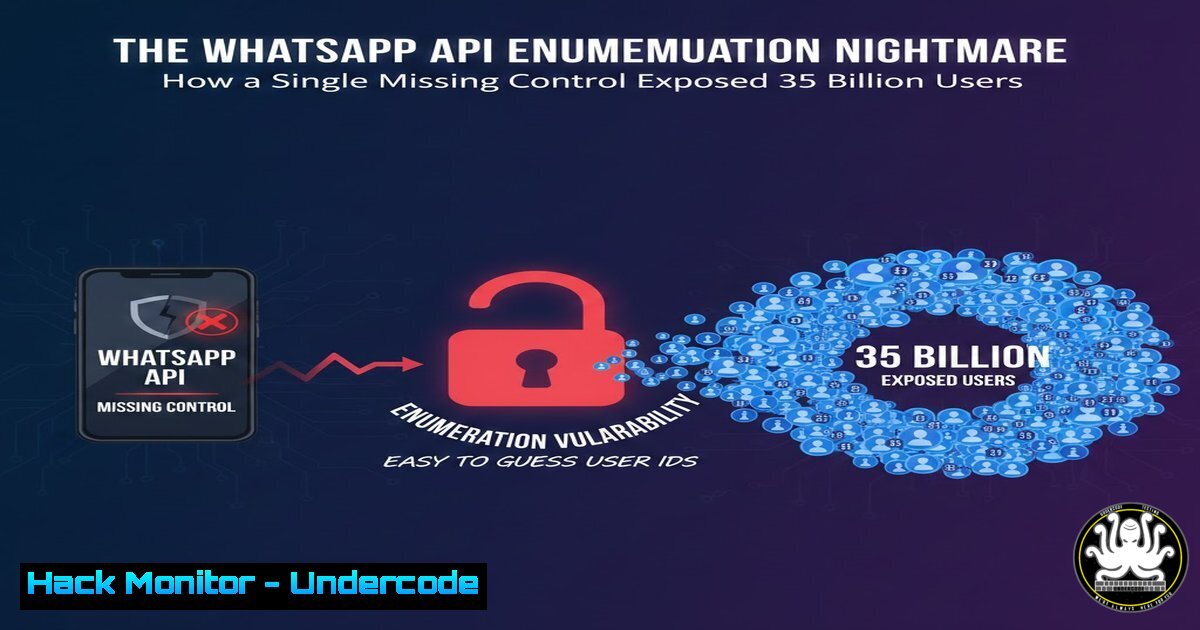
A recent academic demonstration revealed a critical vulnerability in WhatsApp’s infrastructure, allowing researchers to enumerate billions of user accounts through an API endpoint lacking rate limiting. This incident serves as a stark reminder that sophisticated exploits are not always necessary for massive data breaches; sometimes, simple oversights in access control and monitoring can lead to catastrophic exposure. The vulnerability maps directly to established security frameworks like the OWASP Mobile Application Security Verification Standard (MASVS) and the Mobile Application Security Testing Guide (MASTG), highlighting the critical gap between ad-hoc testing and structured security methodologies.
Learning Objectives:
- Understand the technical mechanism behind API enumeration attacks and how to test for rate-limiting deficiencies.
- Learn how to apply the OWASP MASVS and MASTG frameworks to systematically identify and mitigate mobile application vulnerabilities.
- Develop practical skills for hardening APIs, monitoring for abnormal traffic patterns, and implementing defensive controls.
You Should Know:
1. The Anatomy of an API Enumeration Attack
An API enumeration attack occurs when an attacker can systematically query an application programming interface (API) to deduce valid information, such as user account names, phone numbers, or other identifiers. In the WhatsApp case, the endpoint used for account registration did not implement rate limiting, allowing the researchers to check the existence of millions of phone numbers per hour from a single IP address.
Step-by-step guide explaining what this does and how to use it.
Step 1: Identify the Target Endpoint. Using a proxy tool like Burp Suite or OWASP ZAP, intercept the traffic between a mobile app and its backend API. Look for endpoints involved in user registration, login, or password reset, as these often take a unique identifier (e.g., email, phone number).
Step 2: Analyze the Response. Send a series of requests with valid and invalid identifiers. Pay close attention to the HTTP status codes, response times, and body content. A common indicator is a difference in response for a valid user (e.g., HTTP 200 OK) versus an invalid one (e.g., HTTP 404 Not Found or a generic error message).
Step 3: Test for Rate Limiting. Script rapid, sequential requests to the same endpoint. A simple bash loop using `curl` can demonstrate this:
`for i in {1..100}; do curl -s -o /dev/null -w “%{http_code}\n” “https://api.example.com/v1/check_user?phone=1234567890” & done`
If all requests return `200` (or the relevant success code) without any `429 Too Many Requests` errors, rate limiting is likely absent.
2. Implementing Robust Rate Limiting Defenses
Rate limiting is a control that restricts the number of requests a user can make to a web service within a given time frame. It is a primary defense against enumeration, denial-of-service, and brute-force attacks.
Step-by-step guide explaining what this does and how to use it.
Step 1: Choose a Strategy. Common strategies include:
IP-based: Simple but can be bypassed with botnets.
User-based: Requires authentication, ideal for logged-in endpoints.
Token/API-key-based: Best for public APIs, allowing for quota management.
Step 2: Implement on the Server-Side. For a web application using a framework like Node.js with Express, you can use the `express-rate-limit` package.
`const rateLimit = require(“express-rate-limit”);
const limiter = rateLimit({
windowMs: 15 60 1000, // 15 minutes
max: 100 // limit each IP to 100 requests per windowMs
});
app.use(“/api/”, limiter); // Apply to all API routes`
Step 3: Configure Web Application Firewalls (WAF). Services like AWS WAF, Cloudflare, or ModSecurity can be configured with custom rate-based rules to block IPs that exceed a threshold, providing a defense layer before traffic even reaches your application.
- Leveraging the OWASP MASVS and MASTG for Security Assurance
The OWASP Mobile Application Security Verification Standard (MASVS) provides security requirements, while the Mobile Application Security Testing Guide (MASTG) offers a comprehensive testing methodology to verify those requirements.
Step-by-step guide explaining what this does and how to use it.
Step 1: Adopt the MASVS as a Blueprint. The MASVS is categorized into areas like V2: Authentication and Session Management and V4: Network Communication. The WhatsApp flaw directly relates to MASVS-V2.6: “The remote endpoint implements anti-automation controls (e.g., rate limiting) to prevent credential stuffing and account enumeration.”
Step 2: Execute MASTG Test Cases. The MASTG provides specific procedures. For testing rate limiting, refer to MASTG-NETWORK-4: “Ensure that the application implements mechanisms to withstand common denial-of-service attacks.” This involves the same technical testing outlined in the first section of this article.
Step 3: Integrate into SDLC. Make MASVS requirements part of your Definition of Done for user stories. Integrate MASTG test cases into your CI/CD pipeline using SAST/DAST tools that support these checks.
4. Expanding the Attack Surface: Ancillary Data Endpoints
The initial enumeration was only the first step. The researchers found other endpoints that, when fed with the validated numbers, returned profile pictures, “about” text, and device metadata. This demonstrates the risk of interconnected data exposures.
Step-by-step guide explaining what this does and how to use it.
Step 1: Map the Entire API. Use tools like `amass` or `subfinder` for subdomain discovery, followed by `katana` or `gau` to gather endpoints. Then, use a tool like `ffuf` for content discovery:
`ffuf -w wordlist.txt -u https://api.target.com/v1/FUZZ -mc 200`
Step 2: Test for Insecure Direct Object References (IDOR). Once you have a list of endpoints, change parameters (like a user ID) to see if you can access another user’s data. For example, if `GET /api/v1/user/12345/profile` returns your profile, try GET /api/v1/user/12346/profile.
Step 3: Enforce Authorization Checks. Every data-accessing endpoint must have a server-side check to verify that the authenticated user is authorized to view the requested data. Never rely on client-side controls to enforce authorization.
5. Proactive Monitoring and Anomaly Detection
A platform team that “never noticed” 100 million queries per hour lacked sufficient monitoring. Proactive detection of scanning and enumeration is crucial.
Step-by-step guide explaining what this does and how to use it.
Step 1: Establish a Baseline. Use monitoring tools like the ELK Stack (Elasticsearch, Logstash, Kibana) or Splunk to understand normal traffic patterns for your API endpoints.
Step 2: Create Alerting Rules. Configure alerts for anomalous activity. Example Sigma rule (for use with SIEMs like Splunk or Elastic) to detect potential enumeration:
`title: High Volume of 404/200 Responses from a Single IP
description: Detects a single IP generating a high number of requests to a user-validation endpoint, indicative of enumeration.
logsource:
category: web_access
detection:
selection:
c-uri|contains: ‘/v1/check_user’ Target endpoint
status_code:
– 200
– 404
condition: selection and status_code | count() by src_ip > 1000 within 1h`
Step 3: Leverage Threat Intelligence. Feed blocklists of known malicious IPs and Tor exit nodes into your WAF or firewall to preemptively block known bad actors.
What Undercode Say:
- Methodology Trumps Occasional Testing. Bug bounties and annual pentests have their place, but they are no substitute for the comprehensive, systematic coverage provided by continuously applying a framework like MASVS/MASTG. This structured approach leaves far fewer stones unturned.
- The Simplest Gaps Cause the Widest Breaches. The most devastating vulnerabilities are often not zero-days requiring complex exploit chains, but basic security hygiene failures like missing rate limiting and poor monitoring. Prioritizing foundational controls is the highest-return investment in security.
This case is a textbook example of a “failure of process” rather than a “failure of technology.” The controls needed to prevent this were well-documented and publicly available. The real vulnerability was in the development and security verification lifecycle that failed to mandate and validate these controls. Organizations that treat security as a checklist item to be completed during a yearly audit are fundamentally exposed. In contrast, those that bake security requirements and verification into every stage of development build a resilient posture that can catch such simplistic yet devastating flaws before they ever reach production.
Prediction:
The WhatsApp enumeration incident will serve as a canonical case study, accelerating the adoption of MASVS/MASTG and other structured security frameworks across the mobile app industry. Regulatory bodies will likely begin referencing these standards explicitly in data protection guidelines, making them a de facto compliance requirement. Furthermore, we will see a rise in automated attacks from threat actors who weaponize these simple enumeration techniques at scale, targeting not just messaging apps but any online service with phone number or email-based identifiers, leading to a new wave of mass-scale data harvesting for phishing, fraud, and identity theft.
🎯Let’s Practice For Free:
IT/Security Reporter URL:
Reported By: Theonejvo Researchers – Hackers Feeds
Extra Hub: Undercode MoN
Basic Verification: Pass ✅


