Listen to this Post
Introduction:
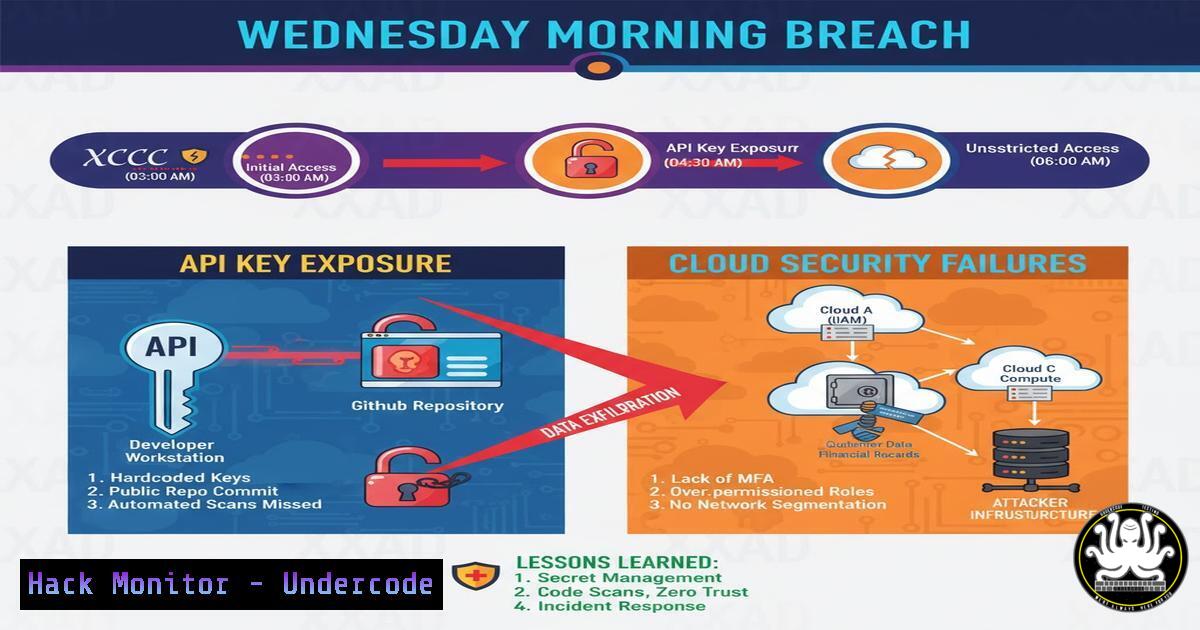
A recent breach of a major advertising network, dubbed the “Wednesday Morning XCC AD Breach,” has exposed a critical vulnerability stemming from exposed API keys and credentials within public code repositories. This incident underscores the persistent threat of insufficient cloud security hygiene and the catastrophic consequences of hardcoded secrets, allowing attackers to exfiltrate terabytes of sensitive data from cloud object storage. The breach serves as a stark reminder that the most sophisticated perimeter defenses are rendered useless by fundamental internal oversights.
Learning Objectives:
- Understand the technical mechanisms through which exposed API keys lead to cloud data exfiltration.
- Learn how to identify, remediate, and prevent the exposure of secrets in code and version control systems.
- Master key commands for cloud security auditing, intrusion detection, and forensic analysis across Linux and AWS environments.
You Should Know:
1. Scanning for Exposed Secrets in Git History
`git log -p –all -S ‘api_key\|password\|secret\|AKIA’ — source/`
This command searches the entire Git history (--all) for patches (-p) that contain changes involving common secret patterns like ‘api_key’, ‘password’, ‘secret’, or AWS Access Key IDs (‘AKIA’). The `-S` flag is the “pickaxe” that digs for these specific string additions or removals. To use it, navigate to your Git repository and run the command. It will output every commit diff where these sensitive strings were introduced or modified, allowing you to identify accidental commits of credentials.
2. Hardening AWS S3 Bucket Policies
`aws s3api put-bucket-policy –bucket YOUR_BUCKET_NAME –policy file://secure-bucket-policy.json`
A primary vector in the breach was a misconfigured S3 bucket. This command applies a strict, JSON-formatted bucket policy to prevent public access and unauthorized reads. The `secure-bucket-policy.json` file should define explicit “Deny” statements for principals other than those explicitly required, ensuring that even if the bucket’s “Public” setting is toggled, the policy overrides it. Always validate the policy with `aws s3api get-bucket-policy –bucket YOUR_BUCKET_NAME` after application.
3. Rotating Compromised AWS Access Keys
`aws iam update-access-key –access-key-id AKIA… –status Inactive`
`aws iam create-access-key –user-name TargetUser`
Upon discovering a potentially exposed AWS Access Key, you must immediately deactivate it using the first command, replacing `AKIA…` with the compromised key ID. This renders the key useless for new API calls. Subsequently, create a new key pair for the user with the second command. Securely distribute the new key and update all authorized systems, ensuring no operational dependencies are broken during the rotation.
4. Detecting Unauthorized S3 Data Access with CloudTrail
`aws cloudtrail lookup-events –lookup-attributes AttributeKey=EventName,AttributeValue=GetObject –start-time 2023-10-25T00:00:00Z –end-time 2023-10-25T23:59:59Z –region us-east-1`
This command queries AWS CloudTrail for all `GetObject` API calls (used to download S3 objects) within a specific 24-hour window. By analyzing the output, particularly the `sourceIPAddress` and `userIdentity` fields, you can identify anomalous access patterns from unexpected geographic locations or IAM principals, which is a direct indicator of credential misuse and ongoing data exfiltration.
- Scanning for Exposed Cloud Credentials on a Linux System
`grep -r “AKIA[0-9A-Z]{16}” /home /opt /var/www/ 2>/dev/null`
`grep -r “eyJhbGciOiJ[^\”]” /path/to/codebase/ 2>/dev/null`
The first command recursively searches (-r) common directories for AWS Access Key IDs, which follow a specific pattern. The second command searches for exposed JSON Web Tokens (JWTs). The `2>/dev/null` suppresses permission denied errors. These searches are critical for post-incident forensics or pre-emptive security audits to find secrets that may have been leaked into filesystems outside of version control.
6. Network Forensics: Identifying Data Exfiltration Flows
`tcpdump -i any -w capture.pcap host
`tshark -r capture.pcap -Y “http.request or http.response” -T fields -e frame.time -e ip.src -e ip.dst -e http.host -e http.request.uri`
If you suspect a specific IP is exfiltrating data to an external server, the first command captures all traffic to and from that IP on the HTTPS port to a file named capture.pcap. The second command, using `tshark` (the command-line version of Wireshark), reads the capture file and filters for HTTP requests and responses, outputting key fields like timestamp, source/destination IPs, the host, and the URI, helping to trace what data was sent and where.
7. Implementing Canary Tokens for Early Detection
`curl -s https://canarytokens.org/generate?action=create -d auth_token=YOUR_AUTH -d kind=aws-keys -d memo=”MyApp-S3-Bucket” -o canary-output.json`
A canary token is a digital tripwire. This command uses the Canary Tokens API to generate a fake, monitored AWS key. When an attacker discovers and uses this decoy key, it triggers an immediate alert. You would place this fake key in a file named `config_backup.txt` within your S3 bucket or code repository. The `-o` flag saves the API response, which contains the generated credentials, to a file for your records.
What Undercode Say:
- The cloud’s shared responsibility model is often misunderstood; the customer is always responsible for securing their data, a fact brutally enforced by this breach.
- Modern development velocity, driven by DevOps and CI/CD, has dangerously outpaced the integration of fundamental security controls, making secrets sprawl a pandemic-level issue.
This breach was not the result of a zero-day exploit but a failure in basic cyber hygiene. The over-reliance on perimeter security creates a fragile defense; once an attacker phishes a single developer or finds one exposed key, the entire internal network and cloud estate can be compromised. The incident analysis reveals a critical gap in the “shift-left” security paradigm: while we scan code for vulnerabilities pre-commit, we are not doing enough to scan for hardcoded secrets post-commit and across the entire development lifecycle. The future of such attacks will be increasingly automated, with bots continuously scraping public repositories and CI/CD logs for any string resembling a credential, making manual oversight completely obsolete.
Prediction:
The automation of cloud credential harvesting and exploitation will accelerate, leading to a new class of “silent” data breaches where exfiltration occurs slowly and mimics normal traffic to avoid detection. In response, we will see the rapid adoption of AI-driven security posture management platforms that autonomously monitor, rotate, and manage secrets while using behavioral analytics to distinguish between legitimate use and credential theft in real-time. The industry will be forced to move beyond simple key management towards a zero-trust architecture for development environments, where every access request for cloud resources is dynamically verified, regardless of its origin.
🎯Let’s Practice For Free:
IT/Security Reporter URL:
Reported By: Mykrishnarajagopal Wednesday – Hackers Feeds
Extra Hub: Undercode MoN
Basic Verification: Pass ✅


