
Listen to this Post
Introduction:
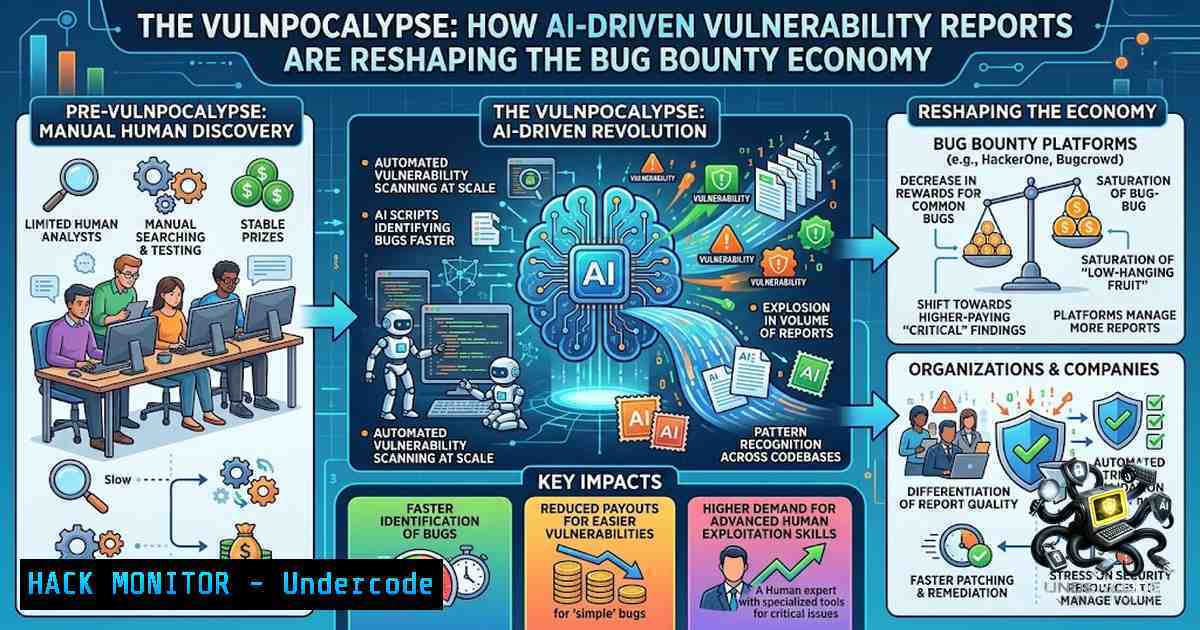
The bug bounty economy is undergoing a seismic shift as AI-powered vulnerability discovery tools flood the market with an unprecedented volume of reports. This “vulnpocalypse” — as industry experts have dubbed it — is driving down bounty prices, extending triage times, and forcing independent security researchers to fundamentally rethink their approach to vulnerability hunting. With submission volumes doubling or even quadrupling year-over-year across major platforms like HackerOne, Bugcrowd, and TrendAI’s Zero Day Initiative, the landscape has become a buyer’s market where mid-tier vulnerabilities worth $10,000–$50,000 are rapidly depreciating.
Learning Objectives & Secrets:
- Objective 1: Understand how large language models (LLMs) are transforming vulnerability discovery economics, including the volume-to-value paradox where increased submissions correlate with decreased per-bug payouts.
- Objective 2 Secret Tip: Leverage AI as a “copilot, not an autopilot” — use LLMs for attack surface mapping and tedious reverse-engineering tasks while maintaining human judgment for exploitability assessment and impact demonstration.
- Objective 3 Secret Tip: Build custom internal tooling that pairs static analysis with local LLMs to compress the research cycle from days to hours, but always validate findings independently before submission.
You Should Know:
- Understanding the AI Slop Problem and Its Impact on Quality
The AI revolution in bug hunting isn’t just about volume — it’s about quality degradation. Curl creator Daniel Stenberg terminated the project’s seven-year bug bounty program after witnessing submission quality collapse: historically over 15% of submissions resulted in confirmed vulnerabilities, but by 2025 that number had dropped below 5%. The problem, he explained, was “an explosion of AI slop reports combined with a lower quality even in the reports that were not obvious slop — presumably because they too were actually misled by AI”.
Apple responded by instituting reporting pauses for users that repeatedly submit ineligible reports. Major platforms including HackerOne, Bugcrowd, and ZDI have adopted AI-powered triaging as an initial filtering layer — essentially fighting AI with AI. However, executives acknowledge this remains an unsolved problem, with triage and payout times still significantly extended.
Step‑by‑Step Guide: Implementing Quality Filters for Vulnerability Reports
To avoid becoming part of the “slop” problem:
- Set up automated pre-screening: Use regex patterns and known vulnerability signatures to filter out false positives before manual review.
- Implement a quality threshold: Require proof-of-concept code or reproducible steps for every submission — if you can’t explain the bug and prove impact without the model, you haven’t found anything.
- Use differential analysis: Compare AI-generated findings against known CVE databases to identify genuinely novel vulnerabilities versus re-discovered issues.
- Maintain a “human-only” review stage: Reserve final exploitability assessment for manual analysis — judgment calls about whether a bug crosses security boundaries cannot be automated.
2. The Economics of Bug Bounty Repricing
The financial reality is stark. In the macOS space, a full TCC/privacy bypass that previously paid approximately $30,500 may now be worth roughly $5,000, while a more limited TCC bypass (e.g., dumping all user photos without consent) has dropped from around $5,000 to $1,000. This compression at the middle tier is forcing researchers to adapt.
However, the picture isn’t uniformly bleak. HackerOne reports that bounty payments to researchers are up 25% in the first half of 2026 compared to the same period last year, and the number of researchers earning $100,000+ has also increased by 25%. Bugcrowd’s CEO Dave Gerry notes that 82% of researchers are now using AI to assist their workflows.
Step‑by‑Step Guide: Adapting to the New Bug Bounty Economics
- Shift from quality to quantity: Rather than hunting for a single $10,000 finding, adopt AI-assisted workflows to uncover larger numbers of lower-value findings.
- Diversify income streams: Consider assisting in other parts of the bug hunting funnel, such as triage, remediation guidance, or security consulting.
- Focus on high-complexity vulnerabilities: While mid-tier bugs are being commoditized, truly novel or complex vulnerabilities (especially in emerging technologies) will retain premium pricing.
- Build reputation capital: Established researchers with proven track records will command premium rates regardless of market conditions.
3. AI-Powered Tooling for Vulnerability Research
Modern bug hunters are building sophisticated AI-integrated workflows. Researcher Ashish Kunwar built an internal tool that pairs static analysis with a local LLM for source code review, also using AI for attack surface analysis and automating tedious exploit development tasks. Another researcher operating under the handle “Impost0r” connects AI to binary analysis tools to automate repetitive reverse-engineering work.
Step‑by‑Step Guide: Setting Up an AI-Assisted Vulnerability Research Environment
Linux/macOS Commands:
 Install Ollama for local LLM deployment
curl -fsSL https://ollama.com/install.sh | sh

Pull a code-analysis optimized model
ollama pull codellama:7b-instruct

Set up Semgrep for static analysis
pip install semgrep
semgrep --config auto /path/to/source

Combine static analysis with LLM review
semgrep --json --config auto /path/to/source | \
jq '.results[] | {check_id, message, path, start}' | \
ollama run codellama:7b-instruct "Analyze these findings for exploitability: $(cat -)"
Windows PowerShell Commands:
 Install WSL for Linux tooling (if not already present)
wsl --install -d Ubuntu

Install Python and semgrep via WSL
wsl bash -c "pip install semgrep && semgrep --config auto /mnt/c/path/to/source"

Use PowerShell to parse results
$results = semgrep --json --config auto C:\path\to\source | ConvertFrom-Json
$results.results | ForEach-Object { Write-Host "Finding: $($<em>.check_id) at $($</em>.path)" }
- API Security and Cloud Hardening in the AI Era
As AI accelerates software development, it’s simultaneously generating poorly written code with new classes of flaws. API security and cloud misconfigurations remain prime hunting grounds.
Step‑by‑Step Guide: Auditing Cloud and API Configurations
1. Cloud security scanning:
 Install Prowler for AWS/Azure/GCP auditing
pip install prowler
prowler aws --checks check_id
2. API security testing:
 Install OWASP ZAP
docker pull owasp/zap2docker-stable
docker run -v $(pwd):/zap/wrk owasp/zap2docker-stable zap-api-scan.py -t https://target.com/api -f openapi
3. Secrets detection:
 Install truffleHog for secrets scanning
pip install truffleHog
trufflehog filesystem /path/to/repo
5. Vulnerability Exploitation and Mitigation Techniques
The fundamental skills of exploitation remain valuable even as discovery becomes automated. Researchers should focus on:
– Understanding memory corruption vulnerabilities (buffer overflows, use-after-free)
– Mastering privilege escalation techniques
– Developing expertise in browser and kernel exploitation
Step‑by‑Step Guide: Basic Exploit Development Workflow
1. Fuzzing setup:
 Install AFL++
git clone https://github.com/AFLplusplus/AFLplusplus
cd AFLplusplus && make && sudo make install

Run fuzzer on target binary
afl-fuzz -i input_dir -o findings_dir -- ./target_binary @@
2. Debugging with GDB:
 Install pwndbg
git clone https://github.com/pwndbg/pwndbg
cd pwndbg && ./setup.sh

Attach to process
gdb -p <pid>
6. Platform-Specific Triage and Submission Strategies
With triage times extended significantly, researchers must optimize their submission strategies:
Step‑by‑Step Guide: Maximizing Submission Success Rates
- Craft comprehensive reports: Include clear reproduction steps, impact assessment, and (where possible) proof-of-concept code.
- Use platform-specific templates: HackerOne, Bugcrowd, and ZDI each have preferred report formats — follow them precisely.
- Pre-validate with AI: Use your local LLM to review your report for clarity and completeness before submission.
- Monitor platform guidelines: Apple’s reporting pause policy demonstrates that platforms are actively penalizing low-quality submitters.
What Undercode Say:
- Key Takeaway 1: The “vulnpocalypse” is not an existential crisis for security research but a fundamental market restructuring that will reward adaptability and skill over sheer discovery volume.
-
Key Takeaway 2: Successful researchers will evolve from being “bug finders” to “security consultants” who leverage AI to accelerate their workflows while maintaining human judgment for critical exploitability decisions.
Analysis: The current transformation mirrors earlier shifts in the cybersecurity industry — from the early days of simple SQL injections commanding premium payouts to today’s complex, multi-layered attack surfaces. AI is democratizing vulnerability discovery, making basic findings accessible to a broader pool of researchers while simultaneously elevating the value of deep expertise. The researchers who will thrive are those who treat AI as a force multiplier rather than a replacement, building custom tooling that pairs static analysis with local LLMs for source code review, attack surface mapping, and exploit development automation. The market is becoming a “volume game”, but volume without quality is just noise. As Aaron Portnoy of Mindgard notes, AI is accelerating development of poorly written software, creating new opportunities for skilled researchers. The question isn’t whether AI will replace bug hunters — it’s whether bug hunters will adapt to become AI-augmented security professionals.
Prediction:
- +1 The democratization of vulnerability discovery will lead to more secure software overall, as more eyes (both human and AI) examine codebases for flaws.
- +1 Researchers who build custom AI-integrated workflows will see their productivity multiply, compressing research cycles from days to hours.
- -1 Mid-tier independent researchers who fail to adopt AI tooling will find their earning potential severely compressed as bounty prices continue to decline.
- -1 The “slop” problem will persist, requiring platforms to invest heavily in AI-powered triage systems that may inadvertently filter out legitimate findings.
- +1 New specialized roles will emerge — AI-assisted vulnerability researchers, LLM prompt engineers for security, and automated exploit developers — creating fresh career pathways.
- -1 The psychological toll of processing low-quality AI-generated reports, as described by curl’s creator, may drive experienced researchers away from the field.
- +1 The bug bounty ecosystem will become more resilient and efficient, with AI handling initial filtering and humans focusing on high-value, complex vulnerabilities.
- -1 Smaller companies and open-source projects may abandon bug bounty programs entirely due to the triage burden, reducing overall opportunities.
▶️ Related Video (84% Match):
🎯Let’s Practice For Free:
🎓 Live Courses & Certifications:
Join Undercode Academy for Verified Certifications
🚀 Request a Custom Project:
Secure, high-velocity infrastructure and disruptive technological engineering. Contact our engineering team for high-tier development and proprietary systems:
[email protected]
💎 Smart Architecture | 🛡️ Secure by Design | ⭐ Trusted by Thousands
IT/Security Reporter URL:
Reported By: https://lnkd.in/p/eQ4UPveM – Hackers Feeds
Extra Hub: Undercode MoN
Basic Verification: Pass ✅


