Listen to this Post
Introduction:
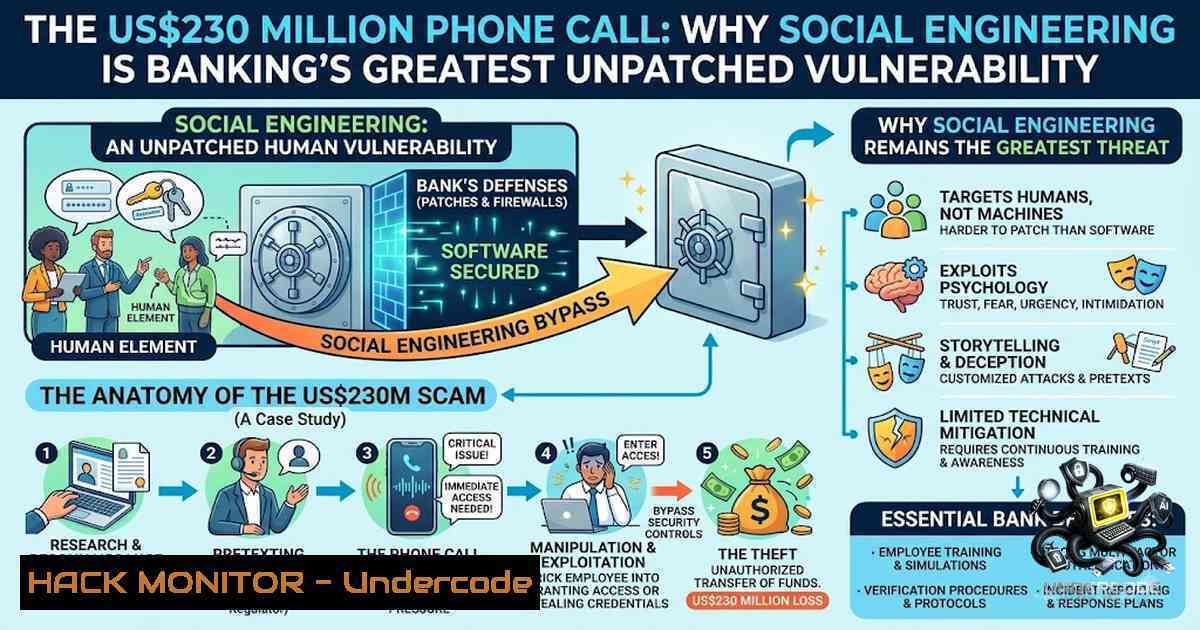
In a landmark heist that has sent shockwaves through the financial sector, attackers walked away with US$230 million without breaking a single line of encryption, deploying zero malware, and exploiting no technical vulnerability. The breach wasn’t executed through code—it was orchestrated through a phone call and the meticulous engineering of human trust. As Ajaay Verma, Vice President of Financial Crime Prevention at BPC, articulated in Episode 7 of Banking Beyond Tomorrow, this incident forces the industry to confront a deeply uncomfortable question: Can we still tell when the person on the other end of the interaction is real? With AI now capable of cloning voices from as little as three seconds of audio, trust itself has become an attack surface. This article dissects the technical anatomy of modern social engineering, provides actionable defense strategies, and equips security professionals with the commands, configurations, and frameworks needed to fortify the human firewall.
Learning Objectives:
- Understand the technical mechanics of AI-driven voice cloning and vishing (voice phishing) attacks targeting financial institutions.
- Master the configuration and deployment of real-time deepfake audio detection APIs and voice biometrics systems.
- Acquire practical Linux and Windows command-line skills for social engineering penetration testing, OSINT gathering, and security auditing.
- Implement NIST-aligned countermeasures and Zero Trust verification protocols to mitigate identity-based fraud.
You Should Know:
- The Technical Anatomy of an AI Voice Clone Attack
The US$230 million heist exemplifies a new class of attack where the adversary’s primary tool is not an exploit kit but a synthetic voice. Generative AI models such as WaveNet and Tacotron have made it possible to replicate a person’s voice from a short audio clip. Attackers harvest these samples from public sources like social media videos, voicemail greetings, or recorded conference calls. Using low-latency voice cloning services—available to criminals for as little as a $50 monthly subscription—they can generate real-time, conversational audio that mimics a trusted executive, colleague, or family member.
Step‑by‑step guide explaining what this does and how to use it:
To understand the threat, security teams should simulate a voice cloning attack in a controlled lab environment. Below is a conceptual workflow using open-source tools and API-based detection services.
Step 1: Audio Harvesting (OSINT)
Attackers begin by collecting audio samples. As a defender, you can audit your organization’s digital footprint.
 Linux: Extract audio from social media or public sources using yt-dlp
yt-dlp -f bestaudio --extract-audio --audio-format mp3 --audio-quality 0 https://www.youtube.com/watch?v=EXAMPLE

Windows (PowerShell): Download and convert using ffmpeg
Invoke-WebRequest -Uri "https://www.example.com/audio.wav" -OutFile "sample.wav"
ffmpeg -i sample.wav -ar 16000 -ac 1 sample_16k.wav
Step 2: Voice Cloning Simulation (Research Only)
While cloning tools are restricted, security researchers can use legitimate platforms like Resemble AI or ElevenLabs under controlled terms. The goal is to generate a synthetic voice sample for testing detection systems.
Step 3: Real-Time Deepfake Detection
Deploy a deepfake detection API to analyze audio streams. For example, Reality Defender offers an API-first platform that identifies synthetic voice in real time.
 Example cURL command to submit audio for deepfake analysis
curl -X POST "https://api.realitydefender.com/v1/detect" \
-H "Authorization: Bearer YOUR_API_KEY" \
-H "Content-Type: multipart/form-data" \
-F "audio=@/path/to/suspicious_call.wav" \
-F "type=voice"
The API returns a confidence score indicating the likelihood of AI generation. Integrate this endpoint into your call center’s interactive voice response (IVR) system to flag anomalies mid-conversation.
- Hardening the Human Firewall: Zero Trust for Voice Interactions
The attack succeeded because the victim trusted the voice on the other end of the line. In a Zero Trust architecture, no interaction is inherently trusted—even if it appears to come from a known identity. Financial institutions must implement “out-of-band” verification for high-value transactions. This means if a request comes via phone, the verification must occur through a separate channel, such as a callback to a verified number on file or an in-app push notification.
Step‑by‑step guide explaining what this does and how to use it:
Step 1: Implement Callback Verification
Configure your payment processing system to automatically flag any transaction above a threshold (e.g., $100,000) for out-of-band verification.
 Python pseudo-code for transaction verification workflow
def verify_high_value_transaction(request):
if request.amount > 100000:
 Initiate out-of-band callback
send_push_notification(request.user_id, "Verify transaction")
 Wait for user confirmation via mobile app (not phone)
if not wait_for_app_confirmation(timeout=300):
decline_transaction(request)
log_incident("Out-of-band verification failed")
Step 2: Deploy Voice Biometrics with Liveness Detection
Voice biometrics alone are vulnerable to deepfakes. Combine them with liveness detection that analyzes micro-second anomalies in speech patterns.
 Linux: Use SoX to analyze audio spectral features for anomalies
sox suspicious_call.wav -1 spectrogram -o spectrogram.png
 Review spectrogram for unnatural frequency patterns indicative of synthesis
Step 3: Configure SIEM Alerts for Social Engineering Indicators
Integrate voice analysis logs into your Security Information and Event Management (SIEM) system. Create alerts for:
– Transactions following a call from an unrecognized number.
– Calls with high deepfake probability scores.
– Requests that deviate from normal user behavior (e.g., unusual transaction beneficiaries).
3. Penetration Testing Social Engineering Defenses
To validate your defenses, conduct regular social engineering penetration tests. The Social Engineer Toolkit (SET) is a standard tool for simulating phishing and vishing campaigns.
Step‑by‑step guide explaining what this does and how to use it:
Step 1: Install the Social Engineer Toolkit on Kali Linux
sudo apt update
sudo apt install setoolkit
Step 2: Launch a Credential Harvesting Simulation
SET can clone a target website to capture credentials, mimicking the initial reconnaissance phase of an attack.
sudo setoolkit
 Select "Social-Engineering Attacks" > "Website Attack Vectors" > "Credential Harvester Attack Method" > "Site Cloner"
 Enter the URL of the target login page (e.g., your corporate VPN portal)
Step 3: Conduct OSINT Reconnaissance
Use `theHarvester` to gather email addresses and domain information that attackers might use to personalize vishing scripts.
theHarvester -d example.com -b google
Step 4: Analyze Results and Train Staff
After the test, review which employees clicked on simulated phishing links or provided sensitive information. Use this data to tailor security awareness training, emphasizing the psychological tactics used in vishing—urgency, authority, and fear.
4. Cloud Hardening Against API-Based Fraud
Modern banking relies heavily on APIs for payments and data exchange. Attackers who successfully socially engineer an employee may gain access to API keys, enabling unauthorized transactions. Hardening API security is critical.
Step‑by‑step guide explaining what this does and how to use it:
Step 1: Implement API Key Rotation and Least Privilege
Ensure that API keys used for payment processing are rotated regularly and have the minimum necessary permissions.
 Linux: Generate a new API key using OpenSSL
openssl rand -hex 32
Step 2: Enforce Mutual TLS (mTLS)
mTLS ensures that both the client and server authenticate each other, reducing the risk of API abuse even if credentials are compromised.
 Nginx configuration for mTLS
server {
listen 443 ssl;
ssl_certificate /etc/nginx/ssl/server.crt;
ssl_certificate_key /etc/nginx/ssl/server.key;
ssl_client_certificate /etc/nginx/ssl/ca.crt;
ssl_verify_client on;
}
Step 3: Deploy API Gateway with Anomaly Detection
Use an API gateway to monitor traffic patterns. Sudden spikes in transaction volumes or unusual beneficiary addresses should trigger alerts.
 Example: Monitor API logs for anomalies using grep and awk
cat /var/log/api/access.log | awk '{print $1, $7}' | sort | uniq -c | sort -1r
- Implementing NIST SP 800-53 Controls for Social Engineering
The NIST Cybersecurity Framework (CSF) provides a structured approach to detecting and protecting against social engineering. Specifically, controls from NIST SP 800-53 (Rev. 5) such as AT-2 (Security Awareness Training) and AC-6 (Least Privilege) are directly applicable.
Step‑by‑step guide explaining what this does and how to use it:
Step 1: Map Controls to Social Engineering Risks
- AT-2: Train employees to recognize vishing attempts. Include simulated voice phishing exercises.
- AC-6: Restrict user permissions so that even if an employee is tricked, the attacker cannot execute high-value transactions.
Step 2: Deploy AI-Based SIEM for Detection
Configure your SIEM to ingest logs from call centers, email gateways, and endpoint detection. Use machine learning models to correlate unusual behavior patterns.
 Example: Splunk search for vishing indicators
index=telephony caller_id=NOT IN (known_numbers) | stats count by caller_id, duration
Step 3: Conduct Regular Tabletop Exercises
Simulate a US$230 million phone call scenario. Test how your incident response team would verify the caller’s identity, freeze transactions, and communicate with law enforcement. Document lessons learned and update playbooks.
What Undercode Say:
- Key Takeaway 1: The most sophisticated cyber defenses are rendered useless when the human element is compromised. Organizations must treat trust as a critical security control, not an assumed constant.
- Key Takeaway 2: AI-generated voice attacks are no longer theoretical; they are cheap, scalable, and already being weaponized against financial institutions. Defenses must evolve from reactive monitoring to proactive, real-time verification.
Analysis: The US$230 million heist is a watershed moment for the cybersecurity industry. It underscores a fundamental shift: the attack surface now includes human cognition and perception. While encryption and firewalls remain essential, they are insufficient against an adversary who simply asks for the keys. The financial sector’s over-reliance on voice as a biometric and trust as a verification mechanism is dangerously outdated. Moving forward, banks must adopt a “verify, then trust” model, leveraging multi-modal authentication (voice + behavioral + contextual) and out-of-band verification for all critical actions. The integration of real-time deepfake detection APIs into call centers is no longer optional—it is a necessity. Furthermore, security awareness training must shift from generic phishing simulations to immersive, AI-driven vishing exercises that prepare employees for the psychological sophistication of modern attackers.
Expected Output:
Introduction:
The US$230 million phone call heist exemplifies a new class of cyberattack where the adversary’s primary weapon is not a zero-day exploit but the engineered manipulation of human trust. As AI makes voices, faces, and identities increasingly convincing, trust itself has become an attack surface. This article provides a technical deep dive into the mechanics of AI-driven vishing, offering actionable commands, configurations, and frameworks to defend against this growing threat.
What Undercode Say:
- The human firewall has fallen—organizations must now verify identity through multiple, independent channels before executing any high-value transaction.
- AI voice cloning is cheap and accessible; defenses must include real-time deepfake detection and continuous security awareness training that simulates psychological manipulation tactics.
Expected Output:
Security teams should immediately audit their call center verification procedures, deploy deepfake detection APIs, and conduct social engineering penetration tests using tools like the Social Engineer Toolkit. Implement NIST SP 800-53 controls, enforce least privilege, and adopt a Zero Trust mindset for all voice-based interactions.
Prediction:
- +1 The financial industry will rapidly adopt multi-modal biometric authentication (voice + facial + behavioral) as the new standard for customer verification, significantly reducing vishing success rates.
- +1 Regulatory bodies will mandate out-of-band verification for all wire transfers above a certain threshold, similar to PSD2’s Strong Customer Authentication (SCA) requirements.
- -1 Attackers will pivot to hybrid attacks, combining AI-generated voice with real-time deepfake video in video conferencing platforms, making impersonation even harder to detect.
- -1 The democratization of AI voice cloning will lead to a surge in vishing attacks against non-financial sectors, including healthcare and government, as criminals diversify their targets.
- +1 The development of open-source deepfake detection frameworks and community-shared threat intelligence will empower smaller institutions to defend against AI-driven social engineering without prohibitive costs.
🎯Let’s Practice For Free:
🎓 Live Courses & Certifications:
Join Undercode Academy for Verified Certifications
🚀 Request a Custom Project:
Secure, high-velocity infrastructure and disruptive technological engineering. Contact our engineering team for high-tier development and proprietary systems:
[email protected]
💎 Smart Architecture | 🛡️ Secure by Design | ⭐ Trusted by Thousands
IT/Security Reporter URL:
Reported By: Ajaay Verma – Hackers Feeds
Extra Hub: Undercode MoN
Basic Verification: Pass ✅


