
Listen to this Post
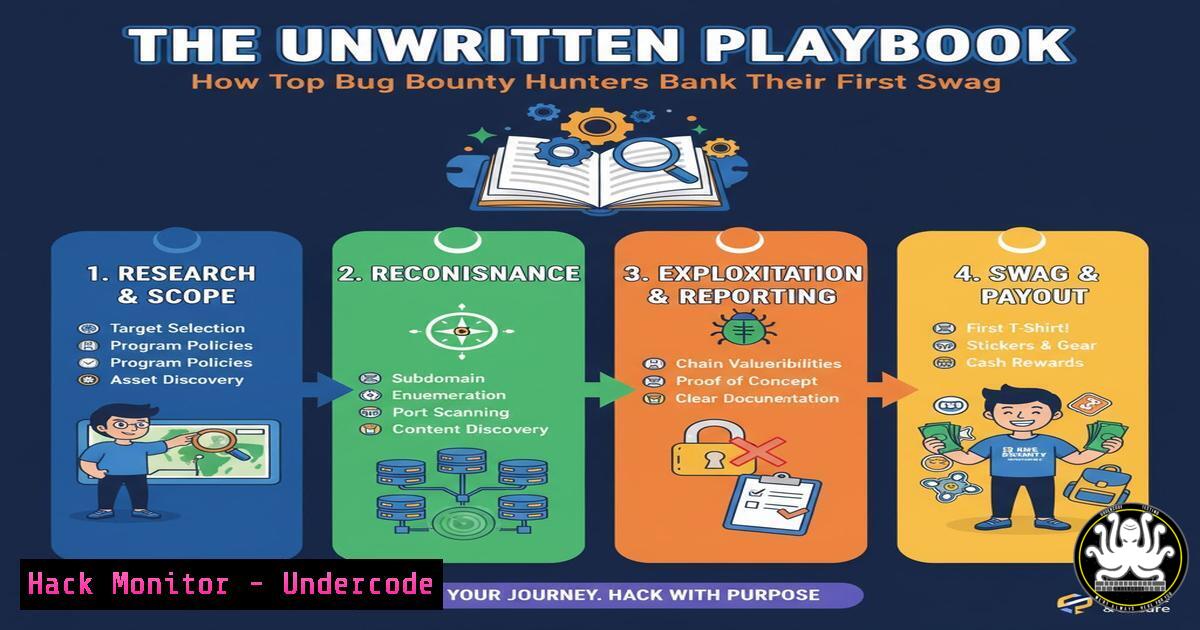
Introduction:
The journey from cybersecurity student to a recognized bug bounty hunter is paved with more than just vulnerability reports; it’s a strategic path of proven methodologies and technical precision. When a hunter receives their first “swag”—the branded merchandise from a successful bug bounty program—it signifies a milestone of validated skill. This article deconstructs the essential technical commands and processes that form the foundation of a successful web application penetration test, guiding aspiring hunters toward their first tangible reward.
Learning Objectives:
- Master the core reconnaissance and subdomain enumeration techniques used to maximize target scope.
- Understand the critical workflow for automating initial vulnerability scanning and analysis.
- Learn the manual verification and exploitation commands that transform a potential bug into a validated report.
You Should Know:
1. Reconnaissance & Surface Mapping
The first phase involves discovering every possible entry point into the target’s application. This expands the attack surface far beyond the main website.
 Subdomain Enumeration with sublist3r and amass
sublist3r -d target.com
amass enum -passive -d target.com -o amass_output.txt
assetfinder --subs-only target.com | tee assetfinder.txt
Step-by-step guide:
- Step 1: Use `sublist3r` to quickly gather subdomains from public sources.
- Step 2: Run `amass` in passive mode for a more extensive, non-intrusive enumeration.
- Step 3: Combine the results using
cat amass_output.txt assetfinder.txt | sort -u > all_subs.txt. - Step 4: Probe these subdomains for live hosts using
httpx:cat all_subs.txt | httpx -silent > live_subs.txt. This provides a clean list of active web targets.
2. Endpoint Discovery & Directory Bruteforcing
With a list of live hosts, the next step is to find hidden directories, API endpoints, and configuration files.
 Directory and File Bruteforcing with ffuf and Gobuster
ffuf -u https://target.com/FUZZ -w /usr/share/wordlists/dirb/common.txt -mc all -fc 404,500
gobuster dir -u https://api.target.com/ -w /usr/share/wordlists/dirb/common.txt -x php,json,bak
Step-by-step guide:
- Step 1: `ffuf` is a fast fuzzer. The `-mc all` flag shows all status codes, and `-fc` filters out common false positives like 404s.
- Step 2: `gobuster dir` is another robust tool. The `-x` flag specifies extensions to append to each word, crucial for finding backup files (
admin.php.bak) or API routes (/v1/users.json). - Step 3: Always fuzz API endpoints separately with a wordlist tailored for API paths, such as
common-api-endpoints.txt.
3. Automated Vulnerability Scanning & Triage
Automation helps identify low-hanging fruit, but manual verification is key to avoiding false positives.
 Passive Scanning with Nuclei
nuclei -l live_subs.txt -t /path/to/nuclei-templates/ -o nuclei_scan_results.txt
Step-by-step guide:
- Step 1: Feed your list of live subdomains (
live_subs.txt) intonuclei. - Step 2: Use the `-t` flag to point to your local clone of the Nuclei Templates repository, which contains thousands of vulnerability checks.
- Step 3: Review the `nuclei_scan_results.txt` file. This output is a starting point for investigation, not a final bug report. Every finding must be manually confirmed.
4. Manual SQL Injection Testing
Despite automation, classic vulnerabilities like SQLi often require manual fuzzing to bypass weak WAFs.
 Manual SQLi Testing with Curl and Query Crafting
curl -G "https://target.com/products" --data-urlencode "category=' OR 1=1--"
sqlmap -u "https://target.com/products?category=Gifts" --batch --level=3 --risk=2
Step-by-step guide:
- Step 1: Use `curl` to manually inject single quotes and logic operators like `OR 1=1` to test for error-based or boolean-based SQLi. Observe changes in HTTP response length or error messages.
- Step 2: If a parameter seems suspicious, escalate to
sqlmap. The `–batch` flag runs non-interactively, while `–level` and `–risk` increase the thoroughness of the tests. - Step 3: Never run `sqlmap` with aggressive settings without explicit permission, as it can damage database contents.
5. Cross-Site Scripting (XSS) Payload Verification
Identifying reflected or stored user input is critical for XSS discovery.
 XSS Probe with Common Payloads
curl -s "https://target.com/search?q=<script>alert(1)</script>" | grep -i "script"
 Using a dedicated tool like dalfox
echo "https://target.com/search?q=test" | dalfox pipe
Step-by-step guide:
- Step 1: Manually test a simple payload like `` and check if it is reflected unencoded in the HTML source.
- Step 2: Use
dalfox, an automated XSS scanner, to perform a more in-depth analysis. The `pipe` mode allows you to feed URLs directly from other tools. - Step 3: Test all entry points, including headers (
User-Agent,X-Forwarded-For) and POST body parameters, not just GET queries.
6. Server-Side Request Forgery (SSRF) Exploitation
SSRF vulnerabilities allow attackers to make the server request internal resources.
 Testing for SSRF with an external interaction service
curl "http://target.com/load?url=http://169.254.169.254/latest/meta-data/"
curl "http://target.com/load?url=http://burpcollaborator.net"
Step-by-step guide:
- Step 1: Test if the application fetches a URL you provide. First, try internal IP addresses like the AWS metadata endpoint (
169.254.169.254). - Step 2: Use an external service like Burp Collaborator or `webhook.site` to provide a URL. If the server makes a request to your webhook, you have confirmed blind SSRF.
- Step 3: Escalate by trying to access internal services, e.g.,
http://localhost:8080/admin` or file URLs likefile:///etc/passwd`.
7. Cloud Metadata & Configuration Audits
Misconfigured cloud services are a prime target for bounty hunters.
 Checking for Public S3 Buckets and Azure Blobs
aws s3 ls s3://target-bucket/ --no-sign-request --region us-east-1
curl -s https://target.blob.core.windows.net/container?restype=container&comp=list
nmap -p 443 --script http-aws-s3-enum target.com
Step-by-step guide:
- Step 1: Attempt to list the contents of a suspected S3 bucket without authentication using the `–no-sign-request` flag. A successful listing indicates a misconfigured, public bucket.
- Step 2: For Azure, a simple `curl` to the blob storage endpoint can sometimes list contents if Anonymous Access is enabled.
- Step 3: Use Nmap’s `http-aws-s3-enum` script to discover S3-style subdomains. Finding a single misconfigured bucket can often lead to a critical finding and significant bounty.
What Undercode Say:
- Methodology Over Tools: The tools are interchangeable; the underlying methodology of reconnaissance, enumeration, testing, and verification is what consistently produces results. A disciplined, documented process separates amateurs from professionals.
- The Human Element in Automation: While automated scanners like Nuclei are powerful force multipliers, they generate noise. The hunter’s value lies in their ability to interpret results, chain low-severity issues into a critical finding, and manually exploit complex logic flaws that scanners cannot see. The “swag” is not earned by running a script; it is earned by the analytical thinking applied to the script’s output.
Prediction:
The future of bug bounty hunting will be dominated by AI-assisted tooling that can understand application context and logic flow, moving beyond simple pattern matching. This will force hunters to specialize in complex vulnerability classes like business logic flaws, insecure direct object references (IDOR), and API authorization bugs. The hunters who succeed will be those who leverage AI to handle repetitive tasks while focusing their expertise on the nuanced, creative exploitation techniques that machines cannot yet replicate. The first “swag” will increasingly become a badge of proficiency in human-machine collaboration.
🎯Let’s Practice For Free:
IT/Security Reporter URL:
Reported By: Murali Dharan – Hackers Feeds
Extra Hub: Undercode MoN
Basic Verification: Pass ✅


