
Listen to this Post
Introduction:
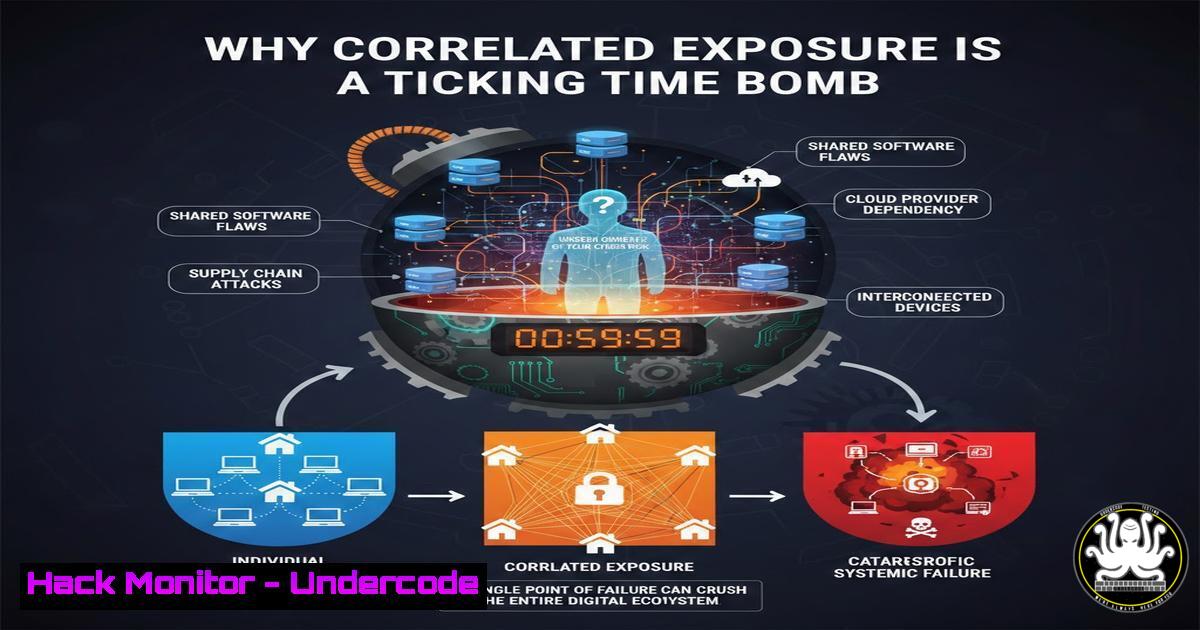
In the world of cybersecurity, risk is rarely linear. While individual vulnerabilities and misconfigurations are often owned by specific departments—IT owns the patch, Security owns the firewall rule, and Procurement owns the vendor—the aggregation of these risks into a single, catastrophic event creates a governance blind spot. This “correlated risk” occurs when a single point of failure in your ecosystem (a cloud provider outage, a supply chain compromise, or a shared software library) triggers a cascade of failures across your portfolio. The conversation then shifts from technical capability to organizational ownership, forcing leaders to ask who is responsible when everything breaks at once.
Learning Objectives:
- Define correlated risk in the context of modern IT and cloud ecosystems.
- Identify tools and techniques to map technical dependencies across your organization.
- Execute practical commands to audit single points of failure in cloud and network infrastructure.
- Understand the governance gap between technical ownership and business accountability.
You Should Know:
- Mapping the Digital Supply Chain: Discovering Hidden Dependencies
Correlated risk often hides in the “invisible” connections between systems. A third-party SaaS provider, a shared API gateway, or a centralized authentication service can become a single point of failure. To visualize this, we need to move beyond simple asset inventories and map technical dependencies.
Step‑by‑step guide: Using Open Source Intelligence (OSINT) and Network Mapping
While sophisticated tools exist, a basic understanding can be gained using command-line utilities to trace dependencies.
- Linux/macOS (Tracing Network Paths): Use `traceroute` to see the path your traffic takes to a critical cloud provider. If multiple critical business functions route through the same ISP or peering point, that’s a potential correlation.
traceroute api.critical-vendor.com
- Windows (Pathping): Combines the features of `ping` and
tracert.pathping aws.amazon.com
- DNS Analysis: Check for over-centralization. If all your external services rely on the same DNS provider, an outage there takes everything down.
Linux/macOS
dig critical-saas-1.com NS
dig critical-saas-2.com NS
- Using `curl` for API Health Checks: Simulate a dependency failure by testing API rate limits or access. If multiple internal apps hit the same external API, you have a correlation risk.
curl -I https://api.shared-service.com/health
- Cloud Infrastructure: Auditing for Single Points of Failure
In cloud environments, correlated risk often manifests in the form of Availability Zone (AZ) failures or misconfigured Identity and Access Management (IAM) policies that, if breached, grant access to everything.
Step‑by‑step guide: Using AWS CLI to Check Redundancy and Over-Permissive Roles
- Check EC2 Instance Distribution: Ensure your critical instances are spread across multiple Availability Zones.
List instances and their AZs
aws ec2 describe-instances --query 'Reservations[].Instances[].[InstanceId,Placement.AvailabilityZone]' --output table
- Identify Overly Permissive Roles (The “Correlation Bomb”): A single role that has access to S3, EC2, and RDS creates a massive blast radius. Use the AWS IAM policy simulator or tools like `aws-vault` to audit. You can list policies attached to a specific role to understand its reach.
List policies attached to a specific role
aws iam list-attached-role-policies --role-name YourCriticalRoleName
- Check S3 Bucket Policies for Global Access: If one misconfigured bucket exposes data for multiple projects, that’s correlated data leakage.
Get the policy of a bucket
aws s3api get-bucket-policy --bucket your-critical-bucket-name --query Policy --output text | python -m json.tool
- Software Supply Chain: Auditing Shared Libraries and Containers
A single open-source library (like Log4j) or a base container image used by dozens of microservices represents a massive correlated risk. A vulnerability in that shared component affects everything downstream.
Step‑by‑step guide: Docker and SBOM Analysis
- Generate a Software Bill of Materials (SBOM): Use `syft` (an open-source tool) to generate an SBOM for a container image to see all its components.
Install syft and generate an SBOM for an image
syft packages your-registry/your-image:latest -o table
- Scan for Known Vulnerabilities: Use `grype` to correlate the components in your SBOM with vulnerability databases.
Scan an image for vulnerabilities
grype your-registry/your-image:latest
- Check Docker Base Image Usage: On a build server or CI/CD system, check how many projects are using a specific base image.
Find all Dockerfiles and grep for a specific base image (e.g., node:14)
find . -name "Dockerfile" -exec grep -H "FROM node:14" {} \;
4. Network Security: The Centralized Firewall Problem
While firewalls are essential, a misconfigured rule or a failure in the central firewall device can correlate risk by taking the entire network offline.
Step‑by‑step guide: Linux iptables and Windows Firewall Auditing
- Linux (iptables): Check for broad “ACCEPT” rules that might bypass intended segmentation. A single rule allowing traffic between all VLANs is a correlation risk enabler.
List all rules with line numbers
sudo iptables -L -n -v --line-numbers
- Windows (Advanced Firewall): Use PowerShell to export all firewall rules and look for overly permissive profiles (Domain, Private, Public all set to Allow for the same port).
Export all firewall rules to a CSV for analysis
Get-NetFirewallRule | Select-Object DisplayName, Direction, Action, Enabled, Profile | Export-Csv firewall_rules.csv
- Configuration Management (Ansible example): If you use Infrastructure as Code, audit playbooks to ensure firewall rules are applied consistently and not overly broad.
Example snippet to check in your playbooks - ensure it's not allowing all traffic</li>
<li>name: Ensure iptables rule is specific
ansible.builtin.iptables:
chain: INPUT
protocol: tcp
destination_port: 22
source: 192.168.1.0/24  Should be specific, not 0.0.0.0/0
jump: ACCEPT
5. Credential Management: The Master Key Risk
If a single set of credentials (a service account, an admin password) grants access to multiple critical systems, ownership of that credential becomes ownership of the correlated risk.
Step‑by‑step guide: Auditing for Shared Accounts
- Windows (Active Directory): Find service accounts used by multiple services.
Find accounts that are members of high-privilege groups (Domain Admins, etc.)
Get-ADGroupMember -Identity "Domain Admins" | Get-ADUser -Properties ServicePrincipalName | Select-Object Name, SamAccountName, ServicePrincipalName
- Linux (PAM and Sudoers): Check for users with broad sudo access across multiple boxes.
Check sudoers files for NOPASSWD or ALL access
sudo grep -r "ALL=(ALL)" /etc/sudoers.d/
sudo visudo -c  Check syntax and list effective rules
- API Key Rotation: Use `grep` to find hardcoded API keys in code repositories (a common source of correlated credential leakage).
Search for potential AWS keys in your codebase
grep -r "AKIA[0-9A-Z]{16}" /path/to/your/code
What Undercode Say:
- Ownership is not about blame, it’s about visibility. The first step to mitigating correlated risk is acknowledging that technical controls (firewalls, IAM) are insufficient without an owner who understands the business impact of a cascading failure.
- Decentralize to survive. The technical mitigation for correlated risk is redundancy and segmentation. Your commands and configurations must enforce diversity—diverse cloud regions, diverse code libraries, and diverse credential stores.
The core issue raised by Daniel Rathbun is that correlated risk is a governance problem wearing a technical disguise. The CFO doesn’t care about the specific firewall rule; they care about the business unit that can’t invoice customers because a shared cloud region went down. The technical work of mapping dependencies using the commands above (traceroute, AWS CLI, grype, etc.) must feed into a business continuity plan that clearly designates an owner for the “in-between” spaces. Ultimately, you cannot secure what you cannot see, and you cannot own what you cannot measure. The organization that masters this visibility turns a ticking time bomb into a managed, and insurable, business decision.
Prediction:
Within the next 18 months, we will see regulatory bodies (like the SEC or GDPR authorities) begin to explicitly mandate the disclosure of correlated risk dependencies, not just individual breaches. Frameworks like the “Critical Path” will evolve from niche security concepts to standard boardroom reporting requirements, forcing CISOs to quantify not just the likelihood of a single event, but the aggregated blast radius of a multi-system failure. This will drive a surge in demand for “Digital Supply Chain Mapping” tools and governance roles focused specifically on ecosystem concentration risk.
▶️ Related Video (78% Match):
🎯Let’s Practice For Free:
IT/Security Reporter URL:
Reported By: Drathbun If – Hackers Feeds
Extra Hub: Undercode MoN
Basic Verification: Pass ✅


