Listen to this Post
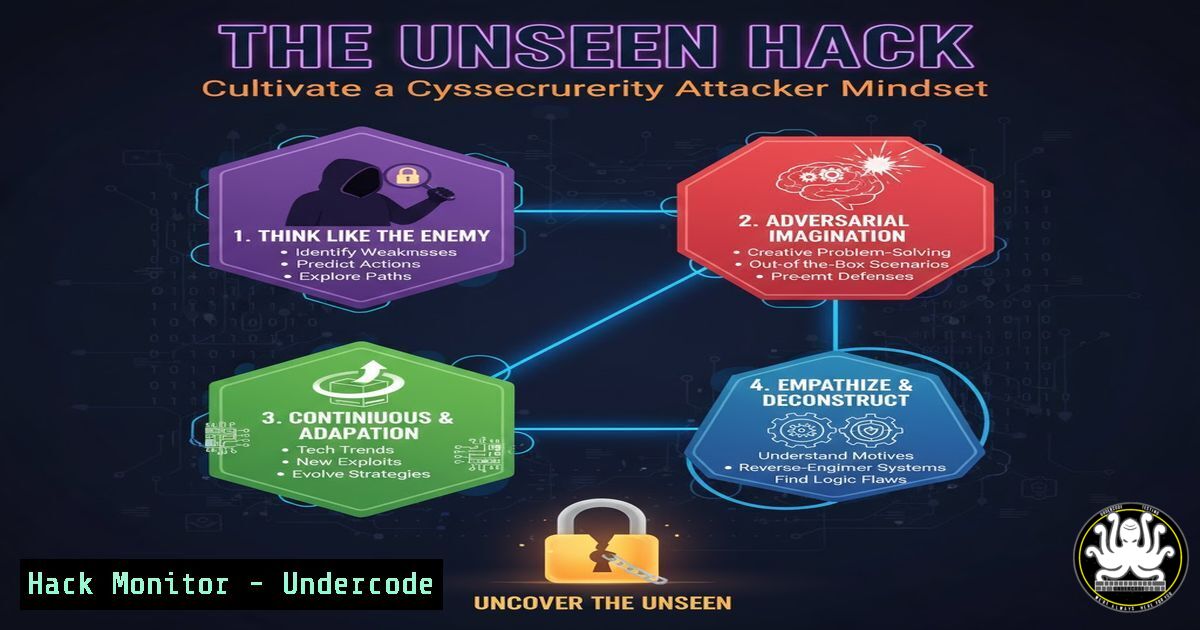
Introduction:
While technical skills are essential in cybersecurity, the most critical tool for penetration testers and security researchers is an offensive mindset. This article deconstructs the thought processes behind vulnerability discovery, moving beyond scripted tutorials to explore how experts form hypotheses, approach targets systematically, and develop the intuition needed to find critical flaws.
Learning Objectives:
- Develop a systematic methodology for target analysis and attack surface enumeration.
- Learn to formulate and test security hypotheses using verified commands and techniques.
- Cultivate the analytical persistence required for advanced vulnerability discovery.
You Should Know:
- The Reconnaissance Mindset: Seeing the Invisible Attack Surface
Before a single exploit is launched, a significant portion of hacking involves passive and active reconnaissance. The goal is to build a comprehensive map of the target’s digital footprint.
`command: subfinder -d target.com`
`command: amass enum -passive -d target.com`
`command: assetfinder target.com`
`command: nmap -sC -sV -oA initial_scan target_ip`
`command: ffuf -u https://target.com/FUZZ -w /usr/share/wordlists/dirb/common.txt`
Step‑by‑step guide:
- Start with passive reconnaissance using tools like `subfinder` and `amass` to discover subdomains without directly touching the target.
- Use `assetfinder` to pull related domains and infrastructure from various sources.
- Perform a light initial `nmap` scan to identify open ports and running services (
-sCfor default scripts, `-sV` for version detection). - Employ a content discovery tool like `ffuf` to brute-force hidden directories and files. The mindset here is to ask: “What has the developer left exposed that they didn’t intend to?”
2. Hypothesis-Driven Testing: From Observation to Exploitation
A vulnerability is often a hypothesis proven correct. This involves observing application behavior and asking “what if” questions.
`command: sqlmap -u “https://target.com/page?id=1” –batch –level=3`
`command: commix -u “https://target.com/search.php?q=test” –all`
`code snippet: ‘ OR 1=1–`
`code snippet: `
`tutorial: Manipulating HTTP headers (X-Forwarded-For, Host) to test for access control bypasses.`
Step‑by‑step guide:
- Identify a potential injection point (e.g., a URL parameter, form field, or HTTP header).
- Formulate a hypothesis: “This parameter is vulnerable to SQL injection.”
- Test manually with a simple payload like `’` to observe for errors, then escalate to
' OR 1=1--. - Automate the process with `sqlmap` or `commix` for comprehensive testing, but always analyze the traffic to understand the mechanism of the flaw.
3. Cloud Infrastructure Enumeration: The New Perimeter
Modern applications reside in the cloud, making misconfigured AWS S3 buckets, Azure Blob Storage, and Google Cloud Storage a prime target.
`command: aws s3 ls s3://bucket-name/ –no-sign-request`
`command: s3scanner –bucket bucket-name`
`command: cloud_enum -k target_keyword`
`tutorial: Using Pacu for automated AWS penetration testing.`
`code snippet: IAM Policy with overly permissive “Action”: “”`
Step‑by‑step guide:
- Use keyword-based tools like `cloud_enum` to discover potentially misconfigured cloud assets.
- For a discovered S3 bucket, attempt to list its contents using the AWS CLI with the `–no-sign-request` flag, which checks for public read permissions.
- If you gain access, the mindset shifts to impact: “What sensitive data is exposed here?” and “Can I write to this bucket to achieve code execution?”
4. API Security Testing: The Hidden Attack Vector
APIs power modern web and mobile applications but often expose complex logic flaws and data endpoints.
command: curl -H "Authorization: Bearer <JWT>" https://api.target.com/v1/users`code snippet: {“user_id”: 12345} -> {“user_id”: 12346}`
`command: kiterunner scan https://api.target.com -w api_wordlist.txt`
`tutorial: Testing for Broken Object Level Authorization (BOLA) by changing an object ID in a GET request.`
<h2 style="color: yellow;">
`tool: Burp Suite with the Autorize extension for automated access control testing.`
Step‑by‑step guide:
- Use `kiteraker` to discover hidden API endpoints that standard wordlists might miss.
- Intercept a legitimate API request with a tool like Burp Suite.
- Form a hypothesis: “Does this endpoint perform proper authorization checks?”
- Test by modifying the `user_id` or other object identifiers in the request (a BOLA attack) to see if you can access another user’s data.
5. Windows Lateral Movement: Living Off the Land
Once initial access is gained, the focus shifts to moving laterally through a network using built-in Windows tools to avoid detection.
`command: wmic /node:target_host process call create “cmd.exe /c whoami”`
`command: PsExec.exe \\target_host -s cmd.exe`
`command: secretsdump.py DOMAIN/target_host$@target_ip -hashes :`
`tutorial: Performing a Pass-the-Hash attack with Mimikatz.`
`command: reg save HKLM\SYSTEM system.save && reg save HKLM\SAM sam.save`
Step‑by‑step guide:
- Discover other hosts on the network using `net view` or a port scanner.
- With appropriate credentials or hashes, use Windows Management Instrumentation (
wmic) or `PsExec` to execute commands on a remote host. - Use a tool like `secretsdump.py` from the Impacket suite to dump password hashes from the remote machine’s SAM database, enabling further lateral movement or privilege escalation.
6. Linux Privilege Escalation: The Path to Root
Privilege escalation is a core skill, requiring a checklist-driven mindset to identify misconfigurations.
`command: sudo -l`
`command: find / -perm -4000 2>/dev/null`
`command: linpeas.sh`
`command: ps aux | grep root`
`command: crontab -l`
`tutorial: Exploiting a SUID binary with known vulnerabilities (e.g., CVE-2021-4034 in pkexec).`
Step‑by‑step guide:
- Always run `sudo -l` to list commands the current user can run as root.
- Search for SUID binaries with
find / -perm -4000 2>/dev/null. The hypothesis is that one may be exploitable. - Run an automated script like `linpeas.sh` to perform a broad system check for misconfigurations in processes, cron jobs, and writable files.
- Analyze the output to form a specific hypothesis for escalation, such as exploiting a vulnerable SUID binary or hijacking a root-run cron job.
7. Vulnerability Mitigation & System Hardening
The offensive mindset is incomplete without understanding defense. Knowing how to fix a flaw is as important as knowing how to exploit it.
`command: sudo ufw enable && sudo ufw default deny incoming`
`command: getsebool -a | grep httpd_can_network_connect`
`command: audit2why -a`
`tutorial: Implementing a Web Application Firewall (WAF) rule set in ModSecurity.`
`code snippet: Content-Security-Policy: default-src ‘self’;`
Step‑by‑step guide:
- Harden the network perimeter by enabling a firewall like UFW with a default-deny policy.
- On Linux, use SELinux by reviewing policies with `getsebool` and audit logs with `audit2why` to understand and restrict application behavior.
- Implement security headers like Content-Security-Policy (CSP) in web applications to mitigate XSS attacks. The defensive mindset asks: “How can I reduce the attack surface and contain a breach?”
What Undercode Say:
- The true differentiator between a script kiddie and a senior researcher is not the knowledge of tools, but the ability to think like an adversary and systematically test complex systems.
- Persistence and curiosity are non-negotiable traits; the most critical vulnerabilities are often found not by running a tool, but by questioning an application’s logic when everyone else has moved on.
The core analysis is that technical proficiency is merely the entry ticket. The real work begins with developing a relentless, inquisitive, and analytical mindset. It’s about connecting disparate pieces of information—a strange subdomain, an unusual HTTP header, a non-standard port—into a coherent attack chain. This cognitive framework allows a professional to find the “unknown unknowns” that automated scanners consistently miss, turning a list of commands into a powerful weapon for both attack and defense.
Prediction:
The increasing automation of basic vulnerability scanning will render low-hanging fruit obsolete, simultaneously raising the baseline defense while creating a higher ceiling for advanced attackers. The future of offensive security will belong entirely to those who have mastered the attacker mindset—professionals capable of discovering complex, business-logic flaws and novel attack chains that machines cannot yet conceive. This will lead to a greater emphasis on AI-assisted hypothesis generation, but the critical thinking and creative exploitation will remain a uniquely human skill.
🎯Let’s Practice For Free:
IT/Security Reporter URL:
Reported By: Valsamaras There – Hackers Feeds
Extra Hub: Undercode MoN
Basic Verification: Pass ✅


