
Listen to this Post
Introduction:
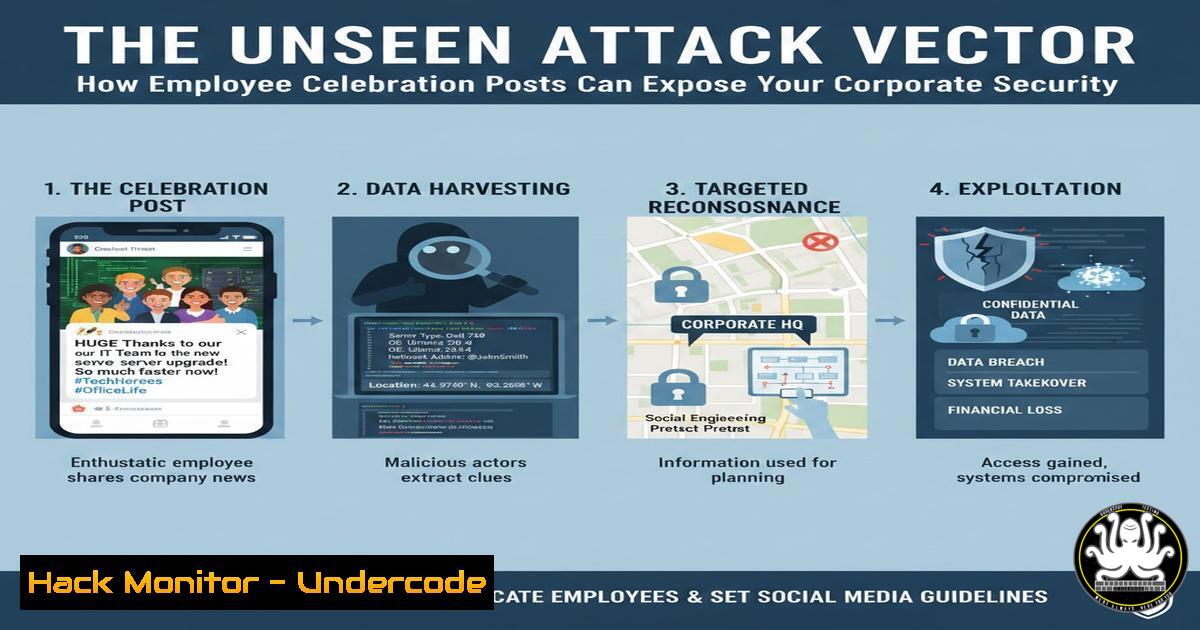
In an era of hyper-connected professional networks, a seemingly innocent celebratory post can become a goldmine for threat actors. The personal and professional details shared by employees, like those in Brinda Shanmugam’s LinkedIn anniversary post, are frequently weaponized for sophisticated social engineering and reconnaissance attacks, bypassing millions spent on technical defenses.
Learning Objectives:
- Understand how OSINT (Open-Source Intelligence) is gathered from social media.
- Implement technical controls to detect and prevent reconnaissance.
- Train employees on secure social media sharing practices to reduce the attack surface.
You Should Know:
- The OSINT Reconnaissance Phase: Extracting Intelligence from Public Posts
A celebratory post, like the one analyzed, provides multiple data points for an attacker. The goal is to build a profile of the target organization and its employees.
Step-by-Step Guide:
- Step 1: Target Identification. The attacker identifies the company:
DigiSME Software Pvt Ltd. They now have a primary target. - Step 2: Employee Profiling. The post reveals the author’s roles:
Security Analyst,Penetration Tester,Ethical Hacker. This tells the attacker that technical phishing attempts must be highly sophisticated, but that non-technical staff in `HRMS projects` might be softer targets. - Step 3: Mapping Internal Structure. Mentions of “cross-team learning” and “different teams across DigiSME” indicate a fluid internal structure. Attackers can use this to craft believable pretexts for internal phishing.
- Step 4: Culture Exploitation. Details about “team dinners, outings, celebrations, and sports activities” are used to craft highly convincing spear-phishing emails. An email titled “Photos from the Last Team Outing!” or “Re: Sports Activity Registration” is highly likely to be opened.
- Step 5: Tooling the Reconnaissance. Attackers use automated OSINT tools to scrape and correlate this data.
- TheHarvester: `theharvester -d digisme.com -l 100 -b linkedin`
– LinkedInt: A tool specifically for scraping LinkedIn data to build email lists and employee trees.
2. Weaponizing Intelligence: Crafting the Phishing Payload
With the gathered intelligence, an attacker moves from reconnaissance to active exploitation.
Step-by-Step Guide:
- Step 1: Payload Development. The attacker creates a malicious document,
DigiSME_Annual_Sports_Event_Invitation.pdf.exe, disguised as an invitation. Alternatively, they may use a weaponized Excel sheet for a fake “HRMS Project Bonus Schedule.” - Step 2: Delivery Mechanism. Using the knowledge of internal culture, the attacker sends a spear-phishing email from a spoofed address like
[email protected]. - Step 3: Command and Control (C2) Setup. The attacker sets up a listener to receive callbacks from compromised machines.
- Linux (using Netcat): `nc -lvnp 443`
– Windows (PowerShell Empire or Cobalt Strike): These frameworks provide advanced post-exploitation capabilities.
3. Internal Lateral Movement and Privilege Escalation
Once initial access is gained, the attacker uses the internal trust model revealed in the post to move laterally.
Step-by-Step Guide:
- Step 1: Network Enumeration. From the compromised host, the attacker maps the network.
- Windows: `nltest /dclist:digisme` & `net view /all`
– Linux: `nbtscan [bash]`
– Step 2: Credential Dumping. The attacker attempts to dump credentials to access other systems. - Mimikatz (Windows): `privilege::debug` followed by `sekurlsa::logonpasswords`
– Step 3: Pass-the-Hash Attack. Using the harvested hashes, the attacker attempts to authenticate to other systems, especially those hosting the HRMS project mentioned.
4. Hardening Defenses: Technical Controls and Monitoring
Organizations must assume such information is public and harden their environments accordingly.
Step-by-Step Guide:
- Step 1: Implement Strict Egress Filtering. Use firewalls to block outbound connections from workstations to unknown IPs, hindering C2 callbacks.
- Example Iptables Rule: `iptables -A OUTPUT -p tcp –dport 443 -d
-j ACCEPT` followed by `iptables -A OUTPUT -p tcp –dport 443 -j DROP`
– Step 2: Deploy Application Whitelisting. Use tools like Windows AppLocker or SRP to prevent the execution of unauthorized binaries likepdf.exe. - Step 3: Enable Enhanced Logging and SIEM Correlation.
- Windows Command to Audit Process Creation: `auditpol /set /category:”Detailed Tracking” /subcategory:”Process Creation” /success:enable`
– Create SIEM rules to alert on `parent_image` of `winword.exe` spawning `cmd.exe` orpowershell.exe.
5. The Human Firewall: Mandatory Security Awareness Training
The most critical mitigation is to train employees on the risks of oversharing.
Step-by-Step Guide:
- Step 1: Develop a Clear Social Media Policy. Explicitly list what information is not to be shared publicly (e.g., internal project names, team structures, specific technologies in use).
- Step 2: Conduct Phishing Simulation Exercises. Regularly test employees with simulated attacks based on real data scraped from your own company’s public posts.
- Step 3: Perform Proactive Self-OSINT. Regularly search for your company and key employees online to see what an attacker sees. Use tools like `Sherlock` to find employee accounts across platforms: `sherlock –company “DigiSME”`
What Undercode Say:
- The Human Element is the Weakest Link. No amount of technical hardening can fully compensate for an untrained employee who unknowingly provides a blueprint for their own company’s attack.
- Assume Breach, Assume OSINT is Public. Security strategies must operate on the assumption that attackers already have significant internal intelligence. Defenses should be designed to be resilient even after initial compromise.
The analysis of Brinda’s post is not a criticism but a stark lesson in operational security (OPSEC). The very culture that makes a company a great place to work—celebrations, recognition, cross-team collaboration—are the exact details malicious actors seek. A comprehensive defense-in-depth strategy must include continuous education on the real-world implications of digital footprints. The goal is not to stop celebration, but to celebrate smartly, without arming adversaries with the intelligence needed to breach the network.
Prediction:
In the next 2-3 years, we will see a dramatic rise in AI-powered OSINT bots that automatically scrape social platforms, correlate employee relationships, and generate hyper-personalized phishing lures at scale. Defense will require an equal investment in AI-driven security awareness platforms that can proactively warn employees in real-time if their post contains risky information before it’s ever published. The battleground will shift from the network perimeter to the news feeds and timelines of every employee.
🎯Let’s Practice For Free:
IT/Security Reporter URL:
Reported By: Brinda Shanmugam – Hackers Feeds
Extra Hub: Undercode MoN
Basic Verification: Pass ✅


