Listen to this Post
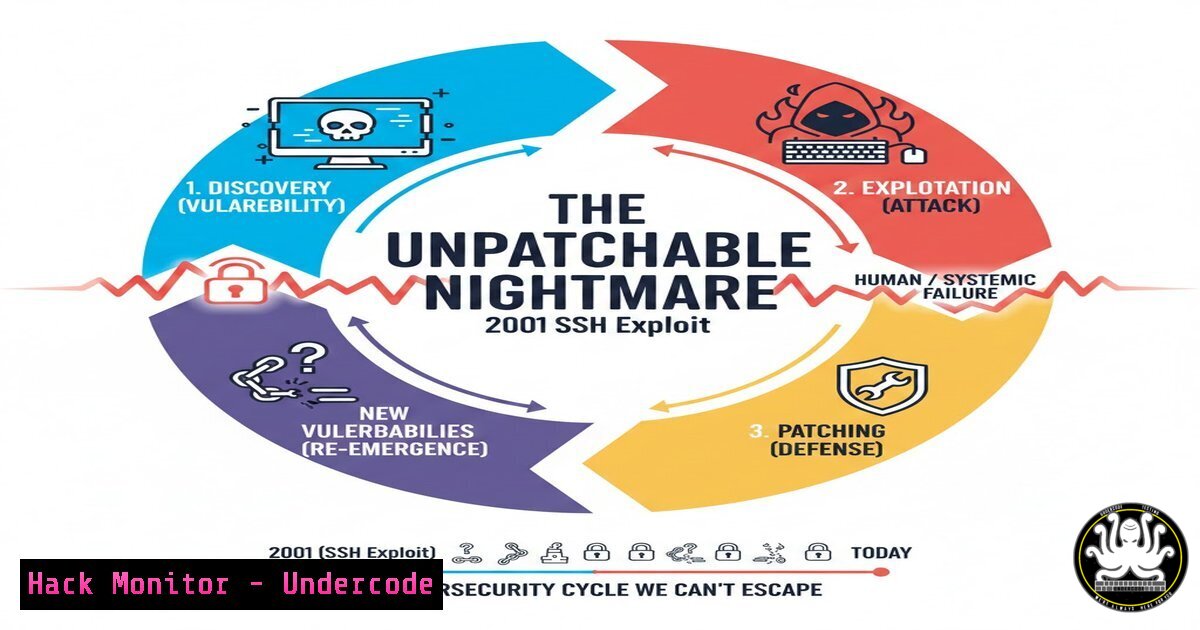
Introduction:
The discovery and exploitation of the SSH1 CRC-32 compensation attack detector vulnerability in 2001 serves as a foundational case study in cybersecurity. This incident, involving the x2 remote exploit, demonstrates timeless patterns: the fallibility of “secure” protocols, the cat-and-mouse game of exploit obfuscation, and the human factors that delay critical patching. Understanding this historical hack provides crucial insights for defending against modern threats targeting firewalls, cloud infrastructure, and AI systems.
Learning Objectives:
- Understand the technical mechanism behind the SSH CRC-32 vulnerability and its exploitation.
- Learn historical and modern techniques for binary obfuscation and anti-forensics.
- Apply system hardening and patch management principles relevant to contemporary IT environments.
You Should Know:
1. The Anatomy of the SSH CRC-32 Vulnerability
The vulnerability, discovered by Michal Zalewski, was not in the encryption itself but in a security routine designed to protect the encryption. SSH version 1 used a cyclic redundancy check (CRC-32) for data integrity. The protocol included a compensation attack detector to prevent malicious modification of this checksum. A programming error within this detector created a buffer overflow condition, allowing remote code execution on the SSH server.
Step-by-Step Exploitation Guide:
- The Flaw: The compensation attacker did not properly validate the payload length before copying data into a fixed-size buffer on the stack.
- The Trigger: A maliciously crafted SSH packet with a specific CRC value and an oversized payload could overwrite the return address on the function’s stack frame.
- The Result: Control of the instruction pointer was seized, allowing the attacker to execute arbitrary shellcode with the privileges of the SSH daemon (often root).
2. Binary Obfuscation and Anti-Forensics with BurnEye
The x2 exploit was protected using BurnEye, a binary encryption tool popular in the early 2000s. This was a precursor to modern packers like UPX or malicious crypters. Its purpose was to hinder static analysis by reverse engineers and antivirus software.
Step-by-Step Obfuscation Guide:
- Encryption: The original exploit binary was encrypted, and a decryption stub was added to the file header.
- Execution Flow: When run, the stub would prompt for a passphrase. The correct phrase (“thisisnotyourexploit”) would trigger the decryption of the main exploit code in memory.
- Evasion: Since the payload was only decrypted at runtime, static signature-based antivirus solutions were largely ineffective. This extended the exploit’s operational life.
3. System Hardening: Lessons from the Aftermath
The post-exploit panic led to ad-hoc but effective system hardening measures. These practices are now standard in cybersecurity frameworks.
Step-by-Step Hardening Guide (Linux):
- Disable Vulnerable Protocols: In
/etc/ssh/sshd_config, set `Protocol 2` to disable the vulnerable SSHv1. - Change Default Port: Modify `Port 22` to a non-standard port (e.g.,
Port 5022) to reduce noise from automated scanners. - Principle of Least Privilege: Run the SSH daemon under a dedicated, non-root user where possible.
Example: Create a user for SSHD and adjust config
sudo useradd -r -s /bin/false sshduser
Then in sshd_config: User sshduser
- Network Segmentation: Use firewall rules to restrict SSH access to specific source IP ranges.
Using iptables to allow SSH only from 192.168.1.0/24
sudo iptables -A INPUT -p tcp --dport 5022 -s 192.168.1.0/24 -j ACCEPT
sudo iptables -A INPUT -p tcp --dport 5022 -j DROP
4. Modern Parallels: The Fortinet Firewall Phenomenon
The post’s analogy is prescient. Just as SSH was blindly trusted in 2001, many organizations today operate under the assumption that their commercial firewalls (from vendors like Fortinet, Palo Alto, and Cisco) are inherently secure. These complex devices run full operating systems and have large attack surfaces, leading to regular critical vulnerabilities (e.g., CVE-2024-21762, a critical FortiOS SSL-VPN flaw).
Step-by-Step Mitigation Guide for Network Appliances:
- Strict Patch Management: Subscribe to your vendor’s security advisories and establish an emergency patch deployment workflow for critical CVEs.
- Reduce Attack Surface: Disable unused services and features (e.g., unused VPN protocols, administrative interfaces exposed to the internet).
- Continuous Monitoring: Implement Intrusion Detection System (IDS) rules specifically tuned for your network appliance traffic.
Example Suricata rule to detect anomalous SSH traffic (conceptual)
alert tcp any any -> $HOME_NET 5022 (msg:"Potential SSH Exploit Attempt"; flow:to_server,established; content:"|00 00 00 01 04|"; depth:5; sid:1000001; rev:1;)
5. The Psychology of Patching and Risk Communication
A key reason the x2 exploit was effective was the perceived difficulty of exploitation mentioned in the initial advisory. This created a false sense of security, slowing patch adoption—a phenomenon that repeats today with CVSS scores and “theoretical” exploits.
Step-by-Step Guide for Effective Patch Management:
- Risk Assessment: Do not rely solely on CVSS scores. Evaluate vulnerabilities based on the context of your specific environment, available exploit code, and attacker interest.
- Automate and Validate: Use tools like WSUS for Windows or Ansible for Linux to automate patch deployment. Always test patches in a staging environment first.
PowerShell command to list available Windows updates
Get-WindowsUpdate -MicrosoftUpdate
- Maintain a Timeline: Establish and enforce strict Service Level Agreements (SLAs) for applying patches based on severity (e.g., critical patches within 72 hours).
What Undercode Say:
- History Doesn’t Repeat Itself, It Rhymes. The core dynamics of the x2 exploit—trust in a technology, delayed patching, and reactive hardening—are identical to those seen in modern attacks on VPNs, firewalls, and cloud services. The players and tools change, but the game remains the same.
- Obfuscation is a Force Multiplier. The use of BurnEye by the x2 authors highlights a critical truth: slowing down the defense directly increases an exploit’s impact and longevity. Today’s AI-powered code obfuscation and polymorphic malware represent the evolution of this same principle.
The x2 story is not a relic; it’s a blueprint. It shows that attacker innovation often targets the assumptions behind a technology, not just the code. The “programming error in a security routine” is a classic example of a flaw in the meta-security—the code meant to protect the security code. Modern defenders must extend their scrutiny beyond primary functions to the secondary safety mechanisms, loggers, and monitoring tools, as these are increasingly the entry point for sophisticated attacks. The shift in 2001 to SSHv2 was a paradigm-level fix, reminding us that sometimes the most effective mitigation is to abandon a flawed architecture entirely.
Prediction:
The convergence of AI and cybersecurity will create a new class of “adaptive exploits.” Similar to how x2 used basic obfuscation, future exploits will leverage AI to autonomously analyze a target environment, modify their shellcode in real-time to evade detection, and identify the weakest link in a patching cycle (e.g., targeting systems during the gap between virtual patching and full deployment). The “human latency” in patching, so evident in 2001, will be systematically exploited by AI-driven attack platforms, making fully automated, large-scale compromise of specific vulnerability classes a common reality within the next 3-5 years. The defense will require AI-powered patch management and dynamic system hardening that can adapt at machine speed.
🎯Let’s Practice For Free:
IT/Security Reporter URL:
Reported By: Simon Howard – Hackers Feeds
Extra Hub: Undercode MoN
Basic Verification: Pass ✅


