
Listen to this Post
Introduction:
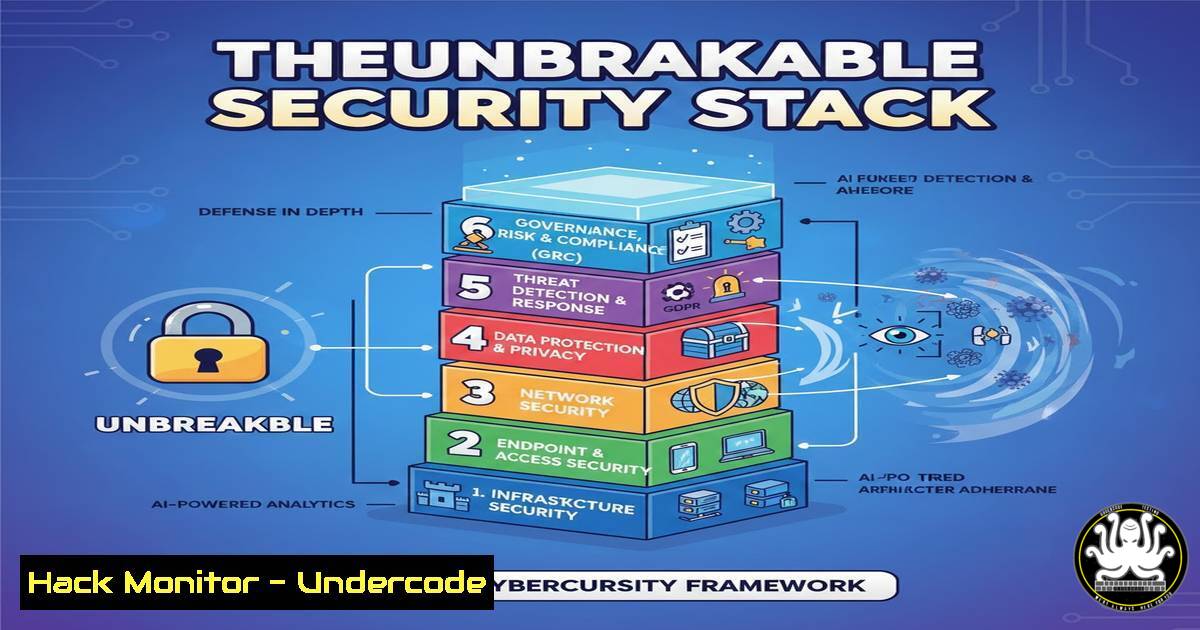
In an era of sophisticated cyber threats, relying on disparate security tools is a recipe for disaster. A cohesive cybersecurity framework integrates technology, processes, and policies across all organizational domains to create a resilient, defense-in-depth strategy. This article deconstructs the core pillars of such a framework, providing actionable technical guidance to transition from theory to practical implementation.
Learning Objectives:
- Understand and implement technical controls across six critical security domains: Information, Network, Cloud, Application, and Security & Incident Management.
- Apply essential Linux and Windows commands for system hardening, monitoring, and incident response.
- Configure key cloud security settings and implement application security best practices to mitigate common vulnerabilities.
You Should Know:
1. Fortifying Information Security: Beyond Encryption
Information Security is the bedrock of confidentiality, integrity, and availability (CIA). It begins with data classification and extends to enforcing access controls and encryption.
Step‑by‑step guide:
Step 1: Data Discovery & Classification. Use tools to locate sensitive data. On Linux, `grep -r “Social_Security_Number\|SSN\|Credit_Card” /home /var/www/` can help find unstructured data. Implement classification labels.
Step 2: Enforce File-Level Encryption. For Windows, use BitLocker (manage-bde -on C:). On Linux, use LUKS: cryptsetup luksFormat /dev/sdb1.
Step 3: Manage Access Rights. Principle of least privilege is key. On Linux, use `chmod` and `chown` (e.g., chmod 600 confidential.txt). On Windows, use `icacls` command: icacls "C:\SecureData" /deny "Users:(R,W)".
Step 4: Deploy Data Loss Prevention (DLP). Tools like `chkrootkit` and `rkhunter` can help detect exfiltration attempts, while enterprise DLP solutions monitor data in motion.
- Hardening Network Security: From Perimeter to Internal Segmentation
Network security prevents unauthorized access and movement. It involves strict access control, continuous monitoring, and attack mitigation.
Step‑by‑step guide:
Step 1: Implement Strict Firewall Rules. On Linux with iptables: `iptables -A INPUT -p tcp –dport 22 -s 10.0.0.0/24 -j ACCEPT` (allow SSH only from internal subnet). On Windows, use PowerShell: New-NetFirewallRule -DisplayName "Block SMB" -Direction Inbound -Protocol TCP -LocalPort 445 -Action Block.
Step 2: Network Device Inventory & Hardening. Use `nmap` for discovery: nmap -sn 192.168.1.0/24. Change default credentials on all devices and disable unused services.
Step 3: Enable Monitoring & IDS/IPS. Use `tcpdump` for packet analysis: tcpdump -i eth0 'port 80' -w capture.pcap. Deploy an open-source IDS like Suricata.
Step 4: DDoS Mitigation. Configure rate-limiting on network devices. Use cloud-based scrubbing services (AWS Shield, Cloudflare) for volumetric attacks.
3. Securing Cloud Environments: The Shared Responsibility Model
Cloud security requires understanding the shared responsibility model. The cloud provider secures the infrastructure; you secure your data, configurations, and access.
Step‑by‑step guide:
Step 1: Enforce Identity and Access Management (IAM). Use multi-factor authentication (MFA) universally. Apply the principle of least privilege. In AWS CLI, create a restrictive policy: aws iam create-policy --policy-name ReadOnlyS3 --policy-document file://policy.json.
Step 2: Secure Configuration & Asset Tracking. Enable logging (AWS CloudTrail, Azure Activity Log). Use infrastructure as code (Terraform, CloudFormation) for consistent, auditable deployments. Disable public read access to storage buckets.
Step 3: Implement Cloud-Specific Backups & DR. Ensure backups are encrypted and in a separate region/account. Test restoration procedures quarterly.
Step 4: Harden Cloud Network Security. Use security groups (AWS) or NSGs (Azure) as stateful firewalls. For Azure: az network nsg rule create --nsg-name MyNSG --name DenyInternet --priority 100 --access Deny --direction Inbound --source-address-prefixes Internet.
- Building Application Security: Shifting Left in the SDLC
Application security integrates security practices into the software development lifecycle (SDLC) to reduce vulnerabilities before deployment.
Step‑by‑step guide:
Step 1: Threat Modeling & Risk Assessment. Use frameworks like STRIDE during design. Document data flows and potential threats.
Step 2: Static & Dynamic Application Security Testing (SAST/DAST). Integrate SAST tools (SonarQube, Bandit for Python: bandit -r /path/to/your/code/) into CI/CD pipelines. Use DAST tools (OWASP ZAP) against staging environments.
Step 3: Secure Authentication & Session Management. Implement libraries for password hashing (e.g., bcrypt). Enforce secure cookie attributes: Set-Cookie: sessionId=abc123; Secure; HttpOnly; SameSite=Strict.
Step 4: Regular Patching & Dependency Management. Use package managers that track vulnerabilities (npm audit, pip-audit). Automate updates where possible.
5. Orchestrating Incident & Problem Management
When defenses fail, a structured response minimizes damage. Incident Management handles the immediate fire; Problem Management finds the root cause to prevent recurrence.
Step‑by‑step guide:
Step 1: Preparation & Tooling. Have a defined IR plan. Deploy a SIEM (Security Information and Event Management) like the ELK Stack or Splunk for centralized logs.
Step 2: Detection & Analysis. Use SIEM queries to find anomalies. On a suspect Linux host, analyze processes: ps auxf, network connections: netstat -tulpen, and recent logins: last -a.
Step 3: Containment, Eradication & Recovery. Isolate affected systems (Linux: iptables -A INPUT -s <malicious_ip> -j DROP). Preserve evidence before wiping and restoring from clean backups.
Step 4: Post-Incident & Problem Management. Conduct a blameless retrospective. Document root cause and update policies, configurations, or training to close the gap permanently.
What Undercode Say:
- Integration is Non-Negotiable: The greatest firewall is useless if applications are riddled with SQLi. True resilience comes from the seamless interaction of all framework layers, not from any single “silver bullet” tool.
- Process Overrides Panic: During an incident, a well-rehearsed plan rooted in Incident and Problem Management is far more valuable than the most skilled technician operating in chaos. Automation of detection and initial response is the next critical evolution.
Analysis:
The framework presented is a mature, holistic view of cybersecurity that aligns with standards like NIST. Its power lies in the interdependence of its domains. However, the real-world challenge is operationalizing it without creating overwhelming complexity. The technical steps provided bridge this gap, offering a starting point for implementation. The most common failure point is not in the understanding of these domains, but in the chronic under-resourcing of the “boring” fundamentals: rigorous patch management, strict access controls, and comprehensive logging. Organizations often invest in advanced threat detection while neglecting to enforce MFA, which blocks the majority of attacks. This framework succeeds only if leadership treats it as a core business function, not just an IT cost center.
Prediction:
The future of this integrated framework will be dominated by AI-driven orchestration. We will see a shift from human-led correlation of security events to autonomous security operations centers (SOCs) where AI agents manage the entire lifecycle—from automatically patching a cloud configuration misstep detected by continuous monitoring, to isolating a compromised container in milliseconds, and simultaneously updating the threat model for the affected application. The “Problem Management” function will be supercharged by AI, predicting systemic vulnerabilities before they are exploited. The human role will evolve from frontline responder to strategic overseer and ethics validator of autonomous defensive systems.
▶️ Related Video (90% Match):
🎯Let’s Practice For Free:
IT/Security Reporter URL:
Reported By: Daniel Johnson – Hackers Feeds
Extra Hub: Undercode MoN
Basic Verification: Pass ✅


