Listen to this Post
Introduction:
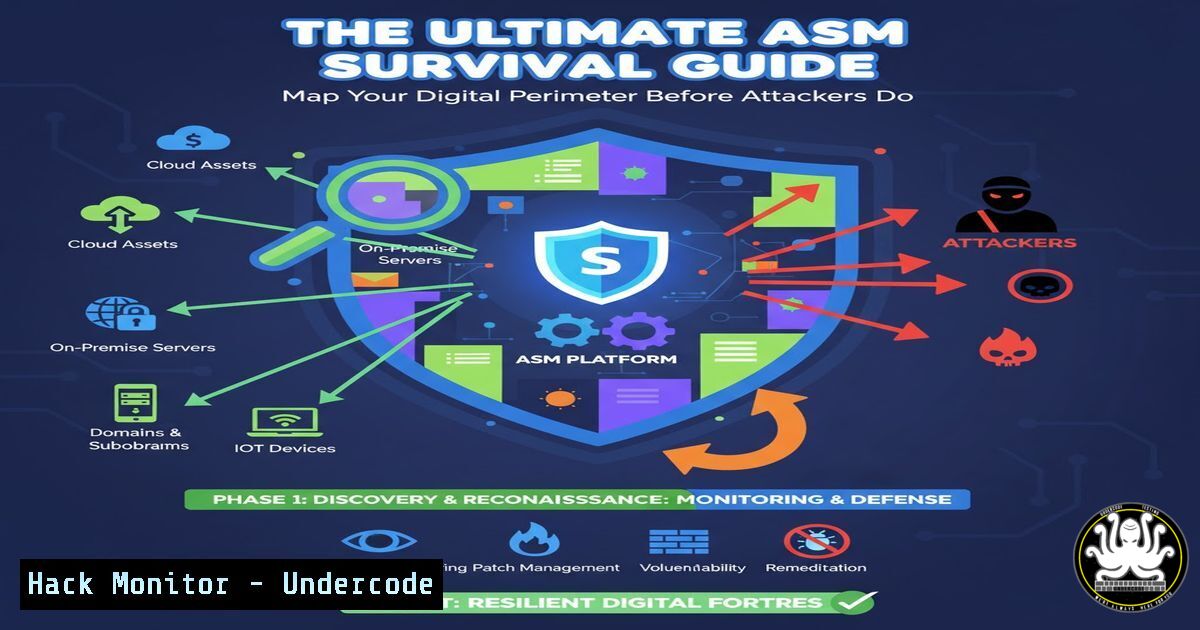
In today’s hyper-connected digital ecosystem, organizations face an ever-expanding attack surface riddled with unknown and unmanaged assets. Attack Surface Management (ASM) has emerged as a critical cybersecurity discipline, transitioning from a niche practice to a foundational security control. This guide provides a technical deep dive into implementing a robust ASM program, moving beyond theoretical concepts to deliver actionable reconnaissance and hardening techniques.
Learning Objectives:
- Master both passive and active reconnaissance methodologies for comprehensive asset discovery
- Implement continuous monitoring and validation of external-facing digital assets
- Apply hardening techniques to reduce exploitable vulnerabilities across discovered assets
You Should Know:
1. Passive Reconnaissance: The Silent Asset Discovery Engine
Passive reconnaissance forms the cornerstone of ASM by allowing security teams to discover assets without sending direct packets to target systems. This stealthy approach avoids detection while building an initial inventory.
 Subdomain enumeration using Amass passive mode
amass enum -passive -d target.com -o amass_passive.txt

Certificate transparency log monitoring with certspotter
certspotter --domain target.com --whois --expired

Shodan host discovery without direct interaction
shodan domain target.com
shodan search "hostname:target.com"

Passive DNS replication analysis
 Using whois for IP range discovery
whois target.com | grep -i "cidr"
Step-by-step guide:
Begin by configuring Amass in passive mode to gather subdomain intelligence from numerous public data sources without generating direct traffic to your target domain. Export results to a text file for analysis. Simultaneously, query certificate transparency logs through CertSpotter to identify subdomains exposed via SSL certificate issuance. Complement these findings with Shodan searches using your organization’s domain to uncover associated IP addresses and services. Finally, perform WHOIS lookups to determine your organization’s allocated IP ranges, providing crucial context for subsequent active scanning phases.
2. Active Scanning: Tactical Target Engagement
While passive methods provide breadth, active scanning delivers depth by directly interrogating discovered assets to verify existence and gather detailed service information.
 Nmap comprehensive discovery scan
nmap -sS -A -T4 -p- -iL discovered_ips.txt -oA nmap_full_scan

Masscan for rapid port scanning across large ranges
masscan -p1-65535 192.168.0.0/16 --rate=1000 -oG masscan_output.txt

HTTP service discovery with Nikto
nikto -h https://target.com -o nikto_scan.html -Format htm

Directory brute-forcing with Gobuster
gobuster dir -u https://target.com -w /usr/share/wordlists/dirb/common.txt -o gobuster_scan.txt
Step-by-step guide:
After compiling assets from passive reconnaissance, initiate structured active scanning. Begin with Nmap using SYN scanning (-sS) with aggressive timing (-T4) across all ports (-p-) against your target IP list (-iL). For larger network ranges, leverage Masscan’s superior speed while maintaining comprehensive port coverage. For discovered web services, conduct vulnerability assessment with Nikto and directory enumeration with Gobuster using common wordlists. This layered approach ensures thorough service discovery while maintaining operational efficiency.
3. Cloud Asset Discovery: Taming the Hybrid Environment
Modern organizations operate across multiple cloud platforms, creating fragmented asset inventories that traditional discovery methods often miss.
 AWS CLI for asset inventory
aws ec2 describe-instances --region us-east-1 --query 'Reservations[].Instances[].PublicIpAddress'
aws s3api list-buckets --query "Buckets[].Name"

Azure CLI for resource enumeration
az vm list -d --query "[].publicIps" -o tsv
az storage account list --query "[].primaryEndpoints.web"

GCP asset discovery
gcloud compute instances list --format="table(EXTERNAL_IP)"
gcloud storage buckets list --format="table(id)"

Cloud-specific vulnerability scanning
prowler aws
scoutsuite --provider aws
Step-by-step guide:
Cloud environments require specialized discovery approaches. Begin by configuring authenticated access to your AWS, Azure, and GCP environments using respective CLI tools. Execute instance enumeration commands to identify publicly accessible cloud resources, paying particular attention to storage services like S3 buckets which are frequently misconfigured. Supplement these findings with cloud-specific security assessment tools like Prowler for AWS or ScoutSuite for multi-cloud auditing to identify misconfigurations and compliance violations across your cloud footprint.
4. API Endpoint Discovery: The Hidden Attack Surface
APIs represent one of the most significant yet overlooked components of modern attack surfaces, requiring specialized discovery techniques.
 API endpoint discovery with Katana
katana -u https://target.com -o katana_api.txt

API security testing with Kiterunner
kr scan https://target.com -w ~/tools/api-wordlists/data/automated/words.txt

Postman for API documentation analysis
 Import OpenAPI/Swagger specifications
postman collection import https://target.com/swagger.json

Burp Suite extension for API discovery
 Using Autorize or API-Doctor extensions
java -jar burpsuite.jar --project-file=api_audit.burp
Step-by-step guide:
API discovery begins with crawling target applications using tools like Katana, which excels at identifying API endpoints through passive analysis and JavaScript parsing. Complement this with Kiterunner, designed specifically for API route discovery using specialized wordlists. For organizations with published API documentation, import OpenAPI/Swagger specifications into Postman for comprehensive endpoint mapping and testing. Finally, leverage Burp Suite extensions tailored for API security to automate discovery during manual testing sessions, ensuring no API endpoint remains undocumented.
5. Vulnerability Correlation: From Discovery to Risk Prioritization
Asset discovery alone provides limited value without contextual vulnerability correlation to drive risk-based prioritization.
 Vulnerability scanning with Nessus
nessus --target-file discovered_assets.txt --scan-name "ASM Scan" --policy "Basic Network Scan"

OpenVAS for open-source vulnerability assessment
openvas-cli --target=discovered_assets.txt --scan-config="Full and fast"

Nuclei for automated vulnerability detection
nuclei -l discovered_assets.txt -t /nuclei-templates/ -o nuclei_results.txt

CVSS scoring calculation and prioritization
 Using cve-search for vulnerability intelligence
cve-search -q "apache tomcat 9.0.0" -o json
Step-by-step guide:
After compiling your comprehensive asset inventory, initiate vulnerability assessment using both commercial and open-source tools. Begin with Nessus or OpenVAS for broad vulnerability detection across discovered assets, then supplement with Nuclei using its extensive template library for targeted detection of specific vulnerabilities. For each identified vulnerability, correlate with CVE databases to determine CVSS scores and exploit availability. This layered approach ensures comprehensive coverage while enabling data-driven prioritization based on actual exploitability and business impact.
6. Continuous Monitoring: The ASM Lifecycle
Attack surfaces evolve continuously, requiring automated monitoring to maintain accurate asset inventories over time.
 OWASP Amass continuous monitoring
amass track -d target.com -config config.ini

ProjectDiscovery CloudWatch for continuous assessment
cloudwatch -d target.com -monitor

Custom monitoring script with cron
!/bin/bash
amass enum -d target.com -o new_scan.txt
diff current_assets.txt new_scan.txt > changes.txt
mv new_scan.txt current_assets.txt

Slack integration for alerting
curl -X POST -H 'Content-type: application/json' --data '{"text":"New asset discovered: '$NEW_ASSET'"}' $SLACK_WEBHOOK
Step-by-step guide:
Implement continuous ASM by configuring OWASP Amass in tracking mode with a configuration file defining monitoring parameters. Schedule regular scans using cron jobs or CI/CD pipelines, with differential analysis to identify net-new assets. Integrate alerting mechanisms through Slack webhooks or email notifications to ensure security teams receive immediate notification of changes. For cloud-native organizations, leverage specialized tools like CloudWatch that provide continuous assessment capabilities tailored to dynamic environments.
7. Attack Surface Reduction: From Discovery to Hardening
Discovery without remediation provides limited security value. Implement systematic hardening based on ASM findings.
 Unnecessary service identification and disablement
systemctl list-unit-files | grep enabled
systemctl disable apache2

Firewall rule hardening with iptables
iptables -A INPUT -p tcp --dport 22 -s 10.0.0.0/8 -j ACCEPT
iptables -A INPUT -p tcp --dport 22 -j DROP

Windows service hardening
Get-WindowsFeature | Where-Object InstallState -eq 'Installed'
Remove-WindowsFeature -Name Web-Server

Cloud security group remediation
aws ec2 revoke-security-group-ingress --group-id sg-123abc --protocol tcp --port 3389 --cidr 0.0.0.0/0
Step-by-step guide:
Systematically review ASM discovery results to identify unnecessary services and exposure points. Begin by auditing enabled services on Linux (systemctl) and Windows (Get-WindowsFeature) systems, disabling non-essential services. Implement restrictive firewall rules using iptables or Windows Firewall to limit access to administrative services. For cloud environments, immediately remediate security groups allowing unrestricted access (0.0.0.0/0) to management ports. This systematic hardening approach directly translates ASM discoveries into concrete risk reduction.
What Undercode Say:
- Comprehensive ASM requires both breadth (passive discovery) and depth (active validation) to be effective
- Continuous monitoring is non-negotiable in dynamic environments where assets change hourly
- Discovery without correlated vulnerability assessment and systematic hardening provides limited security value
The evolution of ASM from periodic assessment to continuous monitoring represents a fundamental shift in cybersecurity strategy. Organizations that master the technical implementation detailed in this guide gain unprecedented visibility into their external exposure, enabling proactive risk management rather than reactive incident response. The most sophisticated ASM programs integrate seamlessly with vulnerability management and patching workflows, creating a closed-loop system where discovery automatically triggers assessment and remediation. As attack surfaces continue to expand through cloud adoption and digital transformation, the technical commands and methodologies outlined here will become increasingly essential components of organizational cybersecurity postures.
Prediction:
ASM will evolve from standalone practice to integrated security control, with AI-driven anomaly detection automatically identifying suspicious assets and misconfigurations. Within two years, we’ll see ASM platforms incorporating predictive analytics to forecast emerging attack vectors based on organizational digital evolution patterns. The convergence of ASM with breach and attack simulation will enable organizations to continuously validate their defensive posture against realistic attack scenarios, fundamentally transforming external risk management from periodic assessment to continuous validation.
🎯Let’s Practice For Free:
IT/Security Reporter URL:
Reported By: Devansh Batham – Hackers Feeds
Extra Hub: Undercode MoN
Basic Verification: Pass ✅


