Listen to this Post
Introduction:
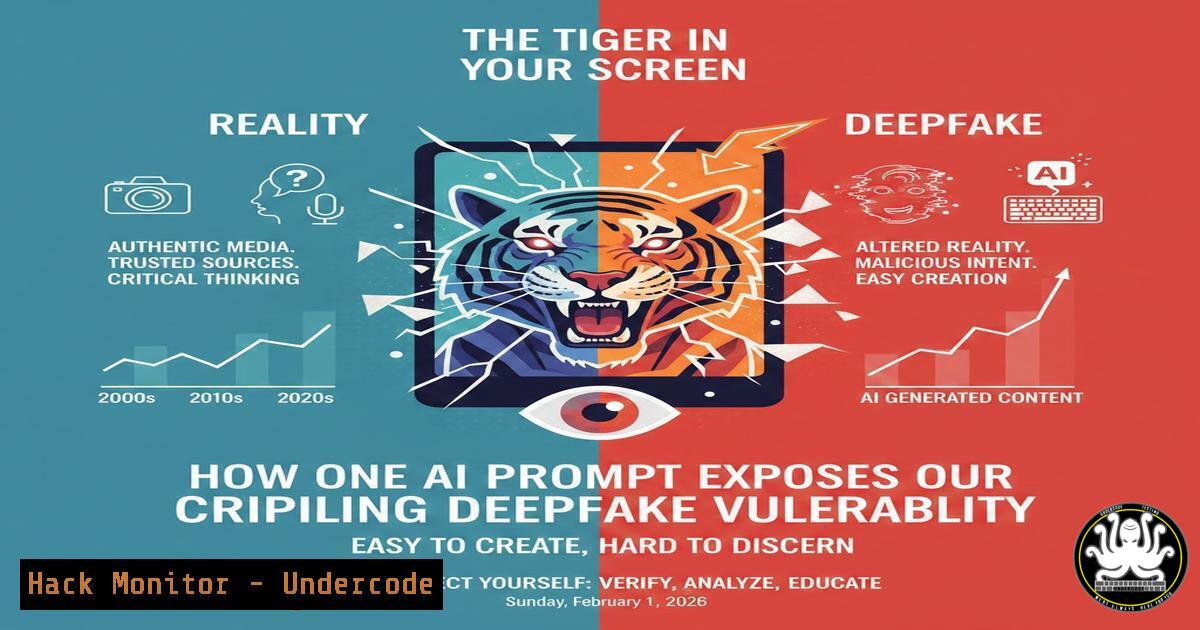
The line between reality and simulation has officially dissolved. A recent demonstration using Google Flow to generate a hyper-realistic, 10-second video of a woman casually interacting with a tiger reveals not just the staggering power of generative AI, but a gaping security threat. This isn’t just a viral curiosity; it’s a blueprint for creating convincing deepfakes with alarming ease, highlighting an urgent need for defensive AI literacy and security protocols in the digital age.
Learning Objectives:
- Decode the structure of an advanced AI video generation prompt and understand its technical components.
- Learn the step-by-step process to create hyper-realistic synthetic media using tools like Google Flow.
- Identify the associated cybersecurity risks, including social engineering, identity fraud, and information warfare.
- Implement basic detection strategies and security hygiene to mitigate deepfake threats.
- Understand the future trajectory of this technology and its implications for IT security.
You Should Know:
1. Deconstructing the Killer More Than Just Words
The provided prompt is a masterclass in structured AI instruction. It doesn’t just describe a scene; it engineers reality by breaking down the input into programmable parameters that the AI model processes.
Step‑by‑step guide explaining what this does and how to use it.
Step 1: Foundation – Scene & Camera. This sets the digital camera specs. “Vlog-style phone selfie mode” dictates lens distortion, sensor noise, and dynamic range. “Handheld, slight shake” introduces Perlin noise algorithms to motion, bypassing the uncanny valley of perfectly stable CGI.
Step 2: Temporal Programming – Action & Timing. “8-10 seconds” is a direct command to the generative model’s frame engine. It choreographs the sequence: subject smile -> dialogue -> tiger entry -> action (lick) -> reaction. This is akin to scripting a timeline in a video editor, but through natural language.
Step 3: Layer Integration – Dialogue & Sound. The spoken dialogue provides a phonetic guide for potential lip-sync generation. The sound design instructions (“subtle wind, tiger growl”) are prompts for a separate audio model that is then composited with the video, creating a multi-modal sensory output.
Step 4: Quality Assurance – Lighting & Mood. Terms like “hyper-realistic,” “natural daylight,” and “true-to-life colors” are quality filters. They guide the model to use its highest-fidelity weights, avoid artistic stylization, and adhere to physical lighting models (like Ray Tracing approximations).
2. The Technical Pipeline: From Prompt to Propaganda
Creating this video is a three-stage technical pipeline: Input Processing, Model Inference, and Output Rendering. Understanding this flow is key to understanding its misuse potential.
Step‑by‑step guide explaining what this does and how to use it.
Step 1: Input Processing & Embedding. Your text prompt is tokenized and converted into numerical embeddings (vectors). Simultaneously, the uploaded photo is encoded into a latent space representation by a Vision Transformer (ViT). These two vectors are concatenated.
Step 2: Diffusion Model Inference. This combined vector guides a diffusion model (like Stable Diffusion Video or a proprietary equivalent). The model iteratively denoises random static, starting from a high-noise state and refining toward an image sequence that maximally matches the prompt and image embeddings. The “8-10 second” timing is controlled by the model’s frame interpolation network.
Step 3: Post-Processing & Output. The raw generated frames pass through upscalers (e.g., ESRGAN) to reach 1080p or 4K resolution. Audio is generated separately by a model like AudioLM or WaveNet and synced. The final file is rendered into a container format like MP4 (H.264 codec).
3. The Attacker’s Playbook: Weaponizing Accessibility
The cybersecurity threat emerges from the democratization of this technology. A malicious actor can use this exact tutorial for social engineering attacks.
Step‑by‑step guide explaining what this does and how to use it.
Step 1: Reconnaissance. An attacker scrapes LinkedIn/Twitter for a target executive’s profile photo and video clips to study mannerisms.
Step 2: Payload Creation. Using Google Flow or a similar tool, they generate a fake video message. The prompt is adjusted: “…CEO looking into camera, speaking urgently: ‘John, I need you to approve the urgent wire transfer to account number XXX immediately. The legal team has cleared it. Do it now.'”
Step 3: Delivery & Exploitation. The deepfake is sent via a compromised email or a fake meeting link. The realism, down to the “handheld shake,” bypasses human suspicion, leading to Business Email Compromise (BEC) or credential phishing.
4. Basic Deepfake Detection for IT Professionals
While detection is an arms race, basic tools can raise red flags. Here’s a practical approach using command-line and cloud tools.
Step‑by‑step guide explaining what this does and how to use it.
Step 1: Metadata Analysis (Fast, Non-Invasive). Use `exiftool` on a downloaded video to check for inconsistencies.
exiftool suspected_video.mp4
Look for mismatches in Create Date, `Software` tags (e.g., generative AI tools), or unrealistically short `Duration` of creation.
Step 2: Forensic Analysis with Python. Use libraries like `face_recognition` to check for anomalies.
import face_recognition
import cv2
video = cv2.VideoCapture("suspected_video.mp4")
success, frame = video.read()
face_landmarks = face_recognition.face_landmarks(frame)
 AI-generated faces often have subtle asymmetries in landmarks or unnatural blinking patterns.
Step 3: Leverage Cloud AI APIs. Use dedicated deepfake detection APIs (e.g., Microsoft Video Authenticator, AWS Fake Media Detection – in preview) for a probability score.
5. Hardening Human Defenses: Security Policy & Training
Technology alone fails; human processes are critical. Integrate deepfake awareness into security protocols.
Step‑by‑step guide explaining what this does and how to use it.
Step 1: Implement a Verification Protocol. Mandate that all financial or sensitive requests transmitted via video must be confirmed through a separate, pre-established channel (e.g., a phone call using a known number, a Signal message).
Step 2: Conduct Phishing Drills with Deepfakes. Include synthetic media in your security awareness training. Show employees examples like the tiger video to illustrate the threat.
Step 3: Technical Controls. Enforce email rules that flag external emails containing video links. Use DNS filtering to block known AI video generation tool domains on corporate networks if not required for business.
- The Future is Synthetic: Preparing for Next-Gen Threats
This technology will evolve from generating tigers to perfectly replicating colleagues in real-time video calls.
Step‑by‑step guide explaining what this does and how to use it.
Step 1: Anticipate Real-Time Deepfakes. Prepare for “live phishing” via platforms like Zoom. The defense is a shared secret (a quickly-changing visual token in the background) or biometric liveness detection requiring a physical turn or wave.
Step 2: Invest in Cryptographic Attestation. Support and advocate for standards like the Coalition for Content Provenance and Authenticity (C2PA), which cryptographically signs media at the device level. Tools will soon verify a media’s “birth certificate.”
Step 3: Develop AI Incident Response Plans. Just as you have a plan for ransomware, create a playbook for responding to a deepfake incident targeting your brand or executives, including crisis communications and technical takedown procedures.
What Undercode Say:
- The Barrier to Entry for Advanced Disinformation is Now Zero. The technical skill required to create a convincing deepfake has collapsed from “nation-state actor” to “motivated individual with a good tutorial.” This represents a paradigm shift in the threat landscape.
- Defense Must Focus on Process, Not Just Detection. The detection arms race is ultimately unwinnable as generative models improve. The primary defense layer must become procedural security—verification protocols, zero-trust communication channels, and trained skepticism. The technology is a tool; the real vulnerability is the inherent trust we place in audiovisual media.
Prediction:
Within 18-24 months, we will see the first major corporate heist or successful geopolitical influence operation directly attributable to a bespoke, AI-generated deepfake video. This will trigger a regulatory scramble, leading to mandated C2PA-style watermarking for all enterprise communication tools and the rise of “digital notary” services. Simultaneously, an entire cybersecurity sub-sector will emerge focused on synthetic media detection and provenance, integrated directly into email gateways, video conferencing systems, and social media platforms. Organizations that fail to adopt AI-specific security hygiene will face catastrophic reputational and financial damage, making AI literacy as fundamental as firewall configuration.
▶️ Related Video (80% Match):
🎯Let’s Practice For Free:
IT/Security Reporter URL:
Reported By: Poonam Soni – Hackers Feeds
Extra Hub: Undercode MoN
Basic Verification: Pass ✅


