Listen to this Post
Introduction:
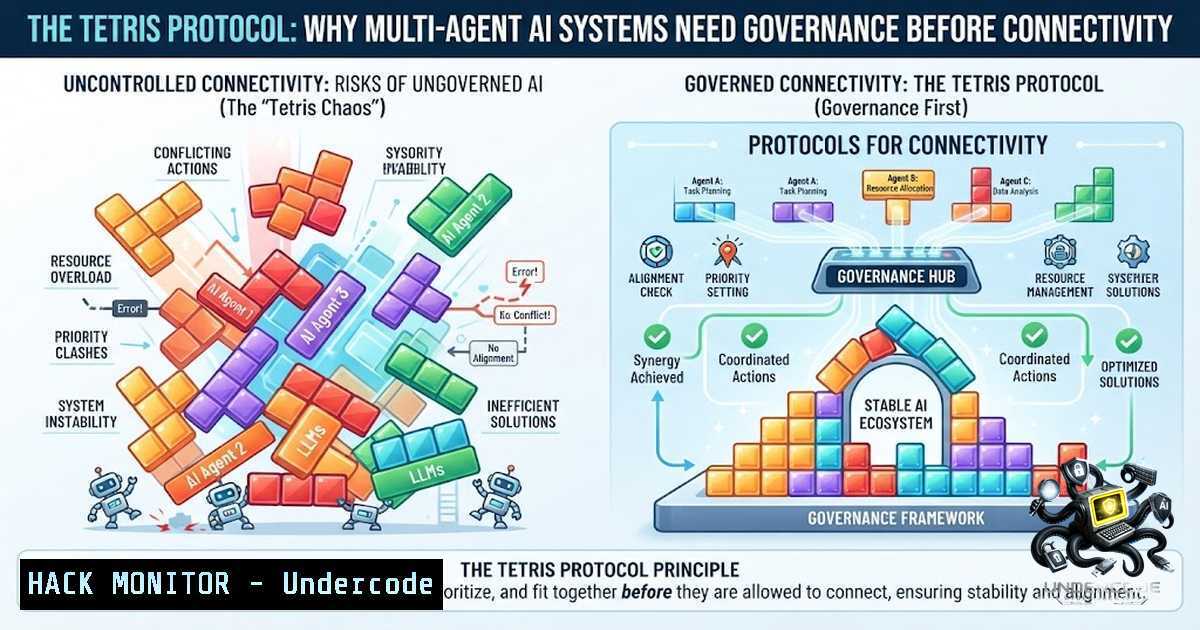
In the rapidly evolving landscape of artificial intelligence, building a single functional agent is a feat of engineering. However, the true challenge—and the source of systemic risk—emerges when these agents must interact, share information, and execute tasks collaboratively. As organizations rush to deploy multi-agent architectures, the industry is learning a hard lesson from a 40-year-old video game: a connection that fits is not necessarily a connection that should be built.
Learning Objectives:
- Understand the architectural prerequisites for secure multi-agent communication beyond simple API connectivity.
- Analyze the role of state, authority, and admissibility gates in preventing cascading failures.
- Apply forensic principles and observability (receipts and logs) to diagnose system failures proactively.
You Should Know:
- The Tetris Fallacy: Fitting Does Not Mean Safe
In the classic game, a piece fits because its shape matches an empty space. In multi-agent systems, however, “fit” requires a quad-vector analysis: the shape (data structure), the information (context), the task (purpose), and the permissions (authorization). A connection that passes a schema validation might still violate a policy constraint. For instance, a financial reporting agent might perfectly parse a data payload from a marketing agent, but if the marketing agent’s credentials lack the “executive_clearance” attribute, the data should be rejected—not processed.
To implement this, we move beyond simple API gateways. Instead, we need an Admissibility Gate that checks all four vectors before passing the payload to the next agent.
Step‑by‑step guide on how to build a basic admissibility gate in Python:
- Define the schema: Use Pydantic to enforce data shape.
- Encode the context: Include a `task_context` header containing the current project scope.
- Check authority: Query a local LDAP or OAuth2 token endpoint to verify the source agent’s roles.
- Validate permissions: Use a policy-as-code tool like OPA (Open Policy Agent) to evaluate if the action is allowed.
- Return a receipt: If the gate closes, log the event. If it opens, issue a cryptographic receipt (hash) that the downstream agent can verify.
Example Linux Command for OPA Policy Check:
opa eval --data ./policy.rego --input input.json "data.auth.allow"
If the system does not pass, the gate returns `”decision”: “deny”` and logs the violation to a security information and event management (SIEM) system.
- The State Problem: When Memory Becomes a Weapon
In the article, Ricky Jones mentions that “some blocks mutate the board so badly that everything downstream gets harder.” This is the state poisoning vector. In stateless APIs, the risk is limited. But in multi-agent systems, agents often share a state store (e.g., Redis or a database) to coordinate. If Agent A writes a state change that is logically correct but contextually dangerous (e.g., marking a “pending” transaction as “completed” prematurely), Agent B will operate on a corrupted reality.
Step‑by‑step guide to implementing State Immutability Patterns:
- Version the state: When Agent A updates a key, it increments the version number.
- Enforce conditional updates: Agent B must provide the current version number to apply its update.
- Maintain a state journal: Instead of overwriting the state, write a new row with a new timestamp.
- Rollback capabilities: If the downstream task fails, the system can revert to the previous state by reading the journal.
- Monitor delta changes: Use `redis-cli –monitor` to watch for suspicious write patterns.
Windows PowerShell Command for Monitoring State Changes:
Get-Content C:\StateLogs\journal.txt -Wait | Select-String "UPDATE"
If you see an update without a corresponding version check, you have a vulnerability.
3. Permission Continuity and the “Broken Transition”
A common mistake is granting initial access (OAuth) and assuming it covers all subsequent steps. The “permission must fit” condition dictates that permissions must persist and adapt across the task lifecycle.
Consider an agent that retrieves a file from S3 and passes it to a classification agent. The classification agent needs permissions to read the file, but it does not need permission to delete the file. The connection is broken if the classification agent inherits the S3 delete permission via a temporary role.
Step‑by‑step guide to implementing Minimal Permissions using AWS IAM (or equivalent):
- Identify the task boundary: Define the exact action and resource.
- Create a specific role: Do not use a generic “admin” or “power_user” role for the agent.
- Attach the policy: Use the principle of least privilege.
- Use Attribute-Based Access Control (ABAC): Tag the request with the
task_id. - Validate the token: In the API gateway, ensure the `Bearer` token contains the `task_id` claim.
Code Snippet (Linux) for validating a JWT token claims:
jq -R 'split(".") | .[bash] | @base64d | fromjson' <<< $JWT_TOKEN
Check that the `permissions` array contains `[“read”]` but not ["delete"].
4. Refusal Behavior: The Art of Saying No
One of the most critical security features in a multi-agent system is the ability to refuse a task gracefully. In the article, “refusal behaviour” is cited as a core component of governance. If an agent receives a request that exceeds its computational budget or violates a safety boundary, it must say “no” and provide a reason.
Step‑by‑step guide to enabling refusal behavior:
- Define safety bounds: Implement a `check_safety()` function that evaluates the input.
- Circuit breakers: If Agent B receives too many requests from Agent A, trigger a circuit breaker.
- Fallback responses: The refusal should include a structured error code (e.g.,
ERR_REFUSED_BUDGET). - Human-in-the-loop: For critical refusals, escalate to a UI where an admin can override or analyze.
- Audit the refusals: Refusal logs are gold for tuning the system.
Logging Refusals in Linux:
Ensure your system is logging to `/var/log/agent_refusals.log` using `rsyslog` or `syslog-1g` with a filter.
5. The Forensic Value of a Crash
Ricky Jones emphasizes: “A failed connection is not rubbish. It is evidence.” This is the principle of Retrospective Observability. Instead of hoping the system never crashes, we design the system to generate high-fidelity receipts when it does.
Step‑by‑step guide to forensic logging:
- Correlation IDs: Pass a unique `X-Request-ID` through all agents.
- Span tags: In OpenTelemetry, add tags like
agent.source,agent.destination, andpayload.hash. - Store the full payload: For a short period (e.g., 7 days), store the exact payload that caused the crash in a secure bucket.
- Replayability: Build a tool to replay the payload against the agent in a sandbox to diagnose the “gap.”
- Generate a “Crash Report”: Include the state vector, the task conditions, and the permission snapshot.
Wireshark / tcpdump command to capture inter-agent traffic:
tcpdump -i eth0 -w agent_traffic.pcap
Analyze this to see if the payload was malformed or if the connection timed out due to network constraints.
6. Orchestration vs. Choreography: The Governance Control Plane
The Tetris board represents a complex environment. To manage this, you need a control plane that sits outside the agents and enforces the rules. This is the difference between Choreography (agents talk directly) and Orchestration (a central controller manages the workflow).
Step‑by‑step guide to setting up a governance control plane:
- Deploy a Message Broker: Use Apache Kafka or RabbitMQ to route messages.
- Intercept and Validate: The broker validates the message against the “admissibility gates” before routing.
- Service Mesh: Implement an Istio or Linkerd service mesh to enforce mutual TLS (mTLS) and authentication between agents.
- Policy Engine: Deploy OPA as a sidecar container to enforce decisions locally.
- Audit Logging: The broker logs every message attempt, success, and failure.
Kubectl Command for checking mTLS status in Kubernetes:
kubectl exec -it pod/agent-a -- curl -v https://agent-b:8080/health
Look for the `X-Forwarded-Client-Cert` header.
7. Cloud Hardening: The Infrastructure behind the Board
The agents exist somewhere—likely in the cloud. Securing the cloud infrastructure is paramount. If the underlying VPC is open, all the application-layer governance is moot.
Step‑by‑step guide to securing the cloud environment:
1. Network segmentation: Place agents in private subnets.
- Security Groups: Only allow ingress from the specific IPs of the other agents or the load balancer.
- Secrets Management: Use AWS Secrets Manager or HashiCorp Vault to store API keys. Do not hardcode them.
- Container Scanning: Scan the agent Docker images for vulnerabilities using `trivy` or
snyk. - Integrity Monitoring: Ensure the agent code hasn’t been tampered with.
Linux command to scan a Docker image for vulnerabilities:
trivy image my-agent:latest
What Undercode Say:
- Key Takeaway 1: “Multi-agent security is not a feature; it is a constraint that must be designed into the shape of the connection. Failing to define the boundaries of ‘fit’ leaves the system open to logic bombs and data poisoning.”
- Key Takeaway 2: “Observability is the most critical aspect of governance. You cannot control what you cannot see, and you cannot secure what you do not audit. The ‘receipts’ are the difference between an incident response and a post-mortem without evidence.”
Analysis:
The Tetris metaphor brilliantly demystifies the complexity of multi-agent systems. It forces engineers to think about geometry (structure), color (context), and gravity (enforcement). The core insight is that security must be embedded in the communication protocol itself, not applied as a layer on top. The emphasis on failure as evidence is a call for a forensic mindset in AI engineering. In an era where AI agents are black boxes, this approach advocates for a transparent, audit-trail-heavy methodology that allows for debugging and accountability. The technical implementation—from OPA to OpenTelemetry—supports a rigorous, policy-as-code culture that is essential for enterprise-grade AI.
Prediction:
- -1: The industry will see a wave of “agent-sprawl” breaches in the next 18 months. Organizations will prioritize connecting agents for speed, neglecting the admissibility gates, leading to data leaks between agents that share a common memory cache.
- +1: This will inevitably lead to the standardization of “Agent Governance Protocols” (AGP). We will see the rise of open-source projects dedicated to permission continuity, similar to OAuth but specifically for inter-agent communication.
- +1: The ability to generate and analyze refusal logs will become a competitive differentiator. Companies that can prove their agents refuse dangerous tasks will gain an edge in regulated industries (finance, healthcare) over those that prioritize connectivity at all costs.
- -1: The “state mutation” problem will become the new SQL injection. Attackers will shift from exploiting code to exploiting the state of the agents, using poorly validated transitions to cause cascading failures that crash entire workflows.
- +1: This threat will accelerate the adoption of immutable, event-sourced architectures in AI, where the state is never overwritten but appended, making “rollbacks” a standard recovery mechanism.
▶️ Related Video (86% Match):
🎯Let’s Practice For Free:
🎓 Live Courses & Certifications:
Join Undercode Academy for Verified Certifications
🚀 Request a Custom Project:
Secure, high-velocity infrastructure and disruptive technological engineering. Contact our engineering team for high-tier development and proprietary systems:
[email protected]
💎 Smart Architecture | 🛡️ Secure by Design | ⭐ Trusted by Thousands
IT/Security Reporter URL:
Reported By: Ricky Jones – Hackers Feeds
Extra Hub: Undercode MoN
Basic Verification: Pass ✅


