
Listen to this Post
Introduction:
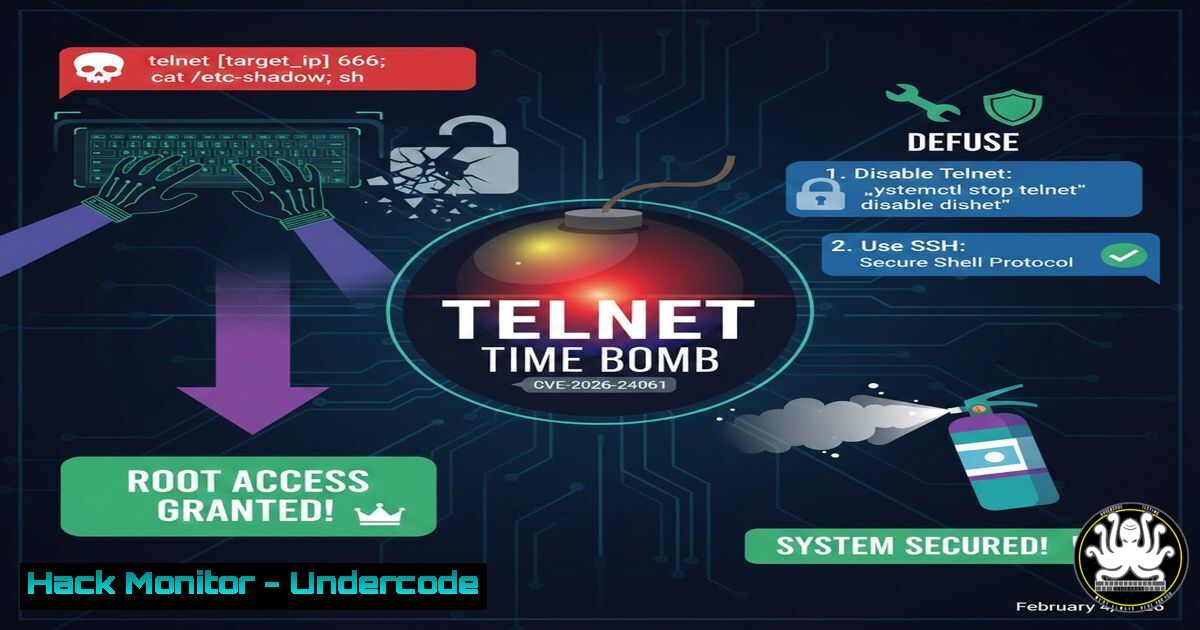
A recently disclosed critical vulnerability, CVE-2026-24061, has exposed the profound dangers of legacy protocols in modern networks. This flaw in GNU telnetd, a service that should have been retired decades ago, allows unauthenticated attackers to gain complete root control of a system with a single, simple command. This incident serves as a stark case study in argument injection attacks and the non-negotiable imperative of network hygiene.
Learning Objectives:
- Understand the mechanism of the argument injection exploit in GNU telnetd (CVE-2026-24061).
- Learn how to detect and eradicate vulnerable Telnet services across Linux and Windows environments.
- Implement modern, secure alternatives and hardening techniques to protect remote access.
You Should Know:
1. The Anatomy of a No-Click Root Exploit
The core of CVE-2026-24061 is an argument injection vulnerability. The Telnet protocol allows a client to send a suggested username to the server. The vulnerable `telnetd` service improperly handles this input, allowing the specially crafted username to break out of its intended argument and inject the `-f root` option into the login process. This option forces an automatic login as root, bypassing any authentication.
Step-by-Step Guide to Understanding the Exploit:
Step 1: Reconnaissance. An attacker scans for open ports, typically port 23, using tools like nmap.
nmap -p 23 192.168.1.0/24
Step 2: Crafting the Malicious Payload. Instead of a normal username, the attacker injects the switch `-f root` as part of the `USER` environment variable command.
Step 3: Execution. The attack is launched from a system with a vulnerable telnet client that allows this variable setting.
USER=' -froot' telnet <target_ip>
The space before `-froot` is critical; it terminates the original `USER` argument and allows the injection of a new command-line switch for the underlying `login` program, granting an immediate root shell.
2. Detecting and Eradicating Telnet on Linux Systems
Telnet is rarely a default installation on modern Linux distros, but it persists in embedded systems, old servers, and poorly maintained infrastructure.
Step-by-Step Guide to Removal and Hardening:
Step 1: Check for Installation.
systemctl status telnet.socket  Check if systemd service is active
dpkg -l | grep telnetd  Debian/Ubuntu
rpm -qa | grep telnetd  RHEL/CentOS/Fedora
Step 2: Uninstall Telnet Server & Client.
 Debian/Ubuntu
sudo apt purge telnetd telnet -y
 RHEL/CentOS/Fedora
sudo yum remove telnet-server telnet -y
Step 3: Verify Port 23 is Closed.
sudo netstat -tlnp | grep :23
sudo ss -tlnp | grep :23
Step 4: Block at the Firewall (IPTables).
sudo iptables -A INPUT -p tcp --dport 23 -j DROP
sudo iptables-save > /etc/iptables/rules.v4  Persist rules
3. Finding and Disabling Telnet on Windows Environments
Windows systems, especially older versions or specific server roles, may have the Telnet Server feature enabled.
Step-by-Step Guide for Windows:
Step 1: Check Telnet Server Status.
Get-WindowsFeature -Name Telnet-Server  In PowerShell as Admin
Get-Service -Name TlntSvr  Check service status
Step 2: Disable and Remove the Feature.
Disable-WindowsOptionalFeature -Online -FeatureName TelnetServer  For client OS
Uninstall-WindowsFeature -Name Telnet-Server -Remove  For Windows Server
Stop-Service TlntSvr -Force; Set-Service TlntSvr -StartupType Disabled
Step 3: Block with Windows Defender Firewall.
New-NetFirewallRule -DisplayName "Block Telnet (TCP 23)" -Direction Inbound -Protocol TCP -LocalPort 23 -Action Block
4. Deploying Secure Alternatives: SSH with Key-Based Auth
Replacing Telnet with SSH (Secure Shell) is the fundamental mitigation. SSH encrypts all traffic and supports robust authentication.
Step-by-Step Guide to Basic SSH Hardening:
Step 1: Install OpenSSH Server.
sudo apt install openssh-server -y  Debian/Ubuntu
sudo yum install openssh-server -y  RHEL/CentOS
Step 2: Disable Password Authentication & Root Login.
Edit `/etc/ssh/sshd_config`:
PermitRootLogin no
PasswordAuthentication no
PubkeyAuthentication yes
Step 3: Use Key-Based Authentication.
Generate a key pair on your client and copy the public key to the server.
ssh-keygen -t ed25519 -f ~/.ssh/id_ed25519
ssh-copy-id -i ~/.ssh/id_ed25519.pub user@server_ip
Step 4: Restart SSH Service.
sudo systemctl restart sshd
5. Vulnerability Management and Continuous Monitoring
Reliance on outdated software is a systemic risk. A proactive stance is required.
Step-by-Step Guide to Proactive Management:
Step 1: Implement Asset Discovery. Use tools like `nmap` or advanced network scanners to create an inventory of all systems and services, flagging any listening on port 23.
Step 2: Enforce Policy with Configuration Management. Use Ansible, Puppet, or Chef to ensure Telnet packages are absent and SSH configurations are hardened across all managed nodes.
 Example Ansible task to remove telnet
- name: Ensure telnet is absent
apt:
name: telnetd
state: absent
Step 3: Integrate with a Vulnerability Scanner. Use tools like OpenVAS, Nessus, or Qualys to regularly scan your network. They will automatically flag CVE-2026-24061 and other critical vulnerabilities.
What Undercode Say:
- Legacy Code is a Live Threat: This exploit isn’t a complex memory corruption flaw; it’s a simple logic bug in a decades-old service. It underscores that any retained legacy system, especially one handling authentication, is a potential catastrophe waiting for its CVE.
- The Perimeter is Every Listening Port: Modern defense-in-depth strategies mean nothing if a single, forgotten Telnet instance is left exposed on an internal or external interface. Attackers pivot from these initial footholds.
Analysis: CVE-2026-24061 is less about a novel hacking technique and more about a failure of basic IT governance. The persistence of Telnet in 2026 is an indictment of legacy system management and lack of proactive sunsetting policies. The attack’s simplicity (CVSS 9.8) means script kiddies and automated bots will weaponize it rapidly, targeting everything from enterprise IoT devices to outdated servers. Defending against it is technically trivial (disable Telnet), but the real challenge is organizational: enforcing strict service policies, maintaining accurate asset inventories, and cultivating a security culture that questions the continued use of any unencrypted protocol.
Prediction:
The exploitation of CVE-2026-24061 will accelerate the forced modernization of industrial control systems (ICS), medical devices, and legacy hardware where Telnet is often hard-coded as a “service interface.” We will see a spike in ransomware and botnet infections originating from these neglected assets. Consequently, regulatory frameworks (like NIST, ISO 27001, and sector-specific guidelines) will introduce stricter audits and penalties for the use of known-insecure protocols. This CVE will become a canonical example in compliance reports, used to justify budgets for legacy system replacement projects and more aggressive internal attack surface management tools.
▶️ Related Video (74% Match):
🎯Let’s Practice For Free:
IT/Security Reporter URL:
Reported By: Blendi Ferizi – Hackers Feeds
Extra Hub: Undercode MoN
Basic Verification: Pass ✅


