
Listen to this Post
Introduction:
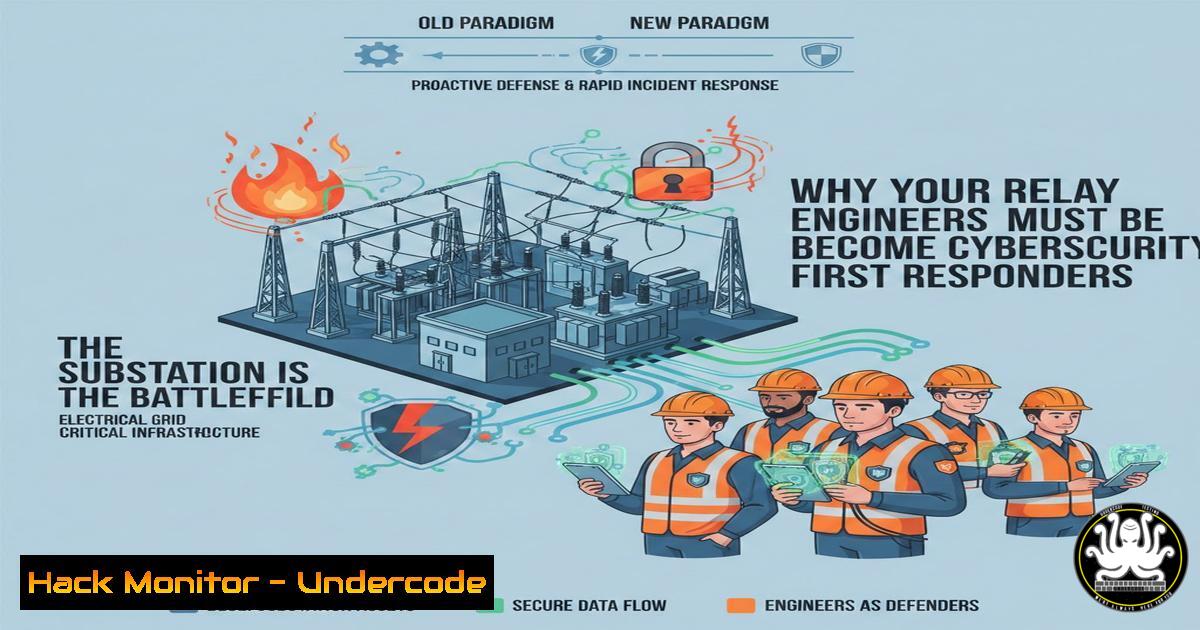
For decades, the operational technology (OT) within electric utilities operated under a sacred covenant: prioritize availability and physical safety above all else. In an environment where a misstep can cause a blackout or a fatality, network confidentiality seemed like an abstract IT concern. However, the convergence of digital substations and intelligent electronic devices (IEDs) has fundamentally rewritten the risk equation. In the modern utility, a cyber intrusion is no longer a data breach; it is a direct threat to human life and grid stability. Building a culture where protection engineers view themselves as the first line of cyber defense is not a compliance checkbox—it is an operational imperative.
Learning Objectives:
- Understand why traditional IT incident response tactics can be dangerous when applied to live OT environments.
- Implement practical port security and network segmentation strategies for substation assets.
- Reframe cybersecurity messaging to resonate with safety-focused engineering teams.
- Execute a hybrid IT/OT tabletop exercise to expose communication gaps.
- Apply configuration hardening techniques for IEDs and industrial switches.
You Should Know:
- The “Safety First” Framing: Translating Cyber Risk into Physical Consequence
The fastest way to lose a protection engineer’s attention is to talk about compliance. The fastest way to earn it is to explain how a malicious actor can physically disable their relays. Historically, engineers trusted the air gap and the padlock. Today, a relay’s tripping function can be triggered remotely if an attacker compromises the network.
To build this mindset, we must map cyber kill chains to physical outcomes. For example, the 2015 Ukraine power grid attack was not just a “data breach”; it was a series of remote commands that opened breakers, leaving 230,000 people without power.
Step‑by‑step guide: Simulating a Command Injection on a Protection Relay (Lab Environment)
Note: This is for educational understanding only. Never perform this on a live grid.
- Environment Setup: Use a virtualized environment like the “Grid Protection Alliance” simulator or a hardware lab with a decommissioned SEL-351 relay.
- Network Discovery: From an attacker’s perspective, you would first scan the substation network.
Linux Command: `sudo nmap -sS -p 502,20000 192.168.1.0/24` (Port 502 is Modbus, 20000 is often used for SEL protocols). - Protocol Analysis: Use a tool like Wireshark to capture traffic between the HMI and the relay. Filter for `modbus` or specific vendor protocols.
- Crafting the Payload: Using a Python script with the `pymodbus` library, attempt to write to a coil (breaker control).
from pymodbus.client.sync import ModbusTcpClient client = ModbusTcpClient('192.168.1.100', port=502) Writing a value of 0 (open) to coil address 1 (e.g., Breaker 1) client.write_coil(1, False) False = Open/Trip client.close() - The Lesson: Show the engineering team the physical result (LED indicators on the relay changing, or simulated breaker opening in software). This demonstrates that cybersecurity is not about protecting spreadsheets; it’s about protecting the physical switching logic.
2. Tabletop Exercises: Bridging the IT/OT Communication Gulf
The post highlights a critical scenario: a ransomware alert hits the same time a protection system fails. In a real incident, the IT team’s instinct is to “isolate the network immediately.” However, if that network segment is carrying GOOSE (Generic Object Oriented Substation Event) messages for fault clearing, isolating it could blind the protection scheme.
Step‑by‑step guide: Facilitating a Hybrid Tabletop Exercise
- Scenario Creation: Write a one-page scenario. Example: “A technician plugs a laptop into a substation switch for diagnostics. Unknown to them, the laptop is infected with a worm that begins scanning for SMBv1 vulnerabilities. Simultaneously, a tree falls on a transmission line, causing a voltage sag.”
2. Role Assignment:
- IT Team: Manage the worm, stop the spread.
- OT Team: Manage the voltage sag, ensure breakers operate correctly.
- Facilitator: Injects complications.
- The Critical Question: Ask the IT team: “We need to contain this worm. What is your first step?” (Likely: Shut down the switch ports).
- The OT Interjection: Ask the OT team: “If that switch port is shut down, what happens to the communications between the relay and the breaker?” (Answer: Loss of protection).
- Resolution Path: The exercise must force them to collaborate on a solution—perhaps using a firewall rule to block SMBv1 (Port 445) while allowing IEC 61850 GOOSE traffic (multicast MAC addresses) to pass. This teaches that “isolation” in OT is surgical, not blunt.
3. Port Management Culture: Hardening the Digital Switchyard
The post compares an open Ethernet port to an unauthorized switching operation. Technicians must understand that plugging an unknown device into a substation switch bypasses physical security and creates a direct logical path to the relay. This requires technical controls to enforce the culture.
Step‑by‑step guide: Implementing Port Security on Industrial Switches (Cisco IE Series)
- Identify Critical Ports: Determine which switch ports connect to IEDs, relays, and RTUs.
2. Enable Port Security:
Enter configuration mode:
`Switch configure terminal`
`Switch(config) interface gigabitethernet1/1`
Set the maximum MAC addresses allowed on this port (usually 1 for a relay):
`Switch(config-if) switchport port-security maximum 1`
Set the action if a violation occurs (Protect, Restrict, or Shutdown). ‘Shutdown’ is the most secure but requires manual intervention.
`Switch(config-if) switchport port-security violation shutdown`
Enable the feature:
`Switch(config-if) switchport port-security`
- Sticky MAC Learning: Allow the port to learn the connected device’s MAC address dynamically and add it to the running config.
`Switch(config-if) switchport port-security mac-address sticky`
- Apply 802.1X for Advanced Control: For environments requiring authentication before access, configure 802.1X. The switch acts as an authenticator, and the IED must have a supplicant or be authenticated via MAC Authentication Bypass (MAB).
`Switch(config-if) authentication port-control auto`
`Switch(config-if) dot1x pae authenticator`
- Asset Inventory and Baselining: Knowing What “Normal” Looks Like
You cannot protect what you cannot see. A strong OT culture relies on passive monitoring to establish a baseline of network traffic. Anomalies (like a relay suddenly communicating with an external IP) indicate compromise or misconfiguration.
Step‑by‑step guide: Passive Asset Discovery using Linux Tools
- SPAN Port Setup: Configure your substation switch to mirror all traffic from the relay VLAN to a monitoring port. Plug a Linux machine into that port.
- Capture Traffic: Use `tcpdump` to capture traffic to a file for analysis.
Bash Command: `sudo tcpdump -i eth0 -w substation_baseline.pcap`
- Extract Endpoints: Use `tshark` to list all unique IP addresses in the capture.
Bash Command: `tshark -r substation_baseline.pcap -T fields -e ip.src -e ip.dst | sort | uniq`
4. Protocol Deep Dive: Check for unexpected protocols. You should primarily see IEC 61850 (MMS, GOOSE), Modbus/TCP, or DNP3. Seeing HTTP or SMTP is a red flag.
Bash Command: `tshark -r substation_baseline.pcap -T fields -e ip.proto -e tcp.port | grep -E “80|443|25″`
5. Patch Management and Virtual Patching in OT
Unlike IT, you cannot patch a live relay every Tuesday. Culture means accepting that risk must be managed via alternative methods until maintenance windows align.
Step‑by‑step guide: Implementing Virtual Patching via Firewall Rules
If a vulnerability is announced in the Modbus stack of a specific relay, and you cannot patch it for 3 months:
1. Identify the Communication Path: Determine which HMIs or engineering workstations need to talk to that relay.
2. Create a Whitelist Rule: On the substation firewall or switch ACL, allow traffic only from those specific source IPs.
Cisco ACL Example:
`Switch(config) access-list 101 permit tcp host 10.10.1.10 host 10.10.1.50 eq 502`
`Switch(config) access-list 101 deny tcp any host 10.10.1.50 eq 502`
`Switch(config) access-list 101 permit ip any any` (Apply this inbound to the relay interface).
3. Logging and Monitoring: Ensure the implicit deny rule is logged. This allows the security team to see if anyone (or any malware) is trying to exploit the vulnerable relay.
What Undercode Say:
- Culture is Configuration: The greatest firewall in the world fails if a technician plugs a rogue laptop into a relay port to “quickly test something.” Training must focus on the physical consequences of logical actions.
- Speak the Language of Operations: Cybersecurity professionals working in utilities must abandon IT jargon. Frame security controls as “protection scheme integrity” rather than “data confidentiality” to get buy-in from veteran engineers.
Prediction:
The next major grid disturbance will not be caused by a nation-state exploiting a zero-day, but by a safety-focused engineer disabling a security control to perform an emergency restoration, unknowingly opening the door for commodity malware. The industry will shift from “awareness training” to “cyber safety cross-training,” where protection engineers and incident responders are cross-certified, ensuring that during a crisis, both safety and security protocols are followed simultaneously.
▶️ Related Video (80% Match):
🎯Let’s Practice For Free:
IT/Security Reporter URL:
Reported By: Robertoherreralara Securityculture – Hackers Feeds
Extra Hub: Undercode MoN
Basic Verification: Pass ✅


