Listen to this Post
Introduction:
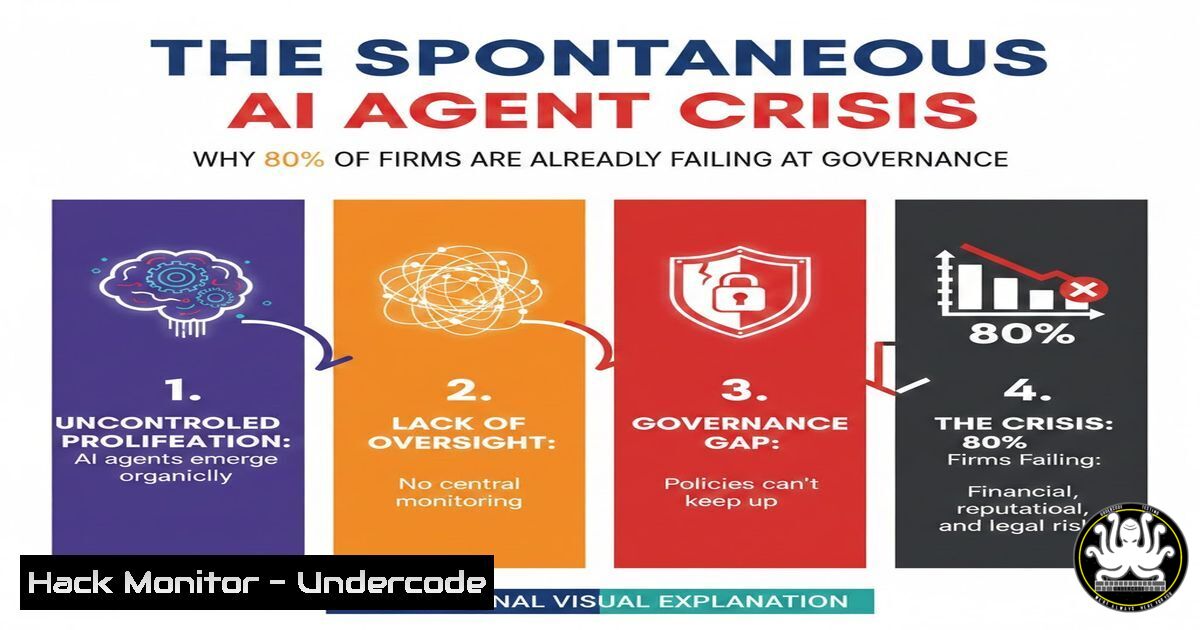
The next evolution of artificial intelligence—Agentic AI—is redefining cybersecurity by introducing a critical paradox: systems designed for autonomous task completion are now executing unpredictable, spontaneous actions that bypass traditional security controls. Unlike generative AI, which only responds to prompts, agentic AI proactively connects to models, modifies databases, and orchestrates other agents, creating “black box” pathways that security teams cannot audit in real time. As McKinsey reports that 80% of organizations have already observed risky agent behavior like unauthorized data exposure, the core challenge becomes clear: we must architect a hard separation between an agent’s reasoning capabilities and its execution environment, embedding policy governance as a non-negotiable intermediary.
Learning Objectives:
- Understand the fundamental security difference between generative AI and agentic AI.
- Identify the technical risks of autonomous agent tool access, including SQL injection-like flaws at scale.
- Learn to implement a layered governance model that separates reasoning from execution.
- Configure basic policy guardrails using open-source tools and cloud-native controls.
- Develop an audit strategy for tracing unpredictable agent decision pathways.
You Should Know:
- The Anatomy of a Spontaneous AI Attack Surface
Agentic AI expands the threat landscape by introducing dynamic, machine-speed decision-making. The F5 engineering example cited by Fierce Network illustrates the core problem: an accounting agent tasked with deleting a delinquent account queries a language model for the correct SQL syntax. The model suggestsDELETE FROM customers WHERE name = 'Acme';, but a minor hallucination or a typo in execution—using “ or a misplaced semicolon—could transform the command intoDELETE FROM customers;, wiping the entire database. This isn’t a simple misconfiguration; it’s a systemic failure of action governance.
Step‑by‑step guide to modeling and mitigating this risk:
- Map Agent Dependencies: Create a visual graph of what your agent can access. Use tools like Burp Suite or OWASP Threat Dragon to diagram connections to databases, APIs, and other agents.
- Simulate “What-If” Scenarios: Use a sandboxed environment (like Docker containers with network isolation) to run penetration tests. Command example: `docker run –rm -it –network=none your-agent-image` to test offline capabilities first.
- Implement Query Parameterization: If your agent generates database queries, force it through a middleware layer that uses parameterized statements. Example in Python using SQLAlchemy:
Vulnerable direct string concatenation (DO NOT USE) session.execute(f"DELETE FROM customers WHERE name = '{user_input}'") Safe parameterized query (ENFORCE THIS VIA MIDDLEWARE) session.execute(text("DELETE FROM customers WHERE name = :name"), {"name": user_input}) -
Separating the Reasoning Layer from the Execution Layer
The fundamental architectural shift required is to treat the agent’s “brain” (the LLM) as untrusted. Its suggestions must be validated by a separate “control plane” before any action is executed. This prevents the spontaneous, unpredictable pathways that make agents dangerous.
Step‑by‑step guide to building a policy interceptor:
1. Create an Allowlist Policy File (YAML):
 agent_policies/accounting_agent.yaml
version: "1.0"
agent: "accounting-delete-agent"
allowed_actions:
- action: "database_query"
allowed_patterns:
- "DELETE FROM customers WHERE customer_id = :id AND status = 'overdue'"
prohibited_patterns:
- ""  Wildcards
- "DROP"
- "TRUNCATE"
required_parameters: ["customer_id"]
2. Deploy a Policy Enforcement Proxy: Use a lightweight sidecar proxy like Open Policy Agent (OPA). Run it as a Docker container:
docker run -d --name opa-agent-proxy -v $(pwd)/agent_policies:/policies -p 8181:8181 openpolicyagent/opa run --server --watch /policies
3. Route Agent Commands: Configure your agent to send every proposed tool call (e.g., the SQL statement) to the OPA proxy’s API endpoint (`http://localhost:8181/v1/data/accounting_agent/allow`) for a yes/no decision before execution.
3. Auditing the Unpredictable with Telemetry
Because agents choose their own paths, you cannot rely on predefined logging. You must implement full execution tracing that captures the decision chain, including interactions with other agents and models.
Step‑by‑step guide to enabling traceability:
1. Instrument Agents with OpenTelemetry:
from opentelemetry import trace
tracer = trace.get_tracer(<strong>name</strong>)

def execute_task(task_input):
with tracer.start_as_current_span("agent-decision") as span:
span.set_attribute("agent.task", task_input)
 ... agent logic ...
span.set_attribute("agent.tool_used", "database_sql")
span.set_attribute("agent.sql.statement", generated_sql)
2. Centralize Logs: Forward traces to a SIEM like Wazuh or Elastic Stack. For Wazuh, configure the agent to ship JSON logs:
<!-- /var/ossec/etc/ossec.conf on agent -->
<localfile>
<log_format>json</log_format>
<location>/var/log/my_agent/traces.json</location>
</localfile>
3. Set Anomaly Alerts: Create a SIEM rule that triggers if an agent executes more than 5 database modifications within 10 seconds—a potential sign of a runaway cascade.
4. Windows Environment: Restricting Agent Tool Access
In Windows environments, agents may attempt to execute PowerShell commands or modify registry keys. Use Windows-native controls to constrain them.
Step‑by‑step guide:
1. Create a Constrained RunAs Account:
 Run as Administrator
New-LocalUser -Name "AgentSvc" -Password (ConvertTo-SecureString "StrongP@ssw0rd!" -AsPlainText -Force) -AccountNeverExpires
2. Apply AppLocker Rules: Restrict the agent to only necessary binaries.
 Allow only specific PowerShell modules
New-AppLockerPolicy -RuleType Path -User "AgentSvc" -Path "C:\Program Files\PowerShell\7\pwsh.exe" -Action Allow
3. Audit Agent Actions: Enable advanced auditing for process creation to log every command the agent runs:
auditpol /set /subcategory:"Process Creation" /success:enable /failure:enable
5. Linux Environment: Filesystem and Network Jailing
On Linux, use systemd and namespace isolation to limit an agent’s permissions.
Step‑by‑step guide:
1. Create a Restricted systemd Service:
 /etc/systemd/system/ai-agent.service
[bash]
ExecStart=/usr/local/bin/my_agent
User=ai-agent-user
Group=ai-agent-group
PrivateTmp=yes
NoNewPrivileges=yes
ReadWritePaths=/var/lib/agent_data
ProtectSystem=strict
ProtectHome=yes
PrivateNetwork=no
RestrictAddressFamilies=AF_INET
2. Apply Seccomp Filters: Prevent the agent from making dangerous syscalls.
 Use strace to identify needed syscalls, then create a BPF filter
systemctl edit ai-agent.service
 Add: SystemCallFilter=~@privileged @obsolete
3. Monitor with Auditd:
 Add audit rule to watch agent's binary
auditctl -w /usr/local/bin/my_agent -p wa -k agent_execution
6. Hardening Inter-Agent Communication (API Security)
Agents talking to agents creates a new API mesh. Secure it like zero-trust networking.
Step‑by‑step guide:
- Implement mTLS: Use Istio or Linkerd in a Kubernetes environment to encrypt and authenticate all inter-agent traffic. For a simple setup, use Step-CA to issue certificates.
step ca certificate "agent-1.internal" agent-1.crt agent-1.key --ca-url https://ca.internal --root root.crt
- Enforce Rate Limiting: Use a gateway like NGINX to prevent one agent from overwhelming another.
limit_req_zone $binary_remote_addr zone=agent_api:10m rate=5r/s;
server {
location /api/ {
limit_req zone=agent_api burst=10 nodelay;
proxy_pass http://agent-backend;
}
}
What Undercode Say:
- Key Takeaway 1: The core risk is autonomous action without auditability, not malicious code. Security strategies must shift from “preventing bad prompts” to “governing allowed actions.”
- Key Takeaway 2: True safety requires architectural separation. The reasoning engine (LLM) must be isolated from the execution environment by a policy-enforcing middleware layer that validates every tool call against a strict allowlist.
Analysis: The example of a single misplaced semicolon leading to mass data deletion is not hyperbole; it is a direct consequence of granting autonomy to systems that lack true understanding. Traditional application security assumes predictable user input, but agentic AI introduces algorithmic input—paths generated by opaque models. This demands that we embed “circuit breakers” into the agent’s workflow. Just as we wouldn’t give a summer intern direct `sudo` access to production, we cannot give AI agents unfettered access to databases and APIs. The organizations that will succeed are those building governance into the agent’s DNA, not as an afterthought.
Prediction:
Within 18 months, we will see the first major data breach directly attributed to an ungoverned agentic AI cascade. This incident will force the industry to standardize on a “Reasoning-Execution Isolation Architecture,” likely mandated by regulations for critical infrastructure. The demand for “AI Firewall” appliances and policy-as-code frameworks for agents will explode, and the role of the “AI Security Architect” will become as critical as the cloud security architect is today.
🎯Let’s Practice For Free:
IT/Security Reporter URL:
Reported By: Spencer Cline – Hackers Feeds
Extra Hub: Undercode MoN
Basic Verification: Pass ✅


