Listen to this Post
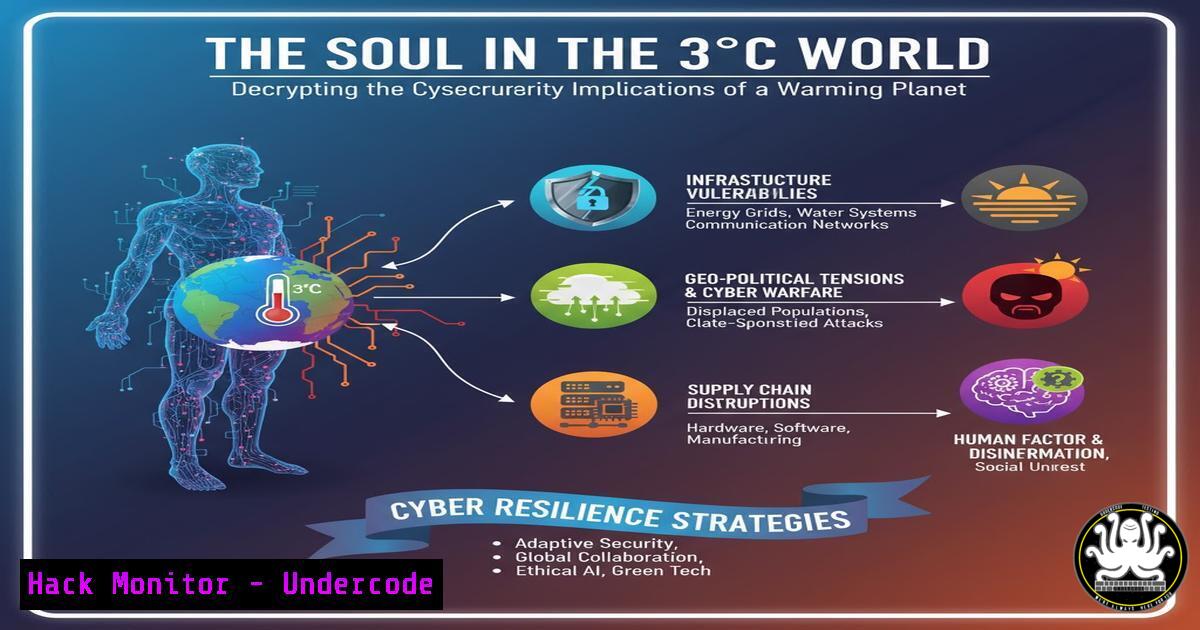
Introduction:
The “3°C World” is no longer a distant climate scenario but an emerging reality with profound implications for global security and digital infrastructure. As physical and digital systems become increasingly intertwined, the threat landscape expands to include climate-induced disruptions, resource wars, and novel attack vectors targeting critical environmental controls and AI systems. This article explores the cybersecurity ramifications of this new epoch and provides actionable technical guidance for defenders.
Learning Objectives:
- Understand the convergence of climate risk and cybersecurity threat vectors.
- Implement hardening techniques for critical infrastructure and cloud environments.
- Develop mitigation strategies for AI-powered threats and supply chain vulnerabilities.
You Should Know:
1. Hardening Critical Infrastructure Against Climate-Physical-Digital Attacks
The convergence of Operational Technology (OT) and Information Technology (IT) creates a vast attack surface. Climate events can be triggers for targeted cyber-physical attacks, aiming to exacerbate disruptions in energy, water, and transportation grids.
 Linux: Auditing open ports and services on a critical server
sudo netstat -tulpn
sudo ss -tulpn
 Check for suspicious processes running as root
ps aux | grep root
 Verify file integrity of critical system binaries (e.g., sshd)
sudo rpm -V openssh-server  For RHEL-based systems
sudo dpkg -V openssh-server  For Debian-based systems
Step-by-step guide:
- Inventory and Isolate: Use `netstat` or `ss` to identify all listening ports and the associated services. Any service not explicitly required for the system’s function should be disabled.
- Process Auditing: The `ps aux` command lists all running processes. Look for unknown processes, especially those running with high privileges, which could indicate a backdoor.
- File Integrity Monitoring: Package verification commands like `rpm -V` check the integrity of installed packages against the repository database. Changes in size, permissions, or checksum can indicate tampering. Implement a dedicated FIM tool like AIDE for continuous monitoring.
2. Securing Cloud Configurations in a Resource-Strained Environment
As climate pressures strain resources, the efficiency and elasticity of cloud environments become critical. Misconfigurations, however, can lead to massive data leaks or resource hijacking.
 AWS CLI: Check for publicly accessible S3 buckets
aws s3api get-bucket-acl --bucket YOUR_BUCKET_NAME --profile YOUR_PROFILE
aws s3api get-bucket-policy --bucket YOUR_BUCKET_NAME --profile YOUR_PROFILE

Check for unrestricted security groups
aws ec2 describe-security-groups --filter "Name=ip-permission.cidr,Values=0.0.0.0/0" --query "SecurityGroups[].[GroupName,GroupId]" --output table --profile YOUR_PROFILE
Step-by-step guide:
- S3 Bucket Auditing: Use the AWS CLI commands to list all S3 buckets and then check their ACLs and policies. A `Grantee` of `http://acs.amazonaws.com/groups/global/AllUsers` in the ACL or a `”Effect”: “Allow”` with `”Principal”: “”` in the policy indicates public read access. This is a primary vector for data breaches.
- Security Group Hardening: The `describe-security-groups` command filters for security groups with rules allowing inbound traffic from anywhere (
0.0.0.0/0). Scrutinize these rules, especially for services like SSH (port 22) or RDP (port 3389), and restrict them to specific, trusted IP ranges.
3. Mitigating AI-Powered Social Engineering and Deepfakes
A 3°C world will be rife with disinformation, including AI-generated content (deepfakes) used for sophisticated social engineering, fraud, and destabilization.
 Python code snippet to verify file hashes (useful for checking tool authenticity)
import hashlib

def generate_sha256(file_path):
sha256_hash = hashlib.sha256()
with open(file_path,"rb") as f:
for byte_block in iter(lambda: f.read(4096),b""):
sha256_hash.update(byte_block)
return sha256_hash.hexdigest()

file_to_check = "downloaded_tool.exe"
expected_hash = "1234567890abcdef..."  Get this from the official source
print(f"SHA256: {generate_sha256(file_to_check)}")
assert generate_sha256(file_to_check) == expected_hash, "File integrity compromised!"
Step-by-step guide:
- Verification Habit: Before executing any downloaded software or tool, always verify its cryptographic hash.
- Code Execution: Use the provided Python script. Replace `file_to_check` with the path to your downloaded file and `expected_hash` with the authentic hash published by the software vendor.
- Assertion Check: The `assert` statement will raise an error if the hashes do not match, preventing the execution of a potentially malicious file that could be used to compromise your system.
4. API Security: The Silent Policy Backend
“The Quiet Policy” referenced in the source text can be analogous to the silent, backend APIs that power modern applications. Insecure APIs are a primary target for data exfiltration.
 Using curl to test API endpoint security headers
curl -I https://api.yourcompany.com/v1/data

Check for missing security headers like:
 - Strict-Transport-Security
 - Content-Security-Policy
 - X-Content-Type-Options
Step-by-step guide:
- Probe with cURL: Use `curl -I` to send a HEAD request to your API endpoint. This fetches only the HTTP headers.
- Analyze Headers: Inspect the output for critical security headers. The absence of `Strict-Transport-Security` (HSTS) forces connections over HTTP, making them susceptible to downgrade attacks. A missing `Content-Security-Policy` header does little to mitigate cross-site scripting (XSS) attacks.
- Enforce Headers: Configure your web server (e.g., Nginx, Apache) or API gateway to include these security headers on all responses.
5. Vulnerability Exploitation and Patching in Windows Environments
Legacy systems, which may be critical in certain infrastructures, are highly vulnerable. Rapid identification and patching are non-negotiable.
 Windows Command Basic system and patch information
systeminfo | findstr /B /C:"OS Name" /C:"OS Version"
wmic qfe get Caption,Description,HotFixID,InstalledOn

PowerShell: Using the PSWindowsUpdate module to manage patches
Get-Module -ListAvailable PSWindowsUpdate
Import-Module PSWindowsUpdate
Get-WUList
Install-WUUpdate -AcceptAll -AutoReboot
Step-by-step guide:
- Assessment: Run `systeminfo` and `wmic qfe` to get a detailed list of the OS version and installed patches. This helps in identifying missing updates.
- PowerShell Automation: Install the `PSWindowsUpdate` module. Use `Get-WUList` to see available updates. The `Install-WUUpdate` command can be used to automate the installation of critical patches, ensuring systems are protected against known vulnerabilities.
6. Network Segmentation and Monitoring for Anomaly Detection
Segmenting the network limits the lateral movement of an attacker, a crucial defense in a complex threat environment.
 Linux iptables example to create a basic segmenting firewall rule
iptables -A FORWARD -i eth1 -o eth0 -j ACCEPT  Allow segment to internet
iptables -A FORWARD -i eth0 -o eth1 -j DROP  Block internet to segment directly

Using tcpdump for basic network monitoring on a critical segment
sudo tcpdump -i eth0 -n 'net 192.168.1.0/24' -w segment_traffic.pcap
Step-by-step guide:
- Policy Creation: Use `iptables` (or a modern alternative like
nftables) to create rules that control traffic between network segments. The example allows a segmented network (eth1) to access the internet (eth0) but blocks unsolicited inbound connections. - Traffic Analysis: Use `tcpdump` to capture traffic on a network segment for analysis. The `-w` flag writes the packets to a file (
segment_traffic.pcap) which can be later analyzed with tools like Wireshark to detect unusual patterns or reconnaissance activity.
7. Incident Response: The First 15 Minutes
When a breach is detected, the initial response is critical to containing the damage.
 Linux: Isolate a compromised system from the network
sudo iptables -P INPUT DROP
sudo iptables -P OUTPUT DROP
sudo iptables -P FORWARD DROP

Create a timeline of activity on a suspect system
sudo ls -alut /bin /usr/bin | head -20  Check for recently modified binaries
sudo grep "Failed password" /var/log/auth.log  Check for brute-force attempts
last -a | head -20  Check recent logins
Step-by-step guide:
- Containment: Immediately block all network traffic to and from the compromised host using
iptables. This prevents data exfiltration and attacker command & control. - Triaging: Create a quick timeline. Check for recently modified system binaries (potential rootkits), review authentication logs for brute-force attacks, and check the `last` command to see recent user logins. This data is crucial for understanding the initial attack vector.
What Undercode Say:
- The 3°C world is not just an environmental crisis; it is a systemic risk multiplier that fundamentally alters the cybersecurity calculus, merging physical disruption with digital sabotage.
- Proactive, intelligence-driven defense is no longer a luxury but a necessity for organizational survival, requiring investment in skills, zero-trust architectures, and resilient systems.
The concept of “The Soul in the 3°C World” and “The Quiet Policy” serves as a powerful metaphor for the unseen, underlying vulnerabilities in our digital ecosystem. Our analysis indicates that the primary threat is no longer just targeted malware but systemic fragility. Climate change acts as a forcing function, accelerating geopolitical tensions and resource competition, which will inevitably spill over into cyberspace. The “Quiet Policy” is the unspoken assumption that our systems are resilient enough—an assumption that is being tested to destruction. Defenders must shift from a posture of compliance to one of active resilience, assuming breach and minimizing impact through segmentation, robust monitoring, and rapid response capabilities. The integration of AI into both defensive and offensive toolkits will define the next decade of cyber conflict, making continuous training and adaptation the most critical control of all.
Prediction:
The convergence of climate stress and AI advancement will lead to the first “Compound Catastrophe Cyber-Event” (C3E) within the next 3-5 years. This will not be a single hack but a cascading failure, where a climate-related physical disaster (e.g., a grid-down scenario from an extreme heat event) is actively exploited and worsened by a coordinated, AI-driven cyber-attack on emergency response and logistics networks. This will force a global reckoning on the interdependence of climate and cyber policy, leading to the creation of new international frameworks for “Climate-Cyber Resilience.”
🎯Let’s Practice For Free:
IT/Security Reporter URL:
Reported By: Ivan Savov – Hackers Feeds
Extra Hub: Undercode MoN
Basic Verification: Pass ✅


