Listen to this Post
Introduction:
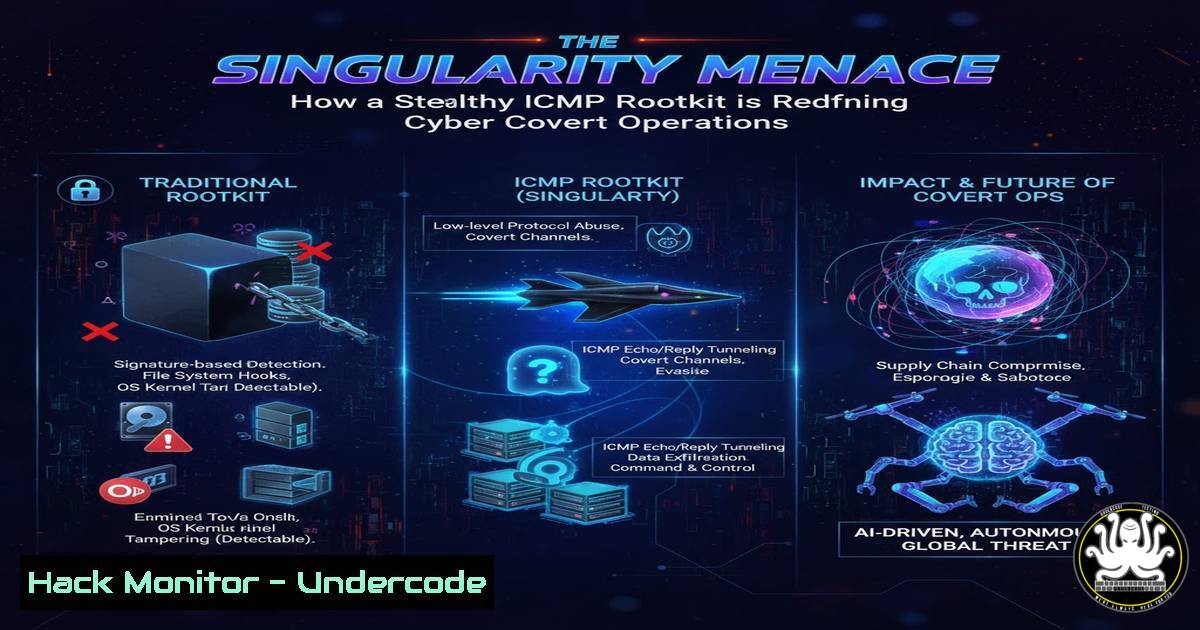
The cybersecurity landscape is witnessing a sophisticated evolution in stealth with the emergence of the Singularity rootkit, a Linux Loadable Kernel Module (LKM) that leverages custom ICMP packets to establish a reverse shell. This technique allows malicious actors to bypass traditional network security controls by hiding command and control (C2) communications within seemingly benign ICMP traffic, making detection exceptionally difficult for conventional intrusion detection systems. Understanding its mechanics is no longer just for offensive researchers; it is a critical requirement for defenders to build resilient monitoring and mitigation strategies.
Learning Objectives:
- Deconstruct the operational methodology of the Singularity ICMP rootkit and its network covert channel.
- Master defensive commands and configurations to detect and block ICMP-based data exfiltration and C2.
- Develop advanced forensic skills to identify kernel-level rootkit compromises on Linux systems.
You Should Know:
1. Intercepting the ICMP Covert Channel
Understanding how to capture and analyze the anomalous ICMP traffic used by Singularity is the first step in defense.
`tcpdump -i eth0 -n ‘icmp and icmp[bash] != icmp-echo and icmp[bash] != icmp-echoreply’ -w singularity_packets.pcap`
Step-by-step guide:
This command uses `tcpdump` to capture all ICMP traffic that is not standard echo requests (pings) or echo replies. Since Singularity uses custom ICMP types, this filter helps isolate its unique packets from normal network noise. Execute this on your border or internal monitoring interfaces. The `-w` flag saves the packets to a file for later analysis with tools like Wireshark, where you can inspect the data payload for the hidden reverse shell communication.
2. Kernel Module Vigilance
Rootkits like Singularity operate as LKMs. Proactive monitoring of loaded modules is essential.
`lsmod | grep -i singularity`
Step-by-step guide:
The `lsmod` command lists all currently loaded kernel modules. Piping its output to `grep` allows you to search for a specific module name. While a sophisticated rootkit may hide itself, this is a fundamental first check. Regularly baseline your system’s modules and investigate any unknown entries. For a more robust check, compare `lsmod` output with the contents of /proc/modules.
3. Deep Packet Inspection for ICMP
Standard firewalls often allow all ICMP traffic. Creating specific rules to inspect ICMP payloads is crucial.
`sudo iptables -A INPUT -p icmp –icmp-type any -m string –string “Singularity” –algo bm -j LOG –log-prefix “SINGULARITY_C2_DETECTED “`
Step-by-step guide:
This `iptables` rule uses the `string` module to perform Deep Packet Inspection (DPI) on all ICMP packets. It scans for the string “Singularity” (or a known C2 signature) using the Boyer-Moore (bm) algorithm. If a match is found, it logs the packet with a unique prefix for easy SIEM (Security Information and Event Management) correlation. This rule does not block but alerts; change `-j LOG` to `-j DROP` to actively block the traffic.
4. Blocking Unusual ICMP Types
A simple but effective defense is to block all non-essential ICMP types at the network perimeter.
`sudo iptables -A INPUT -p icmp -m icmp –icmp-type timestamp-request -j DROP`
`sudo iptables -A INPUT -p icmp -m icmp –icmp-type address-mask-request -j DROP`
Step-by-step guide:
These commands drop specific, rarely used ICMP types that can be abused for covert channels. `timestamp-request` and `address-mask-request` are not required for normal network operations. By creating an explicit allow-list for only essential ICMP types (like echo-request, echo-reply, and destination-unreachable) and denying the rest, you significantly reduce the attack surface for tools like Singularity.
5. System Call Monitoring with Auditd
Rootkits often hook system calls. Configuring the Linux audit subsystem (auditd) can detect such modifications.
`sudo auditctl -a always,exit -F arch=b64 -S socket -k singularity_c2_network`
Step-by-step guide:
This command uses `auditctl` to add a rule (-a) that always generates an audit event on exit (always,exit) for the `socket` system call on 64-bit systems (-F arch=b64). It tags the event with the key “singularity_c2_network” (-k). By monitoring for specific system calls related to network and process creation that are initiated by kernel modules, you can identify anomalous behavior indicative of a rootkit’s network activity.
6. File Integrity Monitoring on Critical Kernel Areas
Detect the initial installation of the rootkit by monitoring key directories for changes.
`sudo aide –check`
Step-by-step guide:
AIDE (Advanced Intrusion Detection Environment) is a file integrity checker. After initializing a database of your system’s critical files (sudo aide --init), you can run periodic checks. Configure AIDE to monitor /lib/modules/, /boot/, and kernel image files. Any unauthorized change, such as the installation of a new LKM, will be flagged, prompting an immediate investigation.
7. Forensic Memory Analysis with LiME
If a compromise is suspected, acquiring a memory dump is vital for deep forensic analysis.
`sudo insmod lime.ko “path=/tmp/memory_dump.lime format=lime”`
Step-by-step guide:
This command loads the LiME (Linux Memory Extractor) kernel module to capture the system’s RAM. You must compile the LiME module for your specific kernel version first. The `path` parameter specifies the output file, and `format=lime` ensures it’s in the standard LiME format. This memory dump can then be analyzed with tools like Volatility to hunt for the rootkit’s code, hidden processes, and network connections in memory, which disk-based analysis would miss.
What Undercode Say:
- The primary innovation of Singularity is not the rootkit itself, but its choice of a nearly invisible transport protocol for C2, forcing a re-evaluation of network security monitoring baselines.
- Defensive strategies must shift from a perimeter-focused “allow-all-ICMP” model to a zero-trust “deny-all, allow-by-exception” model for all protocols, including those traditionally considered harmless.
The emergence of Singularity’s ICMP C2 channel represents a significant leap in offensive tradecraft, directly challenging entrenched network defense paradigms. Most organizations’ firewalls are configured to permit ICMP traffic freely to facilitate network diagnostics, creating a perfect blind spot for this type of attack. The defense-in-depth measures outlined, from kernel module vigilance to advanced packet filtering, are no longer optional for high-security environments. This attack demonstrates that defenders can no longer trust any protocol at face value; deep inspection and strict allow-listing are becoming the minimum standard for effective network segmentation and threat detection. The arms race has clearly moved into the realm of protocol abuse and kernel-level stealth.
Prediction:
The success and publication of techniques like those in the Singularity rootkit will catalyze a rapid adoption of ICMP and other “benign” protocol covert channels (e.g., DNS tunneling, HTTP/2 without content) within mainstream malware and advanced persistent threat (APT) toolkits. This will force a fundamental redesign of Network Detection and Response (NDR) systems, integrating more sophisticated behavioral analysis and machine learning models to identify anomalies in protocol usage rather than relying on signature-based detection. Within two years, we predict that the failure to implement strict protocol allow-listing and deep packet inspection will become a primary cause of major network breaches, as defenders struggle to keep pace with the normalization of these covert exfiltration methods.
🎯Let’s Practice For Free:
IT/Security Reporter URL:
Reported By: Mathsalves Linux – Hackers Feeds
Extra Hub: Undercode MoN
Basic Verification: Pass ✅


