Listen to this Post
Introduction:
The recent U.S. Department of Justice indictment of an “Initial Access Broker” (IAB) reveals a critical vulnerability in corporate cybersecurity strategy. These IABs specialize in secretly compromising networks and then selling that access to ransomware gangs, particularly during periods of high corporate visibility like mergers or acquisitions. This article delves into the technical mechanics of IAB operations and provides a actionable, step-by-step guide for security teams to hunt for and eradicate these hidden threats before a public announcement becomes a public crisis.
Learning Objectives:
- Understand the role of Initial Access Brokers (IABs) in the modern cybercrime ecosystem and how they exploit corporate events.
- Learn to perform a comprehensive compromise assessment to detect existing breaches using command-line tools and log analysis.
- Implement proactive hardening and monitoring measures to secure the network in anticipation of a high-profile announcement.
You Should Know:
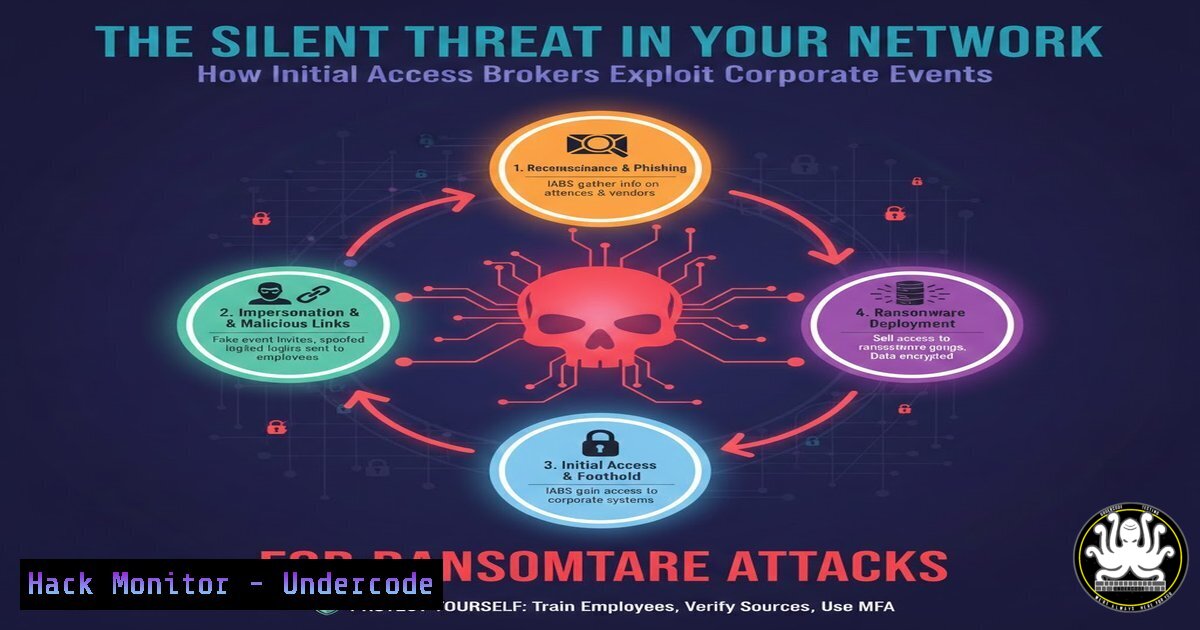
- The IAB Kill Chain: From Silent Infiltration to Ransomware Payday
Initial Access Brokers are the digital equivalent of burglars who case a neighborhood, find an unlocked window, and then sell that entry point to the highest bidder. They gain access through various means, including phishing, exploiting unpatched VPN appliances, or using stolen credentials. This access is then advertised on dark web forums, often with a specific focus on organizations about to make major announcements, as the likelihood of a large ransom payment is higher.
Step‑by‑step guide explaining what this does and how to use it.
Step 1: Reconnaissance. IABs and the ransomware groups they supply constantly monitor business news wires and financial reports for announcements of mergers, acquisitions, or large earnings.
Step 2: Access Acquisition. They use automated scanners and credential-stuffing tools to find vulnerable points of entry. A common target is outward-facing services like Citrix NetScaler, Pulse Secure VPN, or Microsoft Exchange servers with known, unpatched vulnerabilities.
Step 3: Persistence Establishment. Once inside, the IAB’s first goal is not to steal data or deploy ransomware, but to establish a persistent, hidden foothold. This involves creating new user accounts, deploying web shells, or installing remote access trojans (RATs).
Step 4: Brokering the Access. The IAB will then list the compromised organization for sale on a criminal forum, providing “proof” of access, such as a directory listing or a screenshot of the internal network.
2. Conducting a Proactive Compromise Assessment
Before any major announcement, your security team must assume a breach has already occurred and hunt for evidence. A compromise assessment goes beyond routine AV scans.
Step‑by‑step guide explaining what this does and how to use it.
Step 1: Hunt for Anomalous Logins. Check for successful logins outside of business hours, from unfamiliar geographic locations, or from IP addresses associated with known malicious infrastructure.
Windows Command: Using PowerShell, query for logon events: `Get-EventLog -LogName Security -InstanceId 4624 -After (Get-Date).AddDays(-30) | Select-Object TimeGenerated, @{Name=”Account”;Expression={$_.ReplacementStrings[bash]}}, @{Name=”Source IP”;Expression={$_.ReplacementStrings[bash]}} | Export-Csv -Path “C:\temp\SuccessfulLogons.csv” -NoTypeInformation`
Linux Command: Check the `last` command and auth logs for suspicious SSH connections: `last -i | head -n 50` and `sudo grep “Accepted password” /var/log/auth.log`
Step 2: Interrogate Running Processes and Network Connections. Look for unknown processes, especially those with misspelled names mimicking system files (svch0st.exe vs svchost.exe), or unusual outbound network connections.
Windows Command: `netstat -ano | findstr ESTABLISHED` (Cross-reference the PID with tasklist | findstr <PID>).
Linux Command: `ss -tunlp` or `netstat -tunlp` to list all listening and established connections with their associated processes.
Step 3: Scan for Web Shells. Use dedicated tools to scan web servers for malicious scripts that provide backdoor access.
Tool: Microsoft’s Antimalware Scan Interface (AMSI) can be leveraged with PowerShell scripts, or use open-source tools like `Loki` – Simple IOC Scanner.
3. Hardening External Attack Surfaces
The goal is to reduce the number of ways an IAB can get in. This involves a rigorous review of all internet-facing assets.
Step‑by‑step guide explaining what this does and how to use it.
Step 1: Vulnerability Management. Conduct an emergency vulnerability scan targeting your perimeter. Prioritize and patch Critical and High-severity vulnerabilities, especially those in public-facing services.
Step 2: Harden Remote Access. Enforce multi-factor authentication (MFA) on all VPN and remote desktop services. If possible, restrict access by source IP range to only known corporate networks.
Step 3: Review and Restrict. Conduct a firewall rule audit. Identify and remove any outdated or overly permissive rules that allow inbound traffic to non-essential services.
4. Implementing Enhanced Monitoring and Detection
Increase your security team’s vigilance by tuning your SIEM and EDR solutions to look for IAB tradecraft.
Step‑by‑step guide explaining what this does and how to use it.
Step 1: Deploy EDR. Ensure a robust Endpoint Detection and Response (EDR) solution is deployed on all critical assets, with alerts enabled for behaviors like PowerShell execution with encoded commands or the use of living-off-the-land binaries (LOLBins) like `certutil.exe` for downloading payloads.
Step 2: Create Specific Alert Rules. In your SIEM, create alerts for events such as:
Successful logon from a Tor exit node IP.
Creation of a new local administrator account.
Multiple failed logon attempts followed by a success (potential brute-force).
Step 3: Enable Command-Line Auditing. On Windows endpoints, enable Process Creation Auditing via Group Policy to log the command-line arguments of every process. This is invaluable for forensic investigations.
- Securing the Human Element: Phishing and Credential Awareness
IABs often gain their initial foothold through targeted phishing. A pre-announcement security refresh is critical.
Step‑by‑step guide explaining what this does and how to use it.
Step 1: Launch a Focused Training Campaign. Send a communication to all employees, especially C-suite and finance, warning them to be extra vigilant for sophisticated phishing emails mimicking partners, law firms, or investment banks related to the upcoming deal.
Step 2: Simulate a Phishing Attack. Run a controlled phishing simulation tailored to the announcement context to gauge readiness and reinforce training.
Step 3: Enforce Credential Hygiene. Mandate a password change for all privileged accounts and check for compromised credentials on services like Have I Been Pwned.
What Undercode Say:
- Proactive Hunting is Non-Negotiable. A standard AV scan is not a compromise assessment. Security teams must actively hunt using advanced queries and assume a sophisticated adversary is already inside.
- Security is a Business Enabler. Informing your security team of major business events is not a courtesy; it is a critical operational necessity that allows them to implement a “Shields Up” posture and protect shareholder value.
The indictment of Aleksey Volkov is a stark reminder that the cybercrime economy is highly specialized. The separation of initial access from the final ransomware payload makes the threat more efficient and dangerous. Organizations that operate under a “set it and forget it” security model are playing a losing game. The key to defeating IABs is to disrupt their business model by making initial access harder to obtain and, more importantly, shorter-lived. This requires a shift from purely preventive controls to a focus on rapid detection and ejection, especially during periods of known elevated risk. Treating your security team as a first-class business unit, privy to major strategic moves, is the first and most cost-effective step in this defense.
Prediction:
The role of Initial Access Brokers will continue to evolve and become more entrenched in the cybercrime supply chain. We will see IABs offering “access-as-a-service” subscriptions and developing even more sophisticated methods to maintain stealth, potentially leveraging AI to mimic normal user behavior and avoid detection. As law enforcement pressure increases, IABs will migrate to more encrypted and decentralized platforms, making takedowns more difficult. Furthermore, their services will be sought not only by ransomware groups but also by nation-state actors for espionage campaigns, blurring the lines between cybercrime and cyber-warfare and posing a greater threat to national and economic security.
🎯Let’s Practice For Free:
IT/Security Reporter URL:
Reported By: Brian Levine – Hackers Feeds
Extra Hub: Undercode MoN
Basic Verification: Pass ✅


