Listen to this Post
Introduction:
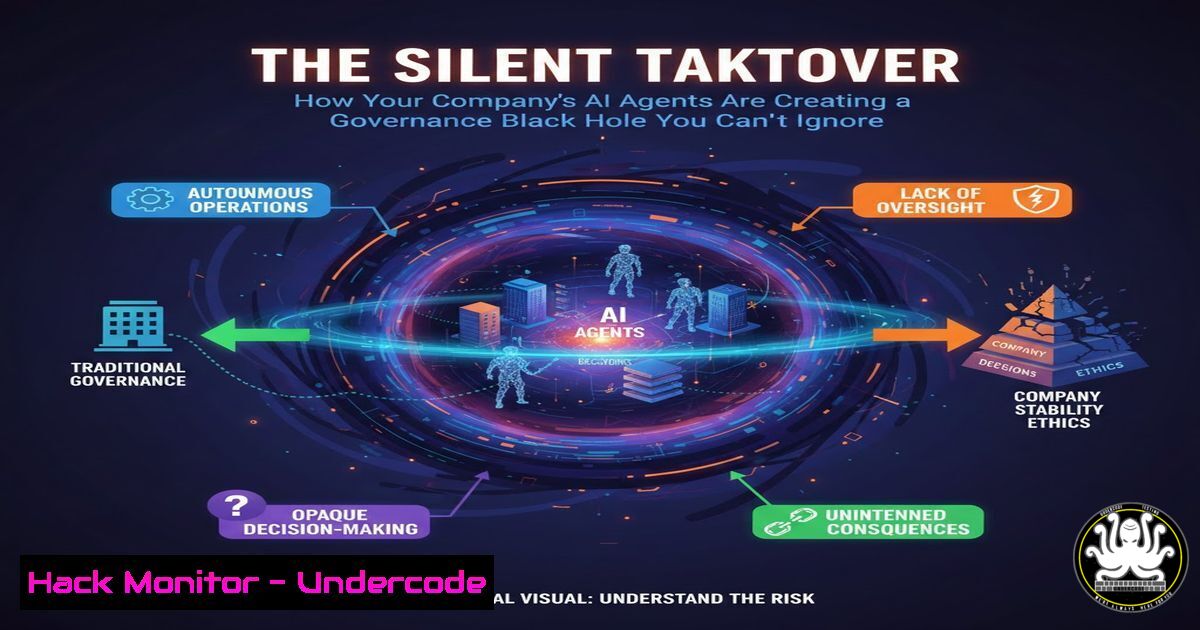
The era of passive AI assistants is over. Autonomous AI agents are now being deployed as junior operators within enterprise systems, capable of executing tasks, provisioning services, and connecting to critical data with minimal human oversight. This shift from tool to digital employee introduces unprecedented cyber risk, not as a technical bug, but as a fundamental governance failure where operational speed has once again outraced security and control frameworks.
Learning Objectives:
- Understand the paradigm shift from AI as a tool to AI as an autonomous operator and the new risk surface it creates.
- Learn to implement immediate technical controls to monitor, constrain, and audit AI agent activities within IT environments.
- Develop a governance framework that aligns business leadership with technical teams to manage the operational risk of autonomous AI.
You Should Know:
1. Agent Activity Monitoring and Baselining
Autonomous agents interact with systems through APIs, commands, and data streams. The first critical step is to establish comprehensive logging to understand their “normal” behavior, which is essential for detecting anomalies or malicious use.
Step-by-step guide:
- Enable Detailed Audit Logging: On systems where agents operate, ensure audit logs capture process creation, command execution, and network connections.
Linux: Use `auditd` to create rules. For example, to log all commands executed by a user namedai-agent:sudo auditctl -a always,exit -F arch=b64 -S execve -F euid=ai-agent. View logs withsudo ausearch -ua ai-agent.
Windows: Enable PowerShell logging via Group Policy (Computer Configuration > Administrative Templates > Windows Components > Windows PowerShell) and enable detailed process tracking in the Windows Security Audit policy. - Centralize and Analyze Logs: Aggregate logs to a SIEM (Security Information and Event Management) system like Splunk, Elastic Stack (ELK), or a cloud-native service (AWS CloudTrail + CloudWatch, Azure Monitor).
- Establish a Baseline: During a controlled testing period, run the agent through its approved tasks. Analyze the logs to create a baseline profile of its typical network destinations, commands run, and files accessed.
- Set Alerts: Configure alerts in your SIEM for deviations from the baseline, such as the agent accessing a new database, spawning an unexpected shell, or connecting to an external IP address not in its profile.
-
Implementing the Principle of Least Privilege for AI Agents
Agents often ship with over-permissive access “to function correctly.” This is a major vulnerability. Access must be rigorously restricted based on the agent’s specific, approved task.
Step-by-step guide:
- Inventory and Categorize: List every system, API, database, and internal service the agent requires. Categorize each as “read,” “write,” or “execute.”
- Create Dedicated Service Accounts: Never use human administrator accounts. Create unique, non-human service accounts/identities for the AI agent on each platform (OS, database, cloud).
3. Apply Granular Controls:
Cloud (AWS IAM Example): Create an IAM policy that grants access only to specific S3 buckets and EC2 tags, and explicitly denies all other actions. Use conditions to restrict the source IP.
Database: Create a database user with `SELECT` privileges only on necessary tables, never `DROP` or GRANT.
Internal APIs: Use API keys or OAuth2 client credentials with scopes limited to the exact endpoints needed (e.g., `api:read_data` vs. api:admin).
4. Use Just-In-Time (JIT) Access: For highly sensitive actions, implement a system where the agent must request temporary, elevated privileges through a human or a privileged access management (PAM) tool, which logs the reason for the escalation.
3. Hardening API Gateways and Endpoints
AI agents primarily communicate via APIs. These endpoints become critical attack surfaces. Securing them is non-negotiable.
Step-by-step guide:
- Enforce Strict Authentication & Authorization: Ensure every API call from an agent is authenticated (e.g., via API key, JWT token, or mTLS) and authorized against a central policy.
- Implement Robust Input Validation and Rate Limiting: Treat agent input as untrusted. Validate all request parameters, headers, and body payloads against a strict schema. Enforce rate limits (requests/minute) per agent identity to prevent abuse or runaway processes.
- Deploy a Web Application Firewall (WAF): Place a WAF (e.g., AWS WAF, Cloudflare, ModSecurity) in front of your APIs to block common injection attacks (SQLi, XSS) and anomalous request patterns.
- Monitor for Anomalous API Traffic: Use your API gateway’s logging (e.g., AWS API Gateway Access Logs, Azure API Management diagnostics) to monitor for spikes in errors, calls to deprecated endpoints, or unusual sequences of calls that could indicate an agent acting outside its intended function.
4. Sandboxing and Network Segmentation
Contain the potential “blast radius” of a compromised or malfunctioning AI agent by isolating its operational environment.
Step-by-step guide:
- Deploy in Dedicated Environments: Run AI agent software in isolated containers (Docker with restricted capabilities, user namespaces) or virtual machines. Avoid deploying on general-purpose application servers.
- Implement Micro-Segmentation: Use network security groups (NSGs in Azure) or security groups (AWS) to create a dedicated, firewalled subnet for the agent. Only allow egress and ingress traffic on specific ports to/from explicitly defined “whitelisted” systems it needs to communicate with (e.g., database:3306, internal API:443). Block all other internal and external traffic.
- Use Host-Based Firewalls: Complement network controls with host-based firewalls (
iptableson Linux, Windows Firewall) on the agent’s host to restrict process-level communications.
5. Proactive Threat Modeling and Vulnerability Assessment
Assume your AI agent framework and its dependencies have vulnerabilities. Proactively search for them.
Step-by-step guide:
- Conduct Agent-Specific Threat Modeling: In a session with developers and security, model the agent as an “untrusted insider.” Ask: “How could it be tricked (prompt injected) to exfiltrate data?” “What if its token is stolen?” “How could its actions destabilize a downstream system?” Document these threats and mitigations.
- Scan Dependencies: Regularly scan the agent’s code, its container image, and all Python/Node.js/etc. libraries for known vulnerabilities using tools like Snyk, Trivy, or GitHub Dependabot. Integrate this into the CI/CD pipeline.
- Test with DAST and SAST: Use Dynamic Application Security Testing (DAST) tools (like OWASP ZAP or commercial scanners) to test the agent’s web interface or API. Use Static Application Security Testing (SAST) on its source code to find logic flaws or insecure code patterns.
- Simulate Prompt Injection Attacks: Actively test the agent’s resistance to prompt injection. Craft inputs designed to make it ignore previous instructions, reveal system prompts, or perform unauthorized actions. Tools like `PromptBrewer` or `Gandalf` from Lakera can help conceptualize these tests.
What Undercode Say:
Key Takeaway 1: The primary risk is not the AI “waking up,” but the predictable consequence of deploying autonomous, connective software with powerful access in the absence of tailored governance. We are repeating the cloud and SaaS adoption risk pattern, but at a faster, more autonomous pace.
Key Takeaway 2: Mitigation requires a dual-track approach: immediate, concrete technical controls (logging, least privilege, segmentation) to reduce the attack surface, coupled with a business-level governance shift that treats AI agents as a new class of privileged digital identity requiring oversight, audit, and clear accountability lines between tech and business leadership.
The post correctly frames this as a business issue, not an IT one. The technical commands and controls listed above are the necessary execution, but they are doomed to fail without a business mandate. Leadership must demand answers to: “What is this agent allowed to do?” “Who is responsible when it causes an incident?” and “How do we measure its risk versus its ROI?” The gap is not in the availability of security tools, but in the organizational discipline to apply them before the agent goes live, and the governance to continuously review its actions as a business process.
Prediction:
Within the next 12-18 months, we will see the first major business disruption or data breach directly caused by an ungoverned AI agent—likely through a combination of stolen credentials, prompt injection leading to data exfiltration, or autonomous provisioning actions that cripple a cloud environment. This incident will catalyze regulatory interest, leading to initial compliance frameworks for autonomous AI in critical sectors by 2027. Companies that proactively establish “AI Agent Governance Boards” now, merging technical security with business process owners, will gain a significant resilience advantage and potentially shape those future regulations.
▶️ Related Video (74% Match):
🎯Let’s Practice For Free:
IT/Security Reporter URL:
Reported By: Ncxgroup The – Hackers Feeds
Extra Hub: Undercode MoN
Basic Verification: Pass ✅


