
Listen to this Post
Introduction:
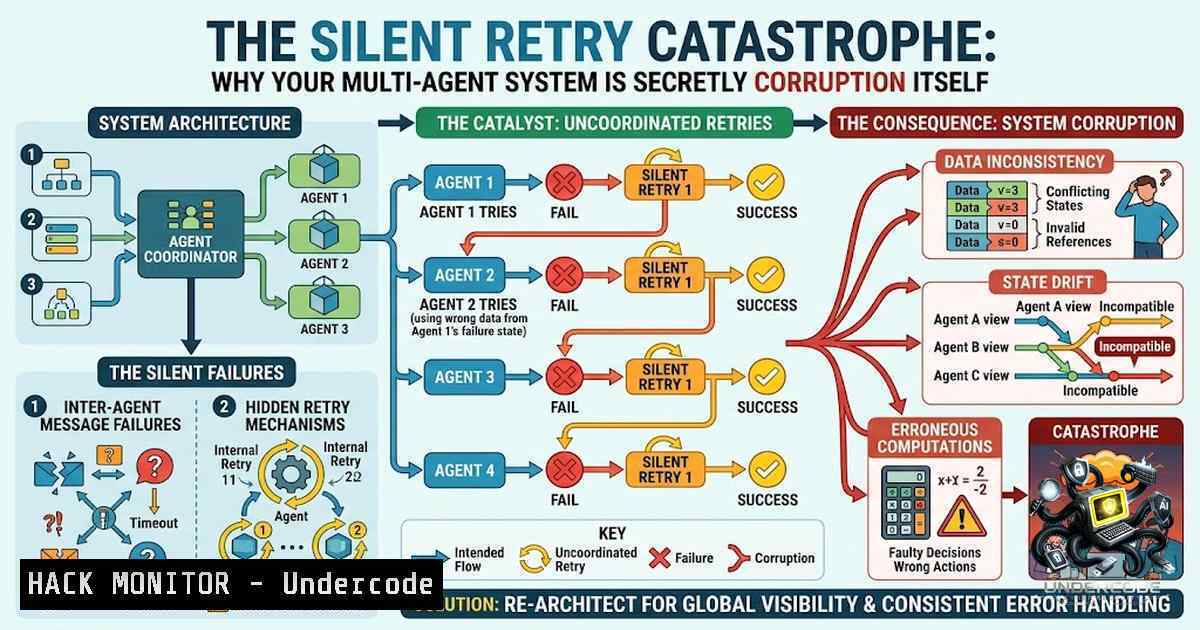
In the world of distributed systems, retry logic is a sacred cow—a standard fallback for transient network failures. However, when you migrate this simplistic pattern to multi-agent architectures, you introduce a silent data corruption vector. The core issue is that while retries are designed to achieve “at-least-once” delivery, they fundamentally break the “exactly-once” execution requirement of agentic workflows, leading to duplicate actions that ripple through the system like a logic bomb.
Learning Objectives:
- Understand why standard exponential backoff retries are dangerous in non-idempotent agent actions.
- Learn how to implement a distributed idempotency layer using external state stores.
- Explore practical command-line and code implementations for idempotency keys across Linux and Windows environments.
- Identify the architectural boundaries necessary to prevent cascading failures in agentic AI systems.
1. The Idempotency Fallacy in Agentic Systems
The post highlights a critical misunderstanding: the assumption that because a call “succeeded on attempt three,” the system is safe. This is false. In single-service backends, retrying a `POST` request might create duplicate database entries, but this is often caught by unique constraints. In multi-agent systems, the “side effects” are far more complex. Agent A might call Agent B, which triggers a state change (e.g., reserving inventory). When Agent A retries, it doesn’t just duplicate a database row; it duplicates the action—potentially double-booking inventory or sending duplicate emails.
Step-by-Step Guide: Identifying Non-Idempotent Actions
- Audit Agent Dependencies: Map out all external API calls and internal agent-to-agent messages.
- Flag State Changes: Highlight any action that results in a state mutation (write operations).
- Test for Replay: If an action re-executed at T+5 minutes yields a different system state than the original execution, it is not idempotent.
- The “Crash” Scenario: Assume the agent crashes immediately after sending the request but before receiving the response. Will the retry cause the same side effect? If yes, you have a problem.
2. Building the External Idempotency Store
The post explicitly warns: “The idempotency store must be outside the agents.” Why? If the store resides in the agent’s memory, a crash wipes the history. The agent reboots, sees no record of the action, and re-executes it. The solution is a distributed cache like Redis or a persistent key-value store.
Step-by-Step Guide: Setting up Redis for Idempotency
- Install Redis (Linux): `sudo apt-get update && sudo apt-get install redis-server`
2. Install Redis (Windows – WSL2): `wsl –install -d Ubuntu` followed by the Linux command. - Start Service: `sudo systemctl enable redis-server && sudo systemctl start redis-server`
4. Connect to Redis: `redis-cli`
- Set Idempotency Pattern: Use the command `SETNX` (Set if Not Exists). This is atomic and perfect for locking.
– `SETNX action:unique_id “EXECUTING”` -> Returns 1 if key does not exist (allow execution).
– `SETNX action:unique_id “EXECUTING”` -> Returns 0 if key exists (return cached result).
Implementation Snippet (Python-like Logic):
def execute_action(action_id, payload):
if redis.setnx(f"action:{action_id}", "PROCESSING"):
try:
result = call_external_api(payload)
redis.set(f"action:{action_id}", result)  Store result
return result
except Exception as e:
redis.delete(f"action:{action_id}")  Allow retry only for actual failures
raise
else:
return redis.get(f"action:{action_id}")  Return previously committed result
3. Generating the Unique Action Key
The key must be deterministic. You cannot use a timestamp alone, as retries will generate a new timestamp. The best practice is to combine a “Client ID” + “Intent Hash” + “Timestamp with Jitter.” However, the post implies a pre-execution generation. This is crucial: the key must be generated before the external call is made.
Step-by-Step Guide: Key Generation Strategy
- Hash the Payload: Generate an SHA-256 hash of the request payload.
- Add Source ID: Include the specific agent ID that is making the call.
- Add Retry Count: If the first attempt fails (network error), the retry should use the same key.
- Expiration: Set a TTL (Time To Live) on the Redis key. If an action takes 10 seconds, set a TTL of 60 seconds to allow for retries. If the TTL expires, the key is cleared, and the action can be retried safely (assuming it was never committed).
Command Line Check (Linux):
To verify the current keys in Redis: `redis-cli KEYS “action:”`
- The “Check Before Commit” Pattern vs. “Commit Before Action”
There is a subtle race condition. Agent A checks the store, sees no key, and proceeds to execute the API call. Agent B, running in parallel, also checks for the same key and sees no key (because Agent A hasn’t written it yet) and executes the duplicate call simultaneously. The fix is the “Locking” pattern.
Step-by-Step Guide: Implementing the Locking Pattern
- Attempt to Set: Use `SETNX` to set the key with a TTL.
- Process: If `SETNX` returns
1, process the action. Crucially, write the result to the store before the external action if possible, or write a “PENDING” status. - Race Condition Mitigation: Write the “PENDING” status immediately. Agent B will see the key exists (even if the result isn’t ready) and wait or poll.
Windows & Linux Commands (Redis CLI):
- Linux Terminal: `redis-cli SETNX action:123 “PENDING”` -> `(integer) 1` (Lock acquired).
- Windows PowerShell (using redis-cli.exe): `.\redis-cli.exe SETNX action:123 “PENDING”` -> `(integer) 0` (Lock failed).
5. LangSmith, Langfuse, and Observability
The post asks about LangSmith or Langfuse. These are critical for debugging this issue. Without tracing, a duplicate action is just a ghost in the machine. LangSmith allows you to trace the exact input hash of the request. If you see two traces with the same input hash but different “Retry” statuses, you can identify the duplicate.
Step-by-Step Guide: Debugging Duplicates with Tracing
- Instrument your Agent: Add a unique `trace_id` to the metadata of every call.
- Search in Langfuse: Filter sessions by the
idempotency_key. - Analyze Timeline: Check if the first attempt returned an error (e.g., 500) and the second returned 200.
- Correlate State: Check the downstream logs (e.g., SQL database) to see if two records were inserted, confirming the duplicate side effect.
6. API Security and Hardening
Duplication isn’t just a bug; it’s a security vulnerability. In microservices, replay attacks are a known threat. The idempotency key acts as a nonce.
Step-by-Step Guide: Hardening the API
- Require Idempotency Header: Force the client (your agent) to provide an `Idempotency-Key` header.
- Validation: On the server side, check the header. If the key has been seen before, return the cached response (200 OK) instead of re-processing.
- Time-based Expiry: Implement a sliding window cache to prevent memory exhaustion.
- Linux Hardening (iptables): While not directly related, ensure your Redis server isn’t exposed to the internet: `sudo iptables -A INPUT -p tcp –dport 6379 -j DROP` (Only allow internal network access).
7. Common Pitfalls and Troubleshooting
- The “Expiry” Trap: If you set a TTL of 10 seconds and the API takes 12 seconds due to latency, the key expires. The retry will see no key and re-execute, causing a duplicate even though the original is still in flight.
- Fix: Extend the TTL to well beyond your expected timeout (e.g., 5 minutes).
- Partial Failures: The API returns a 200 OK but the network drops the response. Your agent retries. The server sees the old key and returns the cached result (because it was already committed). This is the correct behavior.
- Windows File System Limitations: If storing the store locally instead of Redis, ensure atomic writes. Use `[System.IO.File]::OpenWrite` with exclusive locks in PowerShell.
What Undercode Say:
- Key Takeaway 1: Distributed retries are fundamentally incompatible with stateful agents unless protected by an atomic, external locking mechanism. Memory-based solutions are fatal.
- Key Takeaway 2: The duplication bug is often invisible until the downstream system (DB, Warehouse, ERP) breaks, making it a “silent killer” of production AI stacks.
Analysis: The post’s insight highlights the shift from “building a call” to “building a transaction.” Agentic AI introduces a new layer of complexity where “at-least-once” semantics are the default in HTTP, but “exactly-once” is required for business logic. The recommendation to externalize the store is a direct application of the “Stateful vs. Stateless” design pattern, ensuring the agent’s crash doesn’t erase the proof of work. This is a first-class systems engineering problem, not just a prompt-engineering problem.
Prediction:
- +1: The adoption of standard protocols like the `Idempotency-Key` header (popularized by Stripe) will become mandatory in Agentic AI orchestration frameworks.
- -1: We will see a rise in “financial fraud” or “inventory errors” in the coming year caused specifically by AI agents retrying payment or booking APIs without idempotency, leading to significant financial loss before the pattern is standardized.
- +1: LangSmith, Langfuse, and other observability platforms will incorporate “Duplicate Detection” as a core AIOps feature, automatically flagging the “Retry Success” pattern as a high-risk anomaly.
- -1: The engineering burden of managing distributed idempotency will slow down enterprise AI adoption, as companies realize they cannot simply “plug in” LLMs to legacy systems without rewriting state management.
- +1: We will see the rise of “Idempotency as a Service” middleware, where all agent calls route through a proxy that handles key generation and locking, abstracting the complexity away from the individual agent code.
▶️ Related Video (84% Match):
🎯Let’s Practice For Free:
🎓 Live Courses & Certifications:
Join Undercode Academy for Verified Certifications
🚀 Request a Custom Project:
Secure, high-velocity infrastructure and disruptive technological engineering. Contact our engineering team for high-tier development and proprietary systems:
[email protected]
💎 Smart Architecture | 🛡️ Secure by Design | ⭐ Trusted by Thousands
IT/Security Reporter URL:
Reported By: Prisha Singla – Hackers Feeds
Extra Hub: Undercode MoN
Basic Verification: Pass ✅


