Listen to this Post
Introduction:
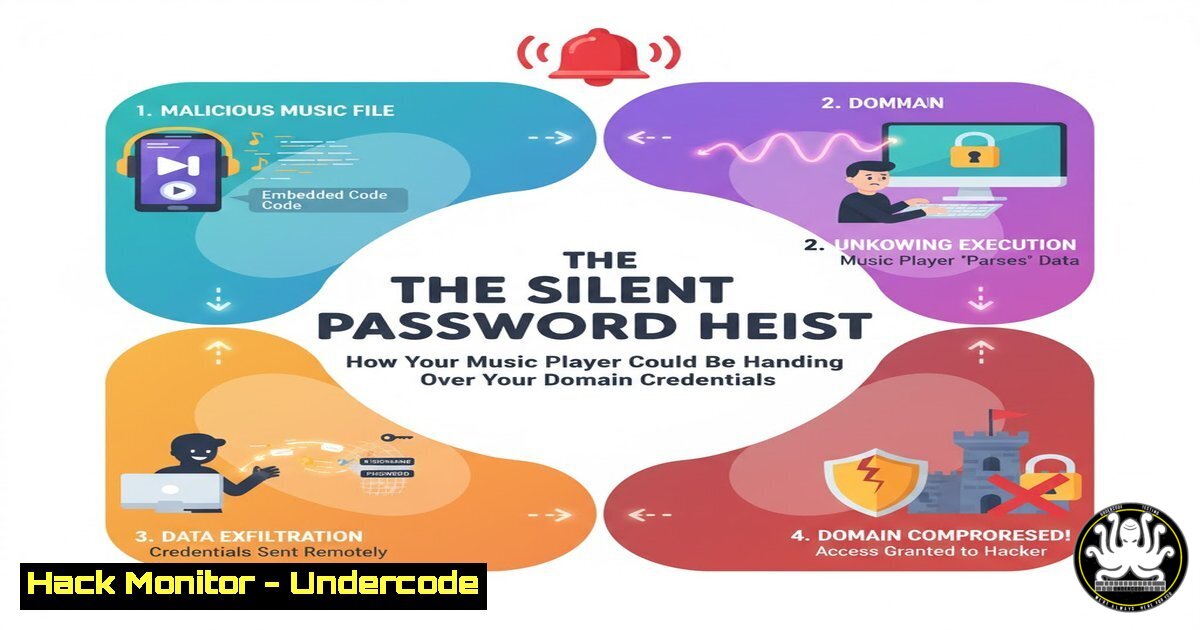
A seemingly innocent action like playing music on a corporate workstation can create a critical security vulnerability. This article explores a sophisticated attack vector that leverages the Windows media player and the Link-Local Multicast Name Resolution (LLMNR) protocol to harvest user password hashes from within an Active Directory environment. Understanding this technique is paramount for both offensive security professionals testing defenses and system administrators hardening their networks.
Learning Objectives:
- Understand the inherent weaknesses of the LLMNR and NBT-NS protocols in Windows networks.
- Learn the step-by-step process of how an attacker can poison name resolution to capture authentication attempts.
- Master the defensive configurations and countermeasures required to mitigate this prevalent attack.
You Should Know:
1. The Achilles’ Heel: LLMNR/NBT-NS Protocol Poisoning
The core of this attack exploits trust in legacy protocols. When a Windows computer attempts to access a network resource (like a fake share triggered by a media player looking for album art), it first tries DNS. If DNS fails, it falls back to LLMNR (for IPv6) and NetBIOS Name Service (NBT-NS for IPv4). These protocols are broadcast-based, meaning the query is sent to every machine on the local subnet. An attacker can easily listen for these broadcasts and respond, claiming to be the requested resource. The victim’s computer, trusting this response, will then attempt to authenticate to the attacker’s machine, sending over the user’s NTLMv2 hash.
2. Step-by-Step Attack Execution with Responder
An attacker on the same network segment can use a tool like Responder to automate this attack.
Step 1: Reconnaissance and Tool Setup.
The attacker first gains a foothold on the network. This could be through a compromised IoT device, a guest wireless network, or a physical connection. They then download and run Responder, a classic tool for LLMNR/NBT-NS poisoning.
On a Linux Attack Machine:
 Clone the Responder tool
git clone https://github.com/lgandx/Responder.git
cd Responder

Run Responder to listen on the specified interface (e.g., eth0)
sudo python3 Responder.py -I eth0 -dw
– -I eth0: Specifies the network interface.
– -d: Enable answers for DHCP broadcast requests.
– -w: Enable the WPAD rogue proxy server.
Step 2: Triggering an Authentication Request.
The attack lies in wait. Now, any event that causes a target machine to search for a non-existent network share will trigger the exploit. In the scenario described, the Windows Media Player, when opening a media file, might attempt to fetch metadata or album art from a network path it cannot resolve. The moment this happens, the target machine broadcasts an LLMNR query.
Step 3: Poisoning the Response and Hash Capture.
Responder, listening on the network, sees the broadcast query for the non-existent hostname. It immediately sends a malicious response claiming to be that host. The victim machine initiates an SMB authentication attempt with the attacker’s system. Responder captures the NTLMv2 challenge-response hash, saving it to a file.
Example Responder Output upon Capture:
[bash] NTLMv2-SSP Client : 192.168.1.105
[bash] NTLMv2-SSP Username : CORP\jmetayer
[bash] NTLMv2-SSP Hash : jmetayer::CORP:1122334455667788:2CEC5A0D...[rest of the hash]
This hash is now stored in `/usr/share/responder/logs/SMBv2-NTLMv2-SSP-192.168.1.105.txt`.
- From Hash to Access: Cracking the Captured Credentials
A captured NTLMv2 hash is not the plaintext password, but it can be cracked offline using tools like Hashcat.
Step 1: Prepare the Hash File.
Ensure the captured hash is in the correct format for Hashcat (e.g., username::domain:challenge:response...).
Step 2: Launch a Password Cracking Attack.
Using a powerful GPU, the attacker can run a dictionary or brute-force attack.
On a Linux Machine with Hashcat:
hashcat -m 5600 'captured_hashes.txt' /usr/share/wordlists/rockyou.txt
– -m 5600: Specifies the hash mode for NTLMv2.
– captured_hashes.txt: The file containing the captured hash.
– rockyou.txt: A common wordlist used for password cracking.
Once cracked, the attacker possesses a valid domain username and password, granting them initial access to the network and enabling lateral movement.
- Mitigation 1: Disabling LLMNR and NBT-NS via Group Policy
The most effective defense is to disable the vulnerable protocols entirely. This is best done through Group Policy in an Active Directory environment.
Step-by-Step Guide for Disabling LLMNR:
1. Open the Group Policy Management Console.
- Edit the GPO applied to your domain workstations.
- Navigate to:
Computer Configuration > Policies > Administrative Templates > Network > DNS Client. - Enable the policy “Turn Off Multicast Name Resolution”.
- Click Apply and OK. Force a group policy update on client machines with
gpupdate /force.
Step-by-Step Guide for Disabling NBT-NS:
This is done via the local network adapter settings but can be scripted and deployed via GPO.
1. Using a PowerShell Script (Deploy via GPO Startup Script):
 Disable NetBIOS over TCP/IP for all adapters
$adapters = Get-WmiObject Win32_NetworkAdapterConfiguration | Where-Object {$_.IPEnabled -eq $true}
foreach ($adapter in $adapters) {
$adapter.SetTcpipNetbios(2)
}
A value of `2` disables NetBIOS over TCP/IP.
5. Mitigation 2: Hardening Network Services and Monitoring
Technical mitigations must be complemented with robust monitoring.
Step 1: Implement Strong Network Segmentation.
Limit lateral movement by segmenting the network. An attacker on the user VLAN should not be able to easily interact with all workstations.
Step 2: Deploy Host-Based Firewalls.
Configure Windows Firewall policies to block unnecessary inbound SMB (445/tcp) and NetBIOS (137-139/tcp&udp) traffic from untrusted networks.
Step 3: Enable Detailed Command-Line Auditing and SIEM Integration.
Use tools like Sysmon and a SIEM to detect the execution of tools like Responder and the associated network patterns.
– Sysmon Configuration Example (Event ID 3 – Network Connection):
<RuleGroup name="" groupRelation="or">
<NetworkConnect onmatch="include">
<Image condition="contains">python</Image>
<DestinationPort condition="is">137,138,139,445,5355</DestinationPort>
</NetworkConnect>
</RuleGroup>
This would log network connections from Python (the interpreter for Responder) to the key ports used in this attack.
What Undercode Say:
- Legacy Protocols are a Gift to Attackers. LLMNR and NBT-NS are enabled by default in most Windows environments and provide a low-hanging fruit for initial access. Their utility in modern networks is negligible compared to the risk they introduce.
- The Attack Chain is Deceptively Simple. This is not a complex zero-day exploit. It abuses intended functionality and design flaws in fundamental network protocols, making it highly reliable and difficult to patch without configuration changes. It highlights that the most dangerous vulnerabilities are often misconfigurations, not software bugs.
This attack demonstrates a critical failure in defense-in-depth. While organizations invest in perimeter security, internal protocols act as a built-in trust mechanism that attackers readily exploit. The reliance on fallback protocols like LLMNR creates a predictable and abusable authentication path. For red teams, this is a staple technique for a reason. For blue teams, disabling these protocols is a non-negotiable hardening step. The fact that a mundane activity like playing a song can initiate a chain of events leading to domain compromise should be a sobering reminder of how intertwined usability and security are.
Prediction:
The underlying weakness of name resolution poisoning will continue to be a foundational attack technique. While awareness is growing, widespread adoption of mitigations is slow. Future attacks will see this method integrated with AI-driven social engineering, where lures are automatically tailored to trigger specific network resource lookups based on a victim’s profile (e.g., mimicking internal project shares or software update servers). Furthermore, as passwordless authentication gains traction, attackers will shift to relaying these captured hashes rather than cracking them, using techniques like SMB relay to achieve direct, unauthorized access to other systems where the same credentials are used, making multi-factor authentication and SMB signing even more critical.
🎯Let’s Practice For Free:
IT/Security Reporter URL:
Reported By: Jmetayer Vous – Hackers Feeds
Extra Hub: Undercode MoN
Basic Verification: Pass ✅


