Listen to this Post
Introduction:
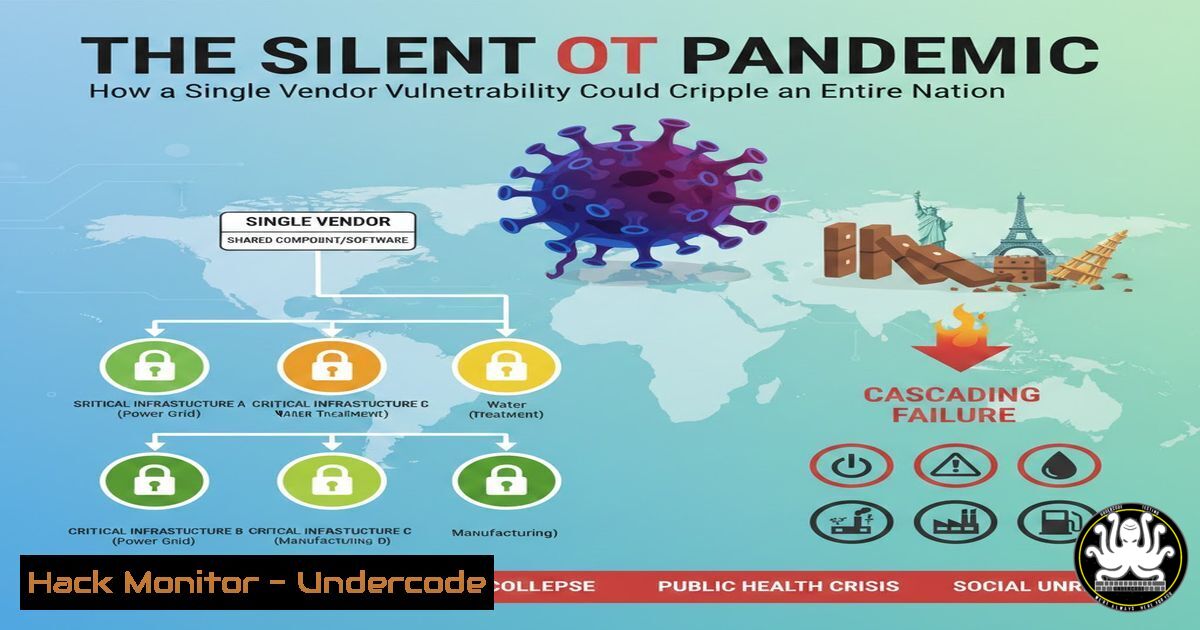
The digital transformation of critical infrastructure has ushered in an era of unprecedented efficiency and connectivity, but at a profound systemic cost. In the Middle East, where rapid modernization has standardized Operational Technology (OT) systems across refineries, power grids, water treatment, and smart cities, a new existential threat has emerged: shared OT vendor dependency. This article deconstructs how the very drive for operational efficiency has created a monoculture, turning a single software vulnerability into a potential continent-scale cyber weapon.
Learning Objectives:
- Understand the concept of OT vendor dependency and its systemic risk profile for critical national infrastructure (CNI).
- Learn actionable strategies for network segmentation, asset discovery, and supply chain hardening in OT environments.
- Implement technical controls and governance models to mitigate the “cascade failure” effect from a shared vendor breach.
You Should Know:
1. The Anatomy of a Systemic OT Risk
The core vulnerability isn’t a zero-day exploit, but a procurement strategy. When multiple critical infrastructure sectors—energy, water, utilities—standardize on a single vendor’s SCADA, PLCs, or IIoT management platforms, they create a homogeneous attack surface. A threat actor, whether state-sponsored or criminal, can develop a single payload with the potential to compromise disparate sectors simultaneously. The attack path moves from targeting an organization to targeting an ecosystem, leveraging the identical software stack deployed across national assets.
2. Step‑by‑Step Guide to IT-OT Network Segmentation
Segmentation is the non-negotiable first line of defense. It creates “consequence boundaries” to contain a breach.
Step‑by‑step guide:
- Map Data Flows: Identify all communication paths between corporate IT networks and OT control networks. Document protocols (e.g., MODBUS, DNP3, OPC-UA) and ports.
- Deploy a Next-Generation Firewall (NGFW): Install a physically separate NGFW at the IT-OT demarcation point. Brands like Palo Alto, Fortinet, or Cisco offer OT-aware models.
- Implement Zone-Based Policies: Adopt the ISA/IEC 62443 standard. Create zones (e.g., Corporate, DMZ, Control Zone, Cell Zone). Define conduits with explicit firewall rules.
Example Rule (Conceptual): `ALLOW Source: Historian_Server_IP, Destination: PLC_Subnet, Port: TCP/502, Protocol: MODBUS, Log: YES`
4. Enforce Deep Packet Inspection (DPI): Configure the NGFW with application-aware policies to allow only valid MODBUS or OPC-UA functions, blocking any anomalous or malicious commands.
3. Asset Discovery and Vulnerability Management in OT
You cannot protect what you don’t know. Passive discovery is key to avoid disrupting delicate processes.
Step‑by‑step guide:
- Deploy a Passive Monitor: Use tools like Wireshark (for analysis) or dedicated OT passive sensors (Nozomi, Claroty, Tenable.ot) on a SPAN port.
- Analyze Network Traffic: Let the sensor map all devices, identifying vendors, models, firmware versions, and communication patterns.
Linux Command for PCAP Analysis: `tshark -r ot_capture.pcap -Y “modbus” -T fields -e ip.src -e ip.dst -e modbus.func_code`
3. Build an Asset Inventory: Populate a CMDB with discovered assets. Tag each with its zone, criticality, and vendor dependency. - Prioritize Patching: Cross-reference assets with vendor advisories. For systems that cannot be patched immediately, enforce compensating controls via the NGFW rules.
4. Hardening Vendor Management and API Security
Third-party vendor access is a major attack vector, especially with remote maintenance.
Step‑by‑step guide:
- Mandate Jump Hosts: Eliminate direct vendor access. Require all third-parties to connect to a secure, audited jump server in the DMZ.
Windows Command for Jump Host Audit Log: `Get-WinEvent -LogName Security | Where-Object {$_.Message -like “RemoteConnection”}`
2. Implement Just-in-Time (JIT) Access: Use Privileged Access Management (PAM) solutions to grant time-bound, approved access for vendor sessions. Record all activities. - Secure Vendor APIs: If the OT vendor’s platform uses cloud APIs, ensure they are authenticated (OAuth 2.0), encrypted (TLS 1.3), and have strict rate-limiting.
Example API Security Header Check withcurl: `curl -I -H “Authorization: Bearer” https://vendor-api.com/ot-data | grep -E “HTTP|Strict-Transport-Security”`
5. Building Resilience Through Deception and Anomaly Detection
Assume breach and prepare to detect lateral movement early.
Step‑by‑step guide:
- Deploy OT Honeypots: Place low-interaction honeypots (Conpot for ICS, HoneyPLC) in isolated network segments to attract and alert on reconnaissance activity.
- Establish Behavioral Baselines: Use your OT monitoring tool to learn normal traffic patterns (e.g., PLC to engineering workstation every 5 seconds).
- Configure Threshold Alerts: Create alerts for deviations like new outbound connections from a PLC, or a programming workstation communicating outside its normal zone.
- Integrate with SIEM/SOAR: Feed all OT logs and alerts into a Security Information and Event Management system for correlation and automated playbook execution (e.g., isolate a compromised zone).
6. Governance: The Board-Level Mandate for OT Security
Technical controls fail without executive governance.
Step‑by‑step guide:
- Quantify Systemic Risk: Present to the board a scenario analysis showing financial, operational, and reputational impact of a cascading OT failure.
- Form an OT Security Council: Include IT Security, OT Engineers, Operations, and Risk Management to bridge knowledge gaps.
- Mandate Vendor Diversification Strategy: For new projects, require a risk assessment for single-vendor reliance and evaluate multi-vendor or open-standards architectures where feasible.
- Fund Cyber-Physical Incident Response Drills: Test tabletop and functional exercises that simulate a major vendor compromise, engaging all stakeholders.
What Undercode Say:
- Key Takeaway 1: The greatest cyber risk to modern critical infrastructure is no longer just advanced attackers, but architectural fragility born of operational convenience. Standardization creates efficiency at the cost of resilience.
- Key Takeaway 2: Mitigation is a hybrid challenge requiring technical segmentation to create blast radius limits and strategic governance to break long-term vendor lock-in. You must defend the current homogeneous landscape while actively architecting a more diverse future.
The analysis reveals a pivot point for national security strategy. Cybersecurity can no longer be viewed through a purely enterprise IT lens. Protecting CNI requires a national-level understanding of shared technological dependencies across private and public sectors. The solution lies in a “defense-in-depth” model applied at an ecosystem level, combining regulatory pressure for security-by-design in OT vendors with mandated cross-sector sharing of threat intelligence. The goal is to move from a fragile, efficient system to a resilient, slightly less efficient one.
Prediction:
Within the next 3-5 years, we will witness the first major, multi-sector critical infrastructure failure directly attributable to shared OT vendor dependency. This event will not be a conventional ransomware attack but a sustained, disruptive campaign targeting the vendor’s software update mechanism or core control logic. The aftermath will trigger a regulatory avalanche similar to GDPR but for OT security, mandating vendor diversification plans, “air-gap-able” system designs, and sovereign OT technology development initiatives in the Middle East and globally. The market will fragment as nations and corporations prioritize resilience over pure operational efficiency, birthing a new generation of secure-by-design OT providers.
▶️ Related Video (80% Match):
🎯Let’s Practice For Free:
IT/Security Reporter URL:
Reported By: Sanjivcherian The – Hackers Feeds
Extra Hub: Undercode MoN
Basic Verification: Pass ✅


