Listen to this Post
Introduction:
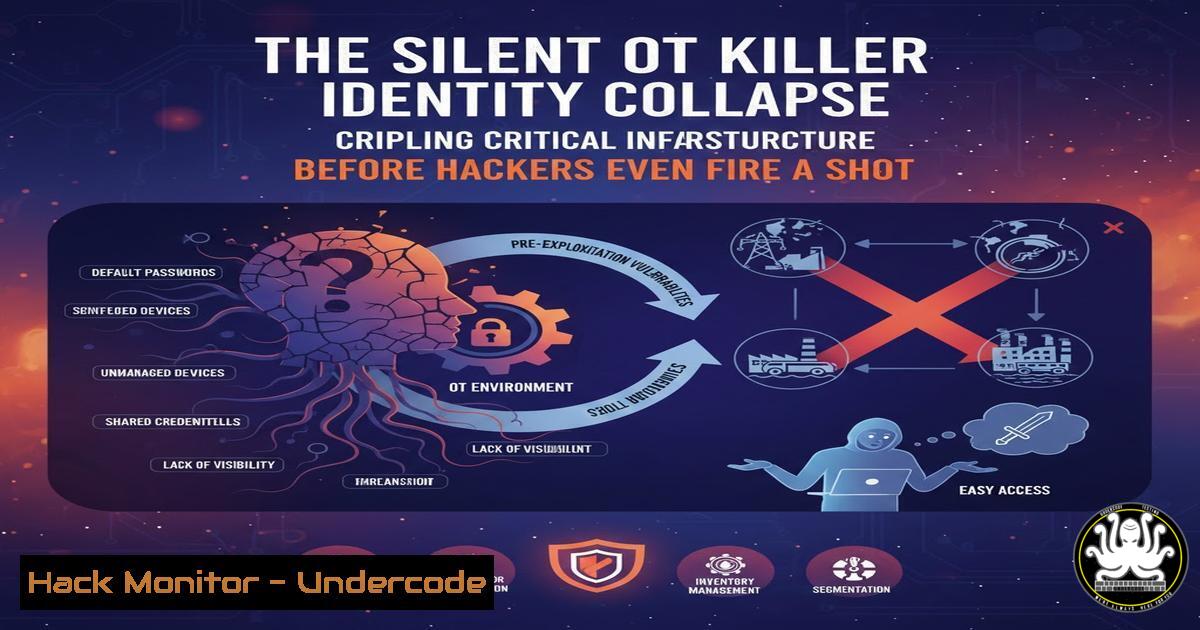
A maintenance ticket for desynced handheld scanners in Western Europe revealed a terrifying reality: the problem wasn’t malware or a firewall breach, but a single, shared operational technology (OT) maintenance account used from different countries and unchanged for years. This “identity collapse” represents the primary attack vector in modern industrial cyber warfare. Attackers no longer target fortified perimeters; they exploit legitimate, overprivileged, and poorly managed credentials to cause physical disruption—stalling conveyors, misrouting goods, and halting production through logins every dashboard marks as green.
Learning Objectives:
- Understand why legacy OT systems are inherently vulnerable to identity-based attacks and the concept of “identity collapse.”
- Learn the core pillars and practical steps for implementing Privileged Access Management (PAM) in an OT environment.
- Master actionable commands and strategies for auditing, securing, and monitoring privileged identities on both Windows and Linux-based industrial assets.
You Should Know:
- The OT Identity Crisis: Why Legacy Systems and Shared Accounts Are Your Greatest Vulnerability
The foundational challenge in OT security is technological friction. Many critical systems, from Human-Machine Interfaces (HMIs) running Windows XP to decades-old SCADA software, cannot support modern identity controls like Multi-Factor Authentication (MFA) or frequent password rotations without risking operational disruption. This forces teams to rely on shared, static credentials for vendors and maintenance, creating a “set-and-forget” identity model.
Step-by-Step Guide to Initial Identity Discovery:
What this does: You cannot secure what you cannot see. The first step is a non-intrusive discovery of all accounts on OT assets, focusing on Windows-based HMIs and engineering workstations which are common entry points.
How to use it: From a command prompt on a Windows OT asset, run:
:: List all local user accounts
net user

:: Get detailed information about a specific user (e.g., a shared 'maintenance' account)
net user [bash]

:: Query active sessions and see who is logged into the system (helps identify shared account use)
query user
Next Step: Catalog every discovered shared or generic account (e.g., admin, maintenance, vendor). For each, document the system it’s on, its purpose, and who is supposed to use it. This manual inventory is the critical first line of defense against invisible risk.
- Pillar 1: Discover and Classify Every Privileged Identity
Discovery goes beyond user accounts. In OT environments, non-human identities like service accounts used by applications (e.g., database services, historian software) are highly privileged and often overlooked. These accounts may have passwords that never expire and are embedded in configuration files.
Step-by-Step Guide to Finding Service Accounts:
What this does: Identifies application service accounts, which are prime targets for lateral movement.
How to use it: On a Windows OT host, use PowerShell to find services not running under standard `SYSTEM` or `NETWORK SERVICE` contexts.
 Get services with custom "Log On As" accounts
Get-WmiObject Win32_Service | Where-Object {$<em>.StartName -notlike "NT AUTHORITY" -and $</em>.StartName -notlike "LocalSystem"} | Select-Object Name, StartName, State
Linux OT Systems (e.g., older UNIX-based controllers): Check for processes running with root privileges.
 Find processes running as root
ps -ef | grep "^root"

Check the /etc/passwd file for system accounts (UID < 1000)
cat /etc/passwd | awk -F: '$3 < 1000 {print $1 " (UID:"$3")"}'
Action: Move all discovered privileged identities—human and machine—into a central register. This is the cornerstone of the PAM “Discover” pillar.
- Pillar 2: Secure with Least Privilege and Zero Trust
The core principle is Least Privilege: grant only the minimum access necessary for a task. In OT, this starts with segmenting networks and enforcing granular access controls.
Step-by-Step Guide to Implementing Least Privilege Access:
- Network Segmentation: Isolate OT networks from enterprise IT using industrial firewalls. Within the OT zone, create further segments for critical control loops (e.g., PLCs for safety systems).
- Role-Based Access Control (RBAC): Define roles like “Operator,” “Maintenance Engineer,” and “Vendor.” An operator may only need to view HMI screens, while a vendor engineer might need temporary write access to a specific PLC.
3. Enforce Strong, Unique Authentication:
Where possible, enforce MFA for all remote access and for local logins to critical assets.
For legacy systems that don’t support MFA, implement compensating controls. Place them behind a jump server (bastion host) that does enforce MFA. All access to the legacy asset must go through this secured gateway.
4. Pillar 3: Automate Credential Lifecycle Management
Manual password management for hundreds of service and shared accounts is impossible at scale and leads to stagnation. Automation is key.
Step-by-Step Guide to Basic Credential Hygiene:
What this does: Automates the rotation of passwords for privileged accounts, a fundamental PAM practice.
Implementation Concept: Use a PAM solution or dedicated scripts to automatically rotate passwords. For OT, rotations must be coordinated with operational schedules.
Example Secure Process:
- The PAM vault generates a new, complex password for the `scada_service` account.
- It updates the password in the vault and on the target SCADA server.
- It then updates the credential in any associated application configuration file or scheduled task.
- All actions are logged, and the old password is immediately retired.
Just-in-Time (JIT) Access: For vendor maintenance, instead of giving permanent credentials, use the PAM system to grant time-bound access (e.g., 4 hours on a Tuesday afternoon). Access is automatically revoked after the window. -
Pillar 4: Audit and Monitor All Privileged Activity
Continuous monitoring is your last line of defense. It allows you to detect anomalous use of valid credentials—the hallmark of an identity-based attack.
Step-by-Step Guide to Proactive Session Monitoring:
What this does: Tracks and records what users do during a privileged session to detect malicious activity.
Critical Commands for Log Analysis:
Windows (Event Logs): Regularly review security logs for event IDs 4624 (logon) and 4625 (logon failure). Look for logons from unusual locations or at strange times.
 Filter recent successful logons from the security event log
Get-WinEvent -FilterHashtable @{LogName='Security'; ID=4624} -MaxEvents 50 | Format-List TimeCreated, Message
Linux (Auth Logs): Monitor `/var/log/auth.log` or `/var/log/secure` for sudo commands and root logins.
 Tail the authentication log in real-time
tail -f /var/log/auth.log

Search for successful sudo escalations
grep "sudo.COMMAND" /var/log/auth.log
Action: Integrate these logs into a Security Information and Event Management (SIEM) system. Set alerts for high-risk actions, such as a service account initiating an interactive login or a vendor account being used outside of a maintenance window.
What Undercode Say:
- Identity is the New, Unmanaged Perimeter: The Colonial Pipeline and KNP breaches prove that attacks pivot on compromised credentials, not just technical exploits. In OT, where availability is paramount, an attacker with a valid login can cause more damage than one with a novel exploit.
- Compliance is a Floor, Not a Ceiling: Standards like IEC 62443 provide a framework, but true security requires going beyond checklists to manage the daily reality of operational friction and legacy constraints. The 2025 Identity Automation Gap report starkly reveals that 96% of organizations still rely on manual identity workflows, creating immense risk.
The analysis is clear: the industrial threat landscape has fundamentally shifted. While ransomware groups evolve, their initial access increasingly relies on exploiting weak identity hygiene. The staggering projection that the PAM market will grow from USD 2.75 billion in 2025 to over USD 7.2 billion by 2030 underscores that organizations are finally recognizing this critical gap. Securing OT is not about adding more firewalls; it’s about rigorously managing trust in an environment built for reliability, not security.
Prediction:
The convergence of IT/OT networks and the proliferation of Industrial IoT will exponentially increase the number of machine identities. Future attacks will increasingly leverage AI to discover and exploit these hidden, privileged service accounts at scale. Organizations that fail to implement automated PAM and identity governance will face not just operational shutdowns, but catastrophic safety incidents. The future of industrial security is a fully authenticated and authorized ecosystem, where every human and machine action is logged, monitored, and granted only just-in-time. The era of permanent, static trust in OT is over.
🎯Let’s Practice For Free:
IT/Security Reporter URL:
Reported By: Antonio Gonzalez – Hackers Feeds
Extra Hub: Undercode MoN
Basic Verification: Pass ✅


