
Listen to this Post
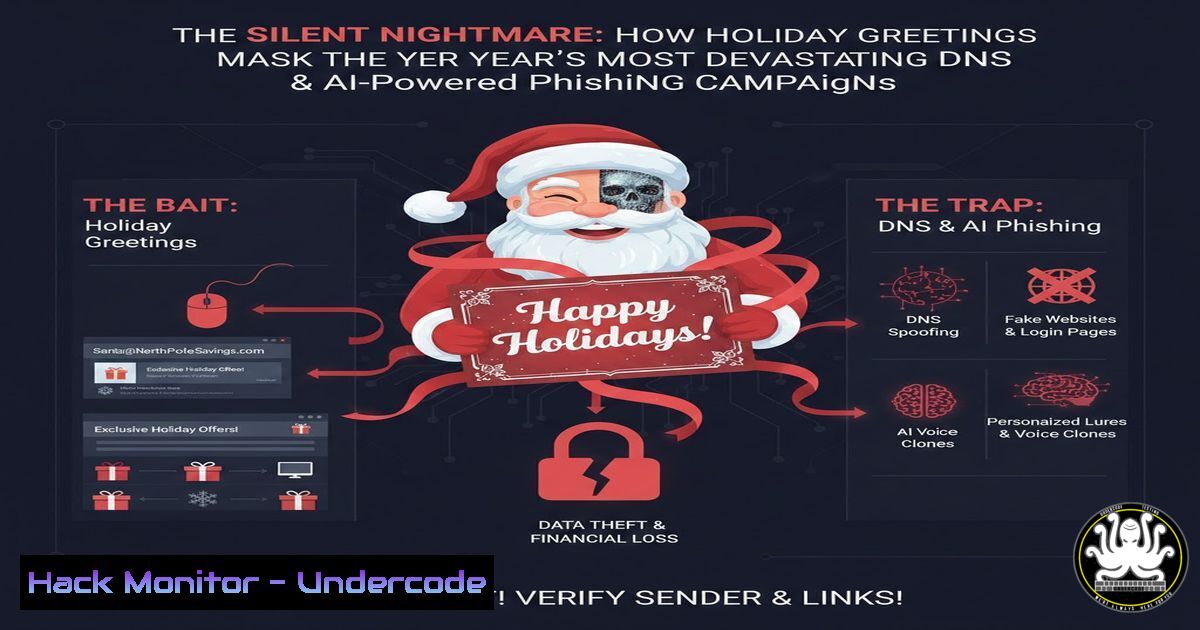
Introduction:
While the festive season brings well-wishes and holiday cheer, cybersecurity experts like Andy Jenkinson remind us that threat actors do not take a vacation. The convergence of advanced AI, ubiquitous cloud assets, and often-overlooked DNS vulnerabilities creates a perfect storm during periods of lowered organizational vigilance. This article deconstructs the technical landscape hinted at by industry leaders, moving from seasonal greetings to the hard truths of internet asset exposure, threat intelligence fusion, and the AI tools that both defend and attack.
Learning Objectives:
- Understand the critical link between DNS misconfigurations, digital asset sprawl, and initial network compromise.
- Learn to deploy command-line tools for continuous attack surface and DNS security auditing.
- Implement a proactive threat intelligence workflow to identify and mitigate phishing and AI-driven social engineering campaigns.
You Should Know:
- Your Digital Footprint is Your Biggest Enemy: Uncovering Asset & DNS Vulnerabilities
The first step in any attack is reconnaissance. Adversaries exploit unknown or unmanaged internet-facing assets—forgotten subdomains, outdated cloud instances, or misconfigured DNS records. The post’s reference to “Internet Asset & DNS Vulnerabilities” is a direct call to action for continuous discovery.
Step‑by‑step guide:
Subdomain Enumeration: Use tools like `amass` and `subfinder` to discover assets.
 Install amass (Kali Linux: sudo apt install amass)
amass enum -passive -d yourcompany.com -o subdomains.txt
 Use subfinder for additional results
subfinder -d yourcompany.com -o subdomains_alt.txt
sort -u subdomains.txt > final_subdomains.txt
DNS Record Auditing: Query for sensitive records that may leak information.
 Use dig to check for common record types
for sub in $(cat final_subdomains.txt); do
echo "=== $sub ==="
dig A $sub +short
dig TXT $sub +short
dig MX $sub +short
done
Vulnerability Check: Probe for dangling CNAME records pointing to deprovisioned cloud resources.
 Check for common cloud CNAME targets
grep -E '.cloudapp.net|.azurewebsites.net|.s3.amazonaws.com' final_subdomains.txt
This process maps your true attack surface, revealing shadow IT and misconfigurations before attackers do.
- Weaponizing Video Insights: How AI Analyzes Content for Phishing 2.0
The LinkedIn marketing message highlights a powerful truth: AI analyzes thousands of videos to find what engages. In adversarial hands, this same technology—machine learning on human communication—powers hyper-personalized phishing (spear-phishing). By scraping public videos and posts, AI can mimic writing styles, identify key relationships (like those in a comment thread), and generate convincing fraudulent messages.
Step‑by‑step guide:
Mitigation via Awareness and Technical Controls:
- Implement DMARC, DKIM, and SPF: Harden your email domain to prevent spoofing.
Example dig command to check your current DNS records
dig TXT yourcompany.com
dig TXT _dmarc.yourcompany.com
- User Training: Conduct mandatory training on AI-generated phishing, focusing on the holiday season when urgency and goodwill are exploited.
- API Security: Secure social media and marketing platform APIs (where AI scrapers harvest data) with strict rate limiting, OAuth scopes, and anomaly detection.
-
From Fractal AI to Circular Economy: The New Threat Intelligence Paradigm
A comment mentions “Fractal AI and Circular Economy.” In a cybersecurity context, this mirrors a modern threat intelligence strategy: a self-similar, adaptive defense (Fractal AI) that learns at every scale, and a “circular” system where threat data is continuously fed back to improve defenses. It’s about creating a resilient, intelligent system.
Step‑by‑step guide: Building a Basic Threat Intel Feed Integrator:
import requests
import json
 Example: Fetching from a free threat intel feed (e.g., AbuseIPDB)
API_KEY = 'your_abuseipdb_key_here'
url = 'https://api.abuseipdb.com/api/v2/blacklist'
headers = {'Key': API_KEY, 'Accept': 'application/json'}
params = {'limit': 100, 'confidenceMinimum': 90}
response = requests.get(url, headers=headers, params=params)
if response.status_code == 200:
data = response.json()
for entry in data['data']:
ip = entry['ipAddress']
score = entry['abuseConfidenceScore']
print(f"Blocking IP {ip} with confidence {score}%")
 Integrate with firewall (e.g., Linux iptables)
 os.system(f"sudo iptables -A INPUT -s {ip} -j DROP")
This simplistic example shows the feedback loop: ingest, analyze, act.
- Cloud Asset Hardening: Locking Down Your Festive Fortress
Holiday rollouts often mean rushed cloud deployments. A single misconfigured S3 bucket, Azure Blob container, or database firewall rule can gift-wrap your data for attackers.
Step‑by‑step guide: AWS S3 Bucket Audit Script:
!/bin/bash
 Audit S3 buckets for public read access
for bucket in $(aws s3api list-buckets --query "Buckets[].Name" --output text); do
echo "Checking bucket: $bucket"
 Check bucket ACL
aws s3api get-bucket-acl --bucket $bucket | grep -q "AllUsers" && echo " [bash] Public ACL found on $bucket"
 Check bucket policy
aws s3api get-bucket-policy-status --bucket $bucket 2>/dev/null | grep -q "IsPublic" && echo " [bash] Bucket policy may allow public access"
 Check for unencrypted default
aws s3api get-bucket-encryption --bucket $bucket 2>/dev/null || echo " [bash] No default encryption configured on $bucket"
done
Run this regularly to ensure configurations don’t drift into a vulnerable state.
- The Human Firewall: The Ultimate Defense During the Holiday Slowdown
The post’s friendly comments section underscores the human network—the primary target. During holidays, with skeleton crews, a single crafted message to a distracted employee can bypass millions in tech defense.
Step‑by‑step guide: Simulating a Phishing Campaign (For Authorized Training Only):
1. Use a framework like GoPhish or King Phisher to set up a controlled campaign.
2. Craft a holiday-themed lure (e.g., “Your Year-End Bonus Notification” or “Company Holiday Party Details Update”).
3. Measure click-through and credential-entry rates.
- Provide immediate, constructive feedback to users who engage, turning a failure into a learning moment. This continuous “circular” training is essential.
What Undercode Say:
- The Attack Surface is Alive and Growing. It is not a static inventory. The casual professional networking and content sharing evident in the original post are the very data sources that fuel the next generation of AI-powered, personalized attacks. Continuous, automated discovery is non-negotiable.
- Threat Intelligence is Meaningless Without Integration. Mentioning “Fractal AI” and “Circular Economy” is more than buzzwords; they represent the need for security systems that are adaptive, learn from every interaction, and feed defensive insights directly into enforcement points (firewalls, email filters, EDR) in real-time. A report read tomorrow is a compromise today.
The analysis of this festive LinkedIn activity reveals a core cybersecurity irony: our professional openness and seasonal goodwill simultaneously increase organizational risk. The experts cited are, perhaps unintentionally, highlighting the dichotomy of the digital age. The path forward is not to retreat but to evolve defenses to be as dynamic, intelligent, and interconnected as the threats themselves. Security must become a pervasive, intelligent layer—a true circular economy of defense.
Prediction:
The convergence trend will accelerate in 2025-2026. AI will not only personalize phishing but will autonomously discover and chain together vulnerabilities—from a misconfigured DNS record to an over-permissioned cloud identity—to execute full breaches with minimal human intervention. Conversely, AI-driven defense platforms that operate on the “Fractal” and “Circular” principles will become standard, capable of predicting attack paths and auto-remediating issues like public S3 buckets before they are exploited. The era of static, human-paced security is ending.
▶️ Related Video (76% Match):
🎯Let’s Practice For Free:
IT/Security Reporter URL:
Reported By: Andy Jenkinson – Hackers Feeds
Extra Hub: Undercode MoN
Basic Verification: Pass ✅


