
Listen to this Post
Introduction:
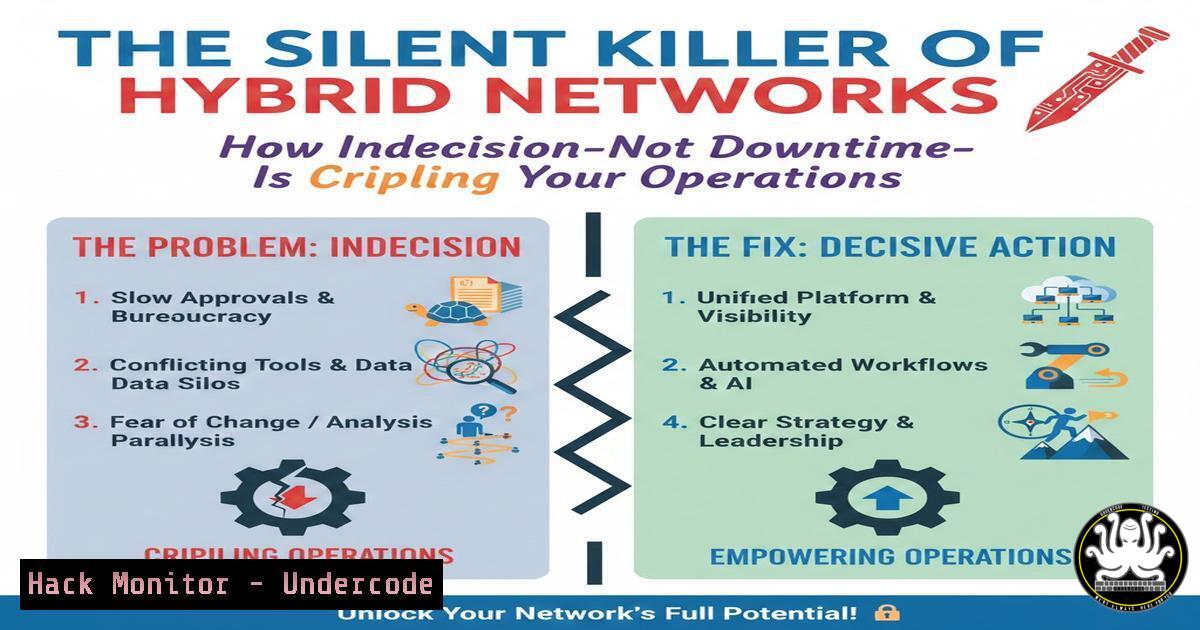
In modern hybrid network environments, the greatest threat isn’t total failure but pathological indecision—where devices perpetually switch between connections like mesh and LTE. This creates imperceptible micro-outages of packet loss and jitter that dashboards miss but humans and critical operations instantly feel, leading to frozen video feeds, jumpy tele-operations, and eroded trust in system reliability.
Learning Objectives:
- Understand the concept of “link-switching indecision” and its impact on real-time applications.
- Learn to implement a multi-homed architecture with active-active paths.
- Configure intelligent switching logic using measurable triggers like latency and packet loss, not just signal strength.
You Should Know:
1. Architecting for Resilience: Multi-Homing and Active-Active Paths
The core solution is to avoid a single point of failure by maintaining multiple active connections simultaneously. This isn’t simple load balancing; it’s ensuring session persistence even when the underlying physical path changes.
Step-by-Step Guide:
On a Linux system, you can establish multi-homing using multiple routing tables and policy-based routing. First, identify your network interfaces (e.g., `eth0` for mesh, `wwan0` for LTE).
 1. Create two new routing tables in /etc/iproute2/rt_tables
echo "200 mesh" >> /etc/iproute2/rt_tables
echo "201 lte" >> /etc/iproute2/rt_tables

<ol>
<li>Add default routes for each interface to its respective table
ip route add default via <mesh_gateway> dev eth0 table mesh
ip route add default via <lte_gateway> dev wwan0 table lte</p></li>
<li><p>Add rules to direct traffic from each interface's IP to its table
ip rule add from <mesh_ip> table mesh
ip rule add from <lte_ip> table lte</p></li>
<li><p>Set a default rule for outbound traffic (optional, based on preference)
ip rule add from all lookup main pref 32766
This setup allows both links to be used. The key is an overlay that abstracts these paths.
- Building the Overlay: Secure Tunnels for Session Persistence
An overlay network (like a WireGuard or IPsec tunnel) creates a consistent virtual interface. Your application sessions bind to this stable tunnel endpoint, not the physical interfaces that may flip.
Step-by-Step Guide:
Configure a WireGuard tunnel that uses both interfaces as potential peers. The `wg` interface will have its own IP, and routing will direct traffic into it.
 Sample WireGuard config (/etc/wireguard/wg0.conf)
[bash]
Address = 10.10.0.1/24
PrivateKey = <your_private_key>
ListenPort = 51820
Table = off  We will manage routing manually
PostUp = ip rule add from 10.10.0.0/24 lookup 100
PostUp = ip route add default via 10.10.0.2 dev wg0 table 100

[bash]  Endpoint reachable via Mesh
PublicKey = <mesh_peer_pubkey>
Endpoint = <mesh_peer_ip>:51820
AllowedIPs = 0.0.0.0/0
PersistentKeepalive = 25

[bash]  Endpoint reachable via LTE
PublicKey = <lte_peer_pubkey>
Endpoint = <lte_peer_ip>:51820
AllowedIPs = 0.0.0.0/0
PersistentKeepalive = 25
The `AllowedIPs = 0.0.0.0/0` for both peers enables multipath routing at the overlay layer. The `PostUp` commands route all traffic from the tunnel into a separate table (100) with a default gateway inside the tunnel.
3. Engineering Intelligence: Switching Logic That Works
Switching must be based on application-layer metrics, not just Layer 1 signal strength (RSSI). Use latency and packet loss as primary triggers, with signal strength as a warning.
Step-by-Step Guide:
Implement a monitoring script that uses `ping` or `mtr` and modifies routing priorities. This example uses `ping` to test latency and loss to a critical gateway.
!/bin/bash
 monitor_link.sh
MESH_GW=<mesh_gateway_ip>
LTE_GW=<lte_gateway_ip>
LOSS_THRESHOLD=2  Percent
LATENCY_THRESHOLD=50  Milliseconds

check_link() {
local gateway=$1
local result=$(ping -c 5 -i 0.2 -q $gateway 2>&1 | tail -2)
local loss=$(echo $result | grep -oP '\d+(?=% packet loss)')
local avg_latency=$(echo $result | grep -oP '/\s\d+.\d/' | cut -d'/' -f2)
loss=${loss:-100}
avg_latency=${avg_latency:-999}
echo $loss $avg_latency
}

read mesh_loss mesh_latency <<< $(check_link $MESH_GW)
read lte_loss lte_latency <<< $(check_link $LTE_GW)

Decision Logic: Prefer mesh unless it breaches thresholds
if (( $(echo "$mesh_loss > $LOSS_THRESHOLD" | bc -l) )) || (( $(echo "$mesh_latency > $LATENCY_THRESHOLD" | bc -l) )); then
 Lower priority of mesh route, prefer LTE
ip route replace default via $LTE_GW dev wwan0 metric 100 table main
ip route replace default via $MESH_GW dev eth0 metric 200 table main
logger "Link Monitor: Switching priority to LTE (Loss:$mesh_loss%, Latency:${mesh_latency}ms)"
else
 Prefer mesh
ip route replace default via $MESH_GW dev eth0 metric 100 table main
ip route replace default via $LTE_GW dev wwan0 metric 200 table main
fi
Schedule this script with `cron` every 10 seconds. The “stay time” is enforced by the script’s interval and hysteresis in the logic.
4. Visibility Beyond Dashboards: Monitoring What Actually Matters
Standard SNMP uptime monitoring is insufficient. You must measure per-path metrics and correlate them with application events.
Step-by-Step Guide:
Implement a lightweight telemetry agent using `tshark` or `tcptrace` to capture packet loss and jitter per interface and feed it into a time-series database like InfluxDB.
 Capture interface statistics and jitter calculations
tshark -i eth0 -a duration:60 -q -z io,stat,1,"SUM(tcp.analysis.lost_segment)tcp.analysis.lost_segment","SUM(tcp.analysis.ack_rtt)tcp.analysis.ack_rtt" -z io,stat,1,"AVG(tcp.analysis.ack_rtt)" > /var/log/mesh_cap.txt
 Parse and send to InfluxDB line protocol
echo "network_metrics,interface=eth0 lost_segments=$(grep ...) $(date +%s%N)" >> /tmp/telegraf_input
Correlate these metrics with application logs using timestamps to “prove the issue exists.”
5. Security Hardening the Hybrid Edge
Multi-homing increases attack surface. Each link must be secured. Implement strict firewall rules and consider a zero-trust network access (ZTNA) model.
Step-by-Step Guide:
Use `nftables` (or iptables) to restrict traffic per interface. Only allow overlay tunnel ports and essential monitoring.
 nftables rules for wwan0 (LTE)
nft add rule inet filter input iif wwan0 ct state {established, related} accept
nft add rule inet filter input iif wwan0 udp dport 51820 accept  WireGuard
nft add rule inet filter input iif wwan0 icmp type echo-request accept
nft add rule inet filter input iif wwan0 drop
Additionally, use IPsec to encrypt LTE traffic even before it hits the overlay if the carrier network is untrusted.
6. Automating Failure Response with Orchestration
Manual intervention is too slow. Use orchestration tools like Ansible or SaltStack to push new routing policies or failover configurations when anomalies are detected.
Step-by-Step Guide:
Create an Ansible playbook triggered by a monitoring alert (e.g., from Prometheus Alertmanager) to reconfigure priority.
 failover_to_lte.yml
- hosts: edge_device
tasks:
- name: Set LTE as primary route
shell: |
ip route change default via {{ lte_gateway }} dev wwan0 metric 50
ip route change default via {{ mesh_gateway }} dev eth0 metric 150
register: route_change
- name: Log the change
debug:
msg: "Forced failover to LTE executed at {{ ansible_date_time.iso8601 }}"
What Undercode Say:
- The Dashboard Lie: Traditional network health dashboards that only report uptime or signal strength create a dangerous illusion of stability. The real metrics—sub-second latency spikes and micro-bursts of packet loss during handovers—are often invisible without targeted, application-aware monitoring.
- Intelligence Beats Strength: A “stronger” signal (RSSI) does not mean a better path. Switching logic must be rooted in layer 3/4 metrics (latency, loss) and, ideally, layer 7 application health checks to prevent the destructive ping-pong effect that degrades user experience.
The core analysis reveals that hybrid network instability is frequently a control plane problem, not a data plane failure. The solution isn’t merely redundant links but a smarter decision engine that uses application-centric telemetry to govern path selection. This requires moving beyond traditional networking paradigms into the realm of intent-based networking, where the system’s goal (“provide a seamless operator experience”) dictates configuration, not just reactive link-up/link-down events.
Prediction:
Within the next 2-3 years, as IoT and edge computing proliferate, we will see the rise of AI-driven, application-aware network switching stacks at the edge. These systems will use predictive analytics, learning normal latency patterns and pre-emptively routing traffic before congestion or loss occurs. Furthermore, this will converge with zero-trust security models, where every path change is authenticated and encrypted, and network slices are dynamically created based on both performance and security policies. The era of dumb, signal-strength-based handoff will end, replaced by autonomous networks that optimize for immutable application requirements rather than mutable link states.
▶️ Related Video (74% Match):
🎯Let’s Practice For Free:
IT/Security Reporter URL:
Reported By: Wisnu Dewandaru – Hackers Feeds
Extra Hub: Undercode MoN
Basic Verification: Pass ✅


