Listen to this Post
Introduction
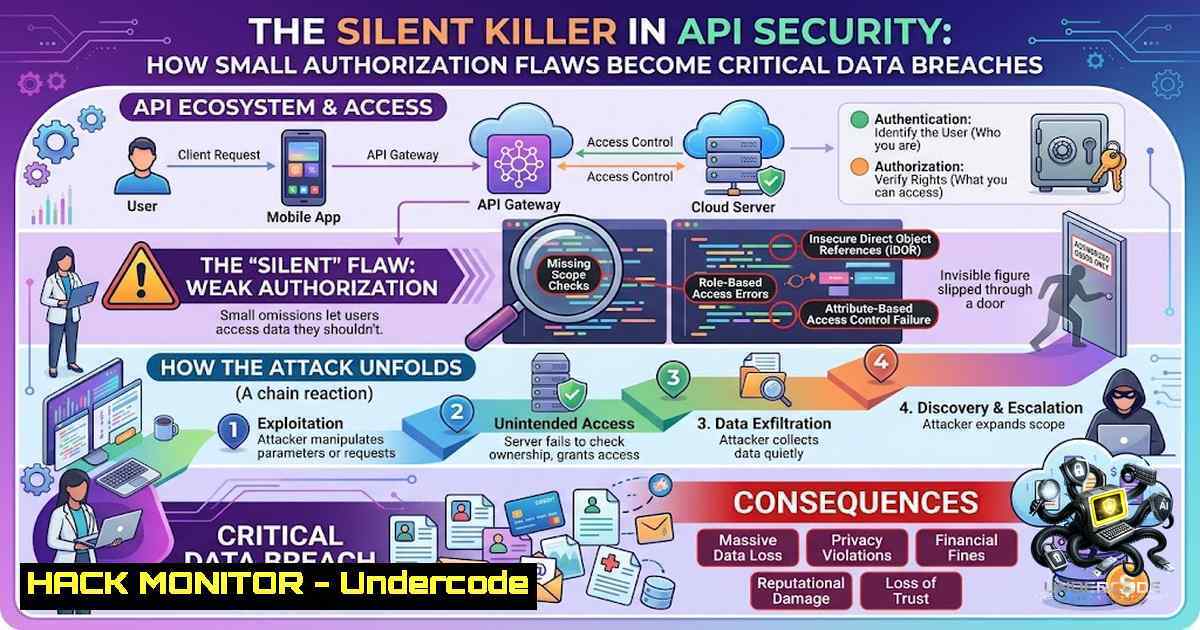
In the world of API security, the most dangerous vulnerabilities are often the quietest ones. Broken Object Level Authorization (BOLA) and Insecure Direct Object References (IDOR) don’t trigger errors, break functionality, or leave obvious traces in logs. Instead, they quietly return valid data to the wrong user. As highlighted by a seasoned bug bounty researcher’s experience with Proton’s program, “small authorization issues can sometimes lead to meaningful findings” — a reminder that the difference between secure and exposed data often comes down to a single permission check.
Learning Objectives
- Understand the fundamental difference between authentication and authorization in API security contexts
- Master step-by-step methodologies for detecting BOLA and IDOR vulnerabilities through multi-session testing
- Learn to configure and use industry-standard tools including Burp Suite, IDOR Hunter Pro, and custom scripting for authorization testing
- Develop practical skills in comparing authorized vs. unauthorized API flows to identify security gaps
You Should Know
1. Understanding BOLA and IDOR: The Core Concepts
Broken Object Level Authorization (BOLA) has occupied the top position in the OWASP API Security Top 10 since its inception in 2019. It occurs when an API authenticates a user but fails to verify whether that user has permission to access a specific object — such as a user record, order, or document.
The critical distinction is simple yet frequently overlooked: authentication proves who you are; authorization determines what you can access. Most API breaches stem from authorization failures, not authentication bypasses. When T-Mobile exposed 37 million customer records in January 2023, the vulnerability was straightforward: an API endpoint that did not verify whether users had permission to access specific data. The Optus breach in Australia was even simpler: an API endpoint requiring no authentication at all, exposing 9.8 million records.
Step-by-Step Guide to Identifying BOLA Targets:
Step 1: Extract Object ID Parameters from API Documentation
 Extract all endpoints with path parameters from OpenAPI/Swagger
curl -s https://target-api.example.com/api/docs/swagger.json | \
python3 -c "
import json, sys
spec = json.load(sys.stdin)
for path, methods in spec.get('paths', {}).items():
for method, details in methods.items():
if method in ('get','post','put','patch','delete'):
params = [p['name'] for p in details.get('parameters',[]) if p.get('in') in ('path','query')]
if params:
print(f'{method.upper()} {path} -> params: {params}')
"
Step 2: Identify common ID patterns — Look for parameters named id, user_id, account_id, order_id, document_id, or UUID patterns in both URL paths and query strings.
Step 3: Test object identifiers across user contexts — Change the object identifier from one user’s resource to another’s and observe whether the API returns data or denies access.
2. Multi-Session Testing Methodology for Authorization Flaws
Detecting BOLA requires testing whether an authenticated user can access objects that belong to another user by manipulating object identifiers in API requests. Because successful exploitation returns a normal `200 OK` response with valid data, there is no signature for traditional scanners to detect. Effective detection requires explicit cross-user testing with multiple authenticated sessions.
Step-by-Step Multi-Session Testing Guide:
Step 1: Set up test accounts — Create at least two user accounts with different privilege levels (e.g., User A and User B).
Step 2: Configure Burp Suite for API testing — Set the proxy listener to 127.0.0.1:8080. Install BApp extensions: Autorize (for automated authorization testing), AuthMatrix, and InQL (for GraphQL).
Step 3: Capture authenticated requests — Proxy your web and mobile applications through Burp Suite to capture actual API traffic. Shadow APIs (undocumented endpoints) often lack security controls applied to documented endpoints.
Step 4: Build an authorization matrix — Document which endpoints each user role can access. Then test every endpoint by accessing other users’ data and admin functions.
Step 5: Execute the BOLA test — Using Burp Repeater, take a request from User A’s session and replace the object identifier with an identifier belonging to User B. If the API returns User B’s data, you’ve found a BOLA vulnerability.
3. Automated Tools for IDOR and BOLA Discovery
While manual testing is essential, automated tools can significantly accelerate the discovery process. Several specialized tools have emerged for detecting these authorization flaws:
IDOR Hunter Pro — An autonomous IDOR vulnerability scanner that detects the pattern where an API returns another user’s data just because you changed a number in the URL. It automates discovery, enumeration, confirmation, and submission-ready reporting.
Quick Start:
git clone https://github.com/IbrahimAbdulqadir/idor-hunter-pro.git
cd idor-hunter-pro
python3 -m venv venv
source venv/bin/activate
pip install -r requirements.txt
playwright install chromium
playwright install-deps chromium
python app.py
Then navigate to `http://127.0.0.1:5000`.
Three Target Discovery Modes:
- Manual Mode — Paste a list of known endpoints; the engine detects ID parameters automatically
- Proxy Mode — Route your browser through the built-in mitmproxy addon; every authenticated request gets scanned in real time
- Crawl Mode — A headless Playwright browser logs in, crawls the site up to 4 levels deep, and captures every API call automatically
IDOR Forge — A powerful tool that dynamically generates and tests payloads, analyzes responses, and reports potential issues.
Basic Usage:
python IDOR-Forge.py -u "https://example.com/api/resource?id=1"
Advanced Usage with Proxy and Custom Headers:
python IDOR-Forge.py -u "https://example.com/api/resource?id=1" -p -m GET --proxy "http://127.0.0.1:8080" -v -o results.csv
python IDOR-Forge.py -u "https://example.com/api/user?id=1" --headers '{"Authorization": "Bearer token"}' --test-values '[1, 2, 3]'
Auto-IDOR-Hunter — A passive Burp Suite extension that hunts for IDOR and BOLA vulnerabilities using 12 distinct bypass techniques. Unlike active scanners that blindly bombard targets, this tool acts as a silent assistant.
4. Comparing Authorized vs. Unauthorized Flows
The most effective way to identify authorization issues is to systematically compare how the API behaves for different users. This involves understanding what “normal” looks like for each privilege level.
Step-by-Step Flow Comparison:
Step 1: Establish baseline — Document all API requests made during a typical authorized flow. Capture request methods, endpoints, parameters, headers, and the full response.
Step 2: Document unauthorized flow — Using a different user account or no authentication, attempt to access the same endpoints. Record what happens — does the API return an error, redirect, or simply omit sensitive data?
Step 3: Identify discrepancies — Look for endpoints where the only difference between authorized and unauthorized access is the object identifier in the request.
Step 4: Test edge cases — Try manipulating:
- Numeric IDs (increment/decrement)
- UUIDs (change one character)
- Base64-encoded identifiers
- Hashed values
Step 5: Check direct URL access — Don’t just test through the UI; test endpoints directly.
5. OAuth and Token-Based Authorization Testing
Modern APIs increasingly rely on OAuth 2.0 and JWT tokens for authorization. These mechanisms introduce their own set of vulnerabilities, particularly around the `redirect_uri` parameter.
Step-by-Step OAuth Authorization Testing:
Step 1: Intercept the OAuth flow — Navigate to the application, click “Login with
," and intercept the authorization request.

Step 2: Identify OAuth parameters — Look for a request similar to:
[bash]
GET /authorize?response_type=code&client_id=3128979333002483118&redirect_uri=https://support.target.com/callback&scope=openid%20profile&state=random_value
Step 3: Test `redirect_uri` validation — Change the `redirect_uri` to an external domain you control:
redirect_uri=https://attacker.com
Step 4: Try common bypass techniques:
- Subdomain abuse: `redirect_uri=https://attacker.com.target.com`
- Path traversal: `redirect_uri=https://target.com/callback/../attacker`
- Open redirect chaining: `redirect_uri=https://target.com/redirect?url=https://attacker.com`
- URL encoding bypass: `redirect_uri=https://target.com%252eattacker.com`
Step 5: Set up Burp Collaborator — In Burp Suite, go to Burp Menu → Burp Collaborator and copy your unique collaborator URL.
Step 6: Craft malicious request — Replace the `redirect_uri` with your Collaborator URL and monitor for leaked authorization codes or tokens.
6. API Security Hardening and Prevention
Step-by-Step Hardening Guide:
Step 1: Implement proper object-level authorization checks — Every API endpoint that accesses a specific resource must verify that the authenticated user owns or has permission to access that resource.
Step 2: Use indirect object references — Instead of exposing database keys directly, use reference maps that are unique per user session.
Step 3: Implement rate limiting — Detect and handle rate limiting to prevent automated enumeration attacks.
Step 4: Regular security testing — Don’t rely solely on automated scanners. Combine them with manual penetration testing.
Step 5: Establish clear scope — Define which endpoints are in scope, maximum requests per minute, and approved testing windows.
Step 6: Never test on production without written authorization.
Step 7: Use OpenAPI specifications and Postman Collections — Upload these to Burp Suite to identify endpoints and detect authentication requirements.
- The Proton Bug Bounty Program: A Model for Responsible Disclosure
Proton’s bug bounty program stands out for its transparency, professionalism, and respect toward security researchers. The program accepts reports via email at `[email protected]` and encourages encryption using their PGP public key. Qualifying vulnerabilities include authentication or authorization flaws, REST API vulnerabilities, and server-side code execution bugs. Rewards range up to USD 100,000 for critical severity findings.
What Undercode Say:
- Small authorization issues can have big impacts — The difference between a secure application and a data breach often comes down to a single permission check.
- Professional bug bounty programs foster better security — Programs like Proton’s that value transparency and researcher respect create a stronger security ecosystem.
- Multi-perspective testing is essential — Effective authorization testing requires testing from multiple user perspectives; you can’t find what you don’t look for.
- Traditional scanners miss authorization flaws — BOLA requests are syntactically valid; they don’t trigger errors or leave obvious traces.
- Documentation is your starting point, not your ending point — OpenAPI specifications and Swagger files provide the foundation, but live traffic capture reveals shadow APIs that often lack security controls.
Prediction
- +1 Authorization vulnerabilities will remain the 1 API security risk through 2027, as the shift to microservices and distributed architectures increases API surface area exponentially.
-
+1 AI-powered authorization testing tools will emerge that can automatically detect anomalous data access patterns across multiple user sessions, reducing false positives and accelerating bug bounty workflows.
-
-1 Organizations that continue to rely solely on automated vulnerability scanners for API security will face increasing breach risks, as these tools fundamentally cannot detect contextual authorization flaws.
-
+1 Bug bounty programs like Proton’s will become the industry standard for API security, with more companies adopting transparent, researcher-friendly disclosure policies.
-
-1 The average time to detect an authorization-related data breach will remain over 200 days, as these vulnerabilities produce no error logs or obvious anomalies.
-
+1 Security researchers who master multi-session authorization testing methodologies will be in high demand, as this skillset remains one of the most effective ways to find critical vulnerabilities.
▶️ Related Video (80% Match):
https://www.youtube.com/watch?v=-AJPXNiV564
🎯Let’s Practice For Free:
🎓 Live Courses & Certifications:
Join Undercode Academy for Verified Certifications
🚀 Request a Custom Project:
Secure, high-velocity infrastructure and disruptive technological engineering. Contact our engineering team for high-tier development and proprietary systems:
[email protected]
💎 Smart Architecture | 🛡️ Secure by Design | ⭐ Trusted by Thousands
IT/Security Reporter URL:
Reported By: Phyowathonewin Bugbounty – Hackers Feeds
Extra Hub: Undercode MoN
Basic Verification: Pass ✅


