Listen to this Post
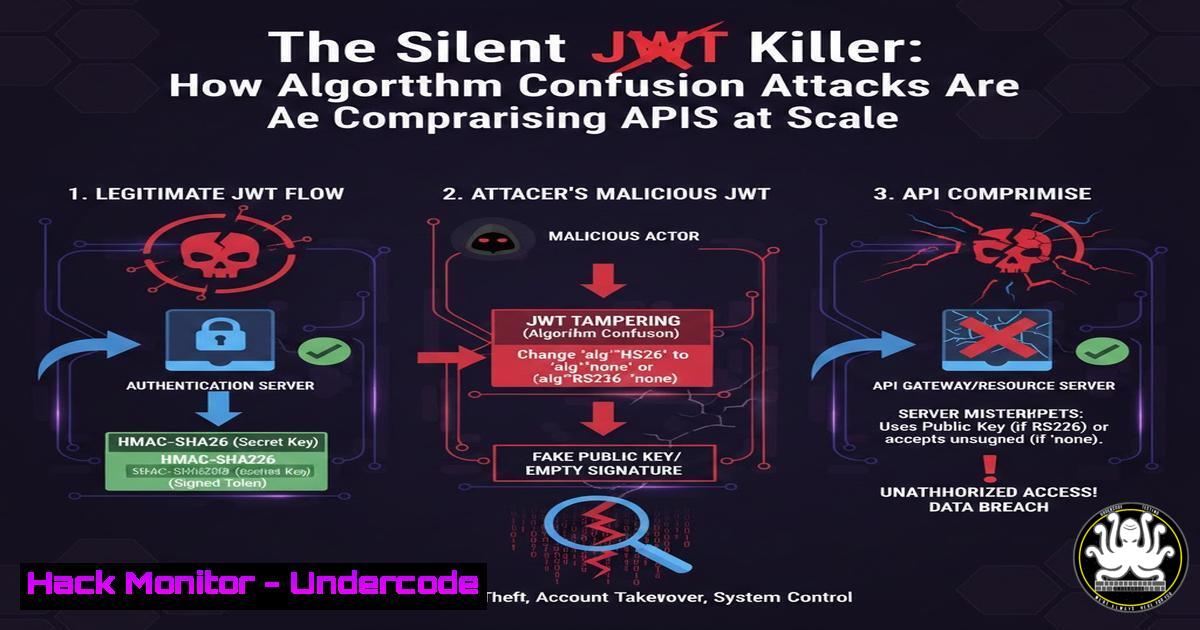
Introduction:
In the architecture of modern web applications, JSON Web Tokens (JWT) have become the cornerstone of authentication and authorization. However, a critical vulnerability known as an algorithm confusion attack (or key confusion attack) threatens this foundation by allowing attackers to forge valid tokens. As highlighted by cybersecurity professionals and training platforms like PortSwigger and PentesterLab, this attack exploits a mismatch between how a server verifies a token’s signature and what it expects, enabling full authentication bypass. Understanding this flaw is essential for developers, red teamers, and security engineers tasked with securing APIs and cloud-native applications.
Learning Objectives:
- Understand the structural components of a JWT and the critical role of the signing algorithm.
- Learn the step-by-step mechanics of both symmetric (HS256) and asymmetric (RS256) algorithm confusion attacks.
- Implement practical mitigations and hardening techniques for Linux/Windows servers and cloud environments.
You Should Know:
1. Deconstructing the JWT and the Algorithm Header
A JWT is a compact, URL-safe token consisting of three Base64Url-encoded parts separated by dots: Header.Payload.Signature. The header typically declares the token type and the signing algorithm (e.g., {"alg":"RS256","typ":"JWT"}). The vulnerability arises when an application’s verification logic is inconsistent. For instance, a server might be configured to use asymmetric RS256 (which uses a private key to sign and a public key to verify) but fails to validate that the incoming token’s `alg` header matches. An attacker can change the header to `HS256` (symmetric HMAC), tricking the server into using the publicly available RS256 public key as the HMAC secret key to verify a forged signature.
2. Step-by-Step Exploitation: From Theory to Token Forgery
The attack path involves token interception, manipulation, and signature forgery. Here’s a practical guide using common tools.
Step 1: Token Capture & Analysis
Intercept a valid JWT using a proxy like Burp Suite or browser developer tools. Decode it using `jwt.io` or the command line:
 Decode the JWT payload on Linux (manual step)
echo "eyJhbGciOiJIUzI1NiIsInR5cCI6IkpXVCJ9.eyJzdWIiOiIxMjM0NTY3ODkwIiwibmFtZSI6IkpvaG4gRG9lIiwiaWF0IjoxNTE2MjM5MDIyfQ" | base64 -d 2>/dev/null | jq
Step 2: Identify the Public Key
Often, the public key is exposed in a standard endpoint like `/jwks.json` or /.well-known/jwks.json. Retrieve it.
 Fetch the JWKS (JSON Web Key Set)
curl -s https://victim.com/.well-known/jwks.json
Step 3: Forge the Malicious Token
Use a tool like `jwt_tool` or a custom Python script to forge a token. Change the `alg` to HS256 and sign the manipulated payload with the extracted public key.
 Using jwt_tool (https://github.com/ticarpi/jwt_tool)
python3 jwt_tool.py <ORIGINAL_JWT> -X a -pk public.pem
Step 4: Submit the Forged Token
Replace the original token in your authenticated request with the newly forged one. If the server is vulnerable, it will accept it as valid, potentially granting elevated access.
3. Lab Environment Setup for Safe Testing
Building a lab is crucial for ethical practice. Use Docker to run a vulnerable API or set up PortSwigger’s Web Security Academy lab (“JWT authentication bypass via algorithm confusion”).
 Example: Pull and run a vulnerable lab environment
docker pull sechallenge/jwt-lab:latest
docker run -d -p 8080:8080 sechallenge/jwt-lab
On Windows, you can use PowerShell to interact with the lab:
 Test connectivity to the lab
Invoke-WebRequest -Uri "http://localhost:8080/api/public-key" -Method Get
4. Mitigation Strategies: Hardening Your JWT Implementation
Prevention requires strict server-side validation and secure configuration.
Step 1: Enforce Algorithm Whitelisting
In your token verification library, explicitly specify the expected algorithm. Do not rely on the token’s header.
 Python PyJWT example - CORRECT
import jwt
public_key = open('public.pem').read()
payload = jwt.decode(token, public_key, algorithms=['RS256'])  Explicitly state algorithm

Python PyJWT example - VULNERABLE
payload = jwt.decode(token, public_key)  Relies on header, vulnerable!
Step 2: Use Separate Key Sets
Never use the same key material for asymmetric and symmetric operations. Keep your HMAC secrets and RSA key pairs completely separate and managed in a secure vault (e.g., AWS KMS, HashiCorp Vault).
Step 3: Implement Key ID (kid) Validation
If using a JWKS, ensure the `kid` parameter in the token header is validated against a trusted list before fetching the corresponding key.
5. Automated Detection and Auditing with Scripts
Incorporate security checks into your CI/CD pipeline. Use a simple audit script to test your own endpoints.
!/bin/bash
 audit_jwt_alg.sh
TARGET_URL="https://your-api.com/login"
JWT=$(curl -s -X POST $TARGET_URL -d 'user=test&pass=test' | jq -r '.token')
if [[ -n "$JWT" ]]; then
ALG=$(echo $JWT | cut -d'.' -f1 | base64 -d 2>/dev/null | jq -r '.alg')
echo "[-] Found JWT using algorithm: $ALG"
 Test for confusion vulnerability (simplified)
python3 jwt_confusion_test.py $JWT
fi
- Cloud-Native Hardening: AWS API Gateway & Azure AD Considerations
In cloud environments, leverage managed services correctly. For AWS API Gateway with custom authorizers:
Ensure your Lambda authorizer code validates the `alg` header.
Store secrets in AWS Secrets Manager, not in environment variables.
For Azure AD, always validate the `iss` and `aud` claims alongside the token signature using the Microsoft Identity Model Extensions for .NET library, which applies strict validation by default.
7. Red Team Tooling: Beyond jwt_tool
Expand your testing toolkit. Use `Burp Suite’s JWT Editor` extension for manual testing during engagements. For reconnaissance, `jwt-heartbreaker` can scan for exposed JWKS endpoints. In post-exploitation, compromised symmetric secrets can be used to forge tokens for lateral movement within an application.
 Using crackjwt to brute-force weak HMAC secrets (for educational purposes)
python3 crackjwt.py -w /usr/share/wordlists/rockyou.txt <JWT_TOKEN>
What Undercode Say:
- The Trust Fallacy: Algorithm confusion is fundamentally a breach of trust in client-provided data. Systems that allow security decisions to be influenced by unverified token headers are architecturally flawed. This extends beyond JWTs to any system where a “hint” from an untrusted source is trusted.
- The Pervasive Risk in Modern Stacks: The vulnerability is often introduced not by custom code, but by misconfigured or default settings in widely-used middleware (e.g., express-jwt, Spring Security OAuth). The rise of microservices and third-party API integrations has exponentially increased the attack surface, making automated secret and key management non-negotiable.
The analysis suggests that while the attack is technically simple, its root cause is a persistent gap between cryptographic theory and developer implementation. Training that focuses solely on “how to fix” without explaining “why this breaks” leads to repetitive mistakes. Platforms like PortSwigger Academy and PentesterLab excel by embedding the attack within a realistic context, forcing practitioners to understand the underlying protocol. The real danger isn’t the complexity of the exploit, but its high impact combined with low detection rates in standard SAST and DAST scans, making it a favorite for persistent red team access.
Prediction:
Algorithm confusion attacks will evolve alongside authentication standards. As JWTs remain prevalent and new standards like DPOP (Demonstrating Proof of Possession) tokens emerge, similar confusion vulnerabilities will likely appear in different forms. The future impact will be amplified by AI-assisted code generation; if AI models are trained on vulnerable code patterns, they may inadvertently propagate these flaws at scale. Furthermore, the increasing complexity of key orchestration in hybrid and multi-cloud environments will create new misconfiguration opportunities. Proactive defense will shift left towards “cryptographic policy as code,” where desired algorithms and key sources are declaratively enforced across the entire CI/CD and runtime pipeline, making unsafe configurations impossible to deploy.
▶️ Related Video (82% Match):
🎯Let’s Practice For Free:
IT/Security Reporter URL:
Reported By: Karan Kurani – Hackers Feeds
Extra Hub: Undercode MoN
Basic Verification: Pass ✅


