Listen to this Post
Introduction:
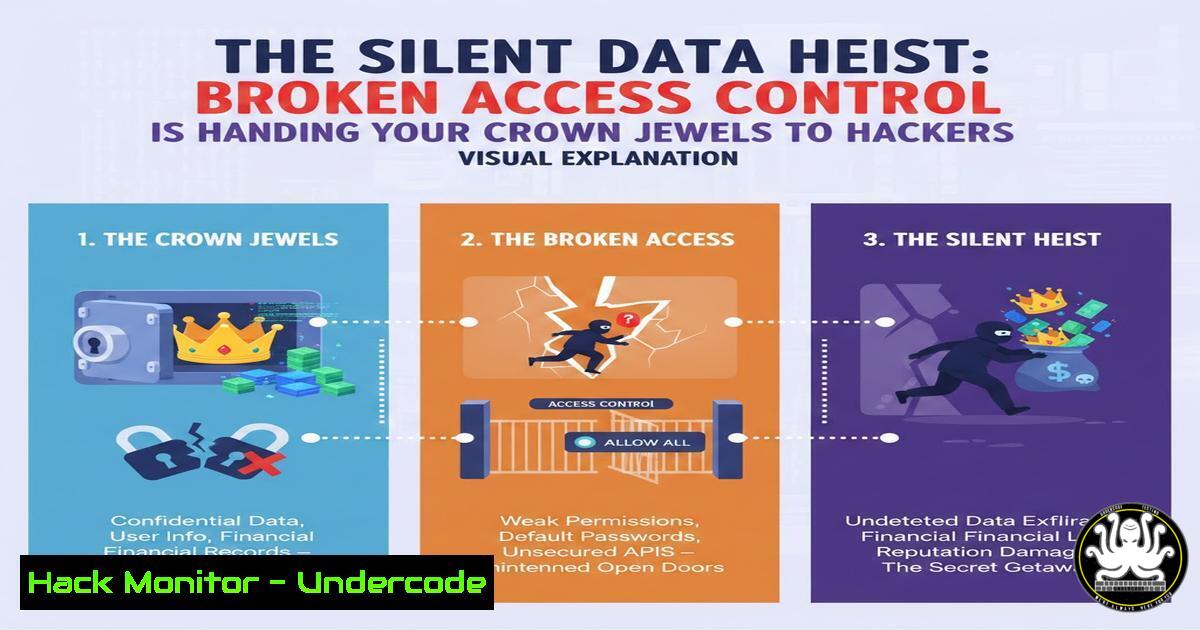
Broken Access Control (BAC) consistently ranks as a critical security risk in the OWASP Top 10, representing a fundamental flaw in how applications enforce user permissions. When authorization checks fail, ordinary users can perform actions reserved for administrators, accessing, modifying, or deleting sensitive data they should never see. This vulnerability turns a simple web application into a free-for-all, exposing everything from personal user details to critical business intelligence.
Learning Objectives:
- Understand the core mechanisms and common types of Broken Access Control vulnerabilities.
- Learn to identify and exploit Vertical and Horizontal Privilege Escalation flaws in a testing environment.
- Implement robust mitigation strategies using principle-based access control and server-side enforcement.
You Should Know:
1. The Anatomy of Broken Access Control
Broken Access Control occurs when an application fails to verify a user’s privileges before allowing access to a specific resource or function. It’s not a single bug but a category of failures in the authorization layer. The most common types are Vertical Privilege Escalation (a regular user gains admin-level access) and Horizontal Privilege Escalation (one user accesses another user’s data of the same privilege level). This often happens due to insecure direct object references (IDOR), path traversal, or missing authorization checks on API endpoints.
Imagine a URL like /admin/userManagement. A developer might hide the link from non-admin users in the UI but forget to implement a server-side check. Any user who guesses or discovers the endpoint can access it directly, leading to a vertical escalation.
2. Hunting for IDOR Vulnerabilities: A Step-by-Step Demo
Insecure Direct Object Reference is a classic BAC flaw where an application exposes a reference to an internal object, like a file, database key, or user account. Attackers can manipulate these references to access unauthorized data.
Step-by-Step Guide:
Step 1: Reconnaissance. Log into an application and note any unique identifiers in the URLs or HTTP parameters when accessing your data. Common examples are ?user_id=123, ?account=456, or /invoices/789.
Step 2: Manipulation. Change the parameter’s value. If you are user_id=100, try `user_id=101` or user_id=99.
Step 3: Observation. If the application returns another user’s data instead of an “Access Denied” error, you have successfully found an IDOR vulnerability.
Example HTTP Request/Response:
 Your legitimate request
GET /api/v1/orders?user_id=100 HTTP/1.1
Authorization: Bearer your_token_here

Response: Returns your orders.

Attacker's manipulated request
GET /api/v1/orders?user_id=101 HTTP/1.1
Authorization: Bearer your_token_here

Response: If broken, returns user 101's orders.
3. Exploiting Path Traversal for File Access
Path Traversal is a BAC flaw that allows attackers to read arbitrary files on the server by manipulating file paths.
Step-by-Step Guide:
Step 1: Identify a parameter that seems to load a file, such as `?file=report.pdf` or ?page=user_profile.html.
Step 2: Use traversal sequences to climb the directory tree. The classic payload is `../../../etc/passwd` to read the Linux password file.
Step 3: Observe the server’s response. A successful exploit will display the contents of the target file.
Example Linux/Windows Payloads:
 Linux
curl -H "Authorization: Bearer <token>" "https://vulnerable-site.com/download?file=../../../etc/passwd"

Windows
curl -H "Authorization: Bearer <token>" "https://vulnerable-site.com/download?file=..\..\..\windows\system32\drivers\etc\hosts"
4. Bypassing UI-Based Controls
A common developer mistake is relying solely on user interface (UI) changes to enforce access control. Buttons or links for admin functions might be hidden from regular users, but the underlying API endpoints remain fully accessible.
Step-by-Step Guide:
Step 1: Use a proxy tool like Burp Suite or OWASP ZAP to intercept all HTTP traffic.
Step 2: As a regular user, perform actions and observe the API calls being made.
Step 3: Manually send a request to an admin endpoint (e.g., POST /api/admin/createUser) that was never displayed in your UI. If the request is successful, you’ve bypassed the UI control.
- Mitigation 1: Implement a Principle-Based Access Control Model
The most robust defense is to adopt a principle-based model where every request is verified against a set of policies. “Role-Based Access Control” (RBAC) is a common and effective pattern.
Implementation Steps:
Step 1: Define clear roles (e.g., User, Moderator, Admin).
Step 2: Create a central access control logic or middleware that checks the user’s role/permissions for every request before processing it.
Step 3: Deny by default. Only allow an action if it is explicitly permitted for the user’s role.
Example Pseudocode Middleware:
 Python Flask Example
from functools import wraps

def requires_role(role):
def decorator(f):
@wraps(f)
def decorated_function(args, kwargs):
if current_user.role != role:
return jsonify({"error": "Forbidden"}), 403
return f(args, kwargs)
return decorated_function
return decorator

@app.route('/admin/deleteUser/<user_id>')
@requires_role('Admin')  This check happens on the server for every request
def delete_user(user_id):
 ... delete logic ...
- Mitigation 2: Avoid Direct Object References & Use Indirect Maps
Instead of exposing internal keys like database IDs, use indirect references that are mapped server-side.
Step-by-Step Guide:
Step 1: When presenting a list of resources to a user (e.g., their documents), generate a random, unique UUID or a hashed value for each item instead of using the sequential database ID.
Step 2: Store a mapping between these indirect references and the real internal IDs on the server.
Step 3: When a request comes in with a UUID (e.g., GET /documents/uuid_here), the server looks up the real internal ID, and verifies that the currently logged-in user owns it, before fetching the data. This makes parameter manipulation ineffective.
7. Automated Testing with OWASP ZAP
Automate the discovery of BAC flaws using security tools.
Step-by-Step Guide:
Step 1: Authenticate to your web application in OWASP ZAP as two different users (e.g., a low-privilege user and a high-privilege user).
Step 2: Use the “Access Control” add-on in ZAP. Configure the testing context by specifying the low and high privilege users.
Step 3: Run the scan. ZAP will attempt to access URLs and functions recorded for the high-privilege user while using the low-privilege user’s session, automatically flagging any successful accesses as potential Broken Access Control.
What Undercode Say:
- Authorization is a Server-Side Mandate. Trusting the client, the UI, or hidden endpoints for security is a catastrophic design flaw. Every single request must be validated against authorization policies on the server.
- The Principle of Least Privilege is Non-Negotiable. Users and system components should only have the minimum permissions necessary to perform their function. This limits the blast radius of any potential BAC flaw.
The persistence of Broken Access Control at the top of vulnerability lists is less about technical complexity and more about a fundamental misunderstanding of trust boundaries. Developers often focus on user experience and functionality, treating authorization as a secondary feature rather than a core security requirement. This creates a landscape where simple, automated scripts can exfiltrate massive datasets without exploiting a single complex software bug. The mitigation is conceptually simple—enforce checks server-side for every request—but requires a cultural shift to “security by design” where authorization is woven into the fabric of the application architecture, not bolted on as an afterthought.
Prediction:
As applications continue to evolve into complex, API-driven microservices architectures, the attack surface for Broken Access Control will expand exponentially. We will see a sharp rise in BAC exploits targeting GraphQL endpoints and cloud-native serverless functions (e.g., AWS Lambda, Azure Functions), where traditional perimeter security is absent and improperly configured IAM roles and event permissions become the new IDOR. The industry’s push towards zero-trust architecture is a direct response to this, fundamentally requiring that every access request be authenticated and authorized, making robust access control not just a feature, but the foundation of modern application security.
🎯Let’s Practice For Free:
IT/Security Reporter URL:
Reported By: Olivia Elena – Hackers Feeds
Extra Hub: Undercode MoN
Basic Verification: Pass ✅


