Listen to this Post
Introduction:
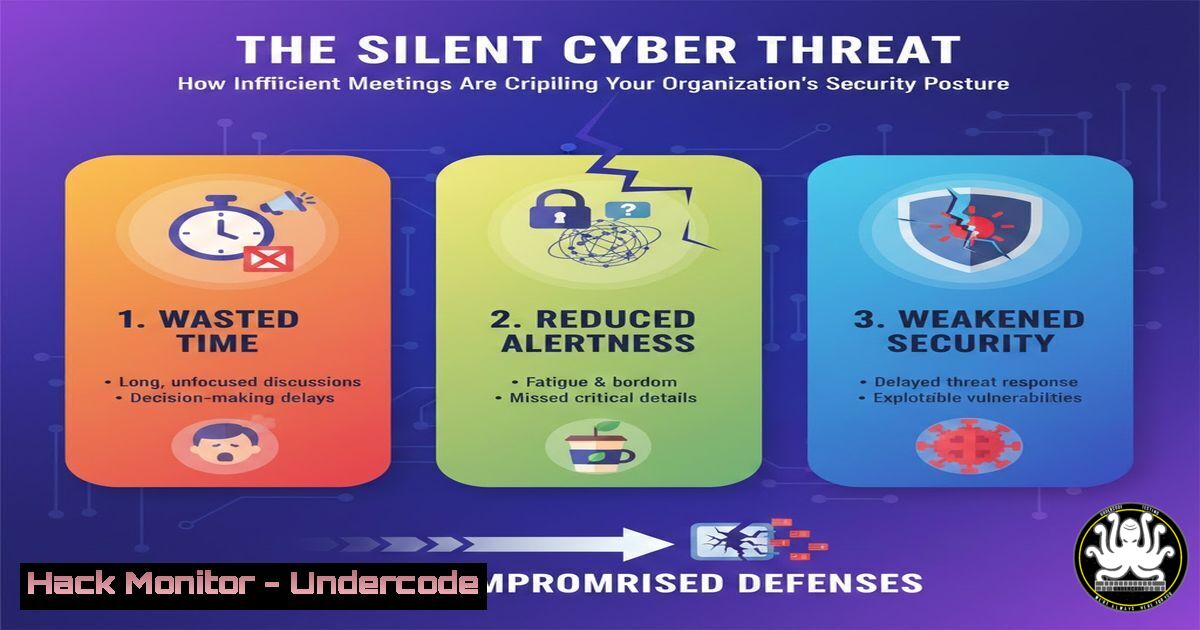
In today’s hyper-connected digital landscape, organizational vulnerabilities extend far beyond unpatched software to include fundamental operational inefficiencies. The epidemic of unproductive meetings, costing economies billions annually, creates critical security gaps by diverting precious time from essential cybersecurity hygiene practices, documentation, and proactive threat monitoring. This silent drain on resources represents a substantial attack vector that sophisticated threat actors increasingly exploit.
Learning Objectives:
- Identify how meeting inefficiency creates specific cybersecurity vulnerabilities in supply chain and IT operations
- Implement technical controls and communication protocols to reclaim security-critical time
- Establish secure, asynchronous communication frameworks that reduce meeting dependency while enhancing audit trails
You Should Know:
- The Meeting-Security Gap: How Wasted Time Directly Creates Vulnerabilities
Extended Analysis:
When security teams and IT personnel spend 35 million daily meetings discussing rather than doing, vulnerability windows widen exponentially. The 90-minute meeting described represents 90 minutes where security patches remain unapplied, log analysis goes unperformed, and threat detection rules stay unwritten. This creates a direct correlation between meeting inefficiency and security debt—the accumulating security tasks that remain incomplete due to resource misallocation.
Step-by-Step Guide:
- Conduct a meeting audit using calendar analytics to identify security-critical teams with >15 hours weekly in meetings
- Implement the following PowerShell command to extract meeting analytics from Microsoft 365 environments:
Get-CSVMailboxFolderStatistics -Identity "[email protected]" -FolderType Calendar |
Export-CSV "C:\audit\meeting_analysis.csv" -NoTypeInformation
- Cross-reference high-meeting-load periods with security incident reports to identify correlation patterns
- Establish a “security time debt” metric calculating hours diverted from essential security activities
- Silent Voices, Critical Vulnerabilities: The Security Intelligence You’re Missing
Extended Analysis:
The “quiet team member” phenomenon represents more than missed innovation—it constitutes a critical intelligence failure in security contexts. Junior security analysts, system administrators, and network operators often possess unique observational data about system anomalies, suspicious patterns, or configuration drift that never surfaces in dominated meeting conversations. This creates intelligence silos where critical threat indicators remain undiscovered.
Step-by-Step Guide:
- Implement pre-meeting intelligence gathering using secure forms or encrypted collaboration platforms
- Establish anonymous reporting channels for security observations using tools like:
 Set up encrypted suggestion system
sudo apt install gnupg
gpg --gen-key
echo "security_observation" | gpg --encrypt --armor --recipient [email protected]
- Create rotating “security intelligence brief” responsibilities ensuring all team members present findings
- Utilize threat intelligence platforms with collaborative features that capture input from all security personnel
- Asynchronous Communication as Security Control: Implementing Secure Alternatives
Extended Analysis:
The shift from meetings to emails, Slack, and phone calls represents more than efficiency—it creates immutable audit trails essential for security incident response and compliance. Asynchronous communication provides timestamped evidence chains critical for forensic investigations, while reducing the “context switching” that causes security oversights and configuration errors.
Step-by-Step Guide:
- Implement encrypted communication channels for security-critical discussions:
 Configure Signal CLI for secure team messaging
sudo apt install signal-cli
signal-cli -u +1234567890 register
signal-cli -u +1234567890 send -m "Security Update Required" +0987654321
- Establish message retention policies aligned with compliance requirements
- Create structured communication templates for security incidents ensuring consistent data capture
- Implement automated logging of all security-related communications to SIEM systems
- Supply Chain Attack Vectors: When Meeting Culture Obscures Critical Dependencies
Extended Analysis:
The supply chain war room scenario represents a microcosm of third-party risk management failures. Inefficient meeting structures delay critical vulnerability disclosures to partners, slow patch deployment across interconnected systems, and create communication gaps that attackers exploit in sophisticated supply chain attacks. The logistics manager’s postponed work likely includes security documentation and vendor compliance checks.
Step-by-Step Guide:
- Automate vendor security assessment using API integrations:
import requests
def vendor_security_scan(vendor_url):
headers = {'User-Agent': 'Security-Scanner/1.0'}
response = requests.get(vendor_url + '/security.txt', headers=headers)
if response.status_code == 200:
return parse_security_info(response.text)
else:
log_security_gap(vendor_url)
- Implement Software Bill of Materials (SBOM) exchange protocols with partners
- Establish automated security posture reporting between supply chain participants
- Create shared vulnerability management portals reducing meeting dependency
5. Time-Based Security Metrics: Quantifying the Meeting Impact
Extended Analysis:
The $250 billion productivity loss represents quantifiable security risk when translated into missed security activities. Each unnecessary meeting directly impacts Mean Time to Detection (MTTD) and Mean Time to Response (MTTR)—two critical security metrics. Organizations must calculate the “security opportunity cost” of meeting culture to properly allocate defensive resources.
Step-by-Step Guide:
- Implement security productivity monitoring:
-- Query security ticket resolution times during high-meeting periods
SELECT ticket_id, creation_time, resolution_time, meeting_hours
FROM security_tickets
JOIN calendar_analytics ON DATE(creation_time) = meeting_date
WHERE meeting_hours > 2;
- Establish baseline security task completion rates during meeting-light periods
- Calculate meeting-driven security delays using project management analytics
- Implement automated security task prioritization during meeting-heavy periods
6. Cross-Functional Communication Protocols for Rapid Incident Response
Extended Analysis:
The “cross-functional supply chain meeting” failure mode becomes catastrophic during security incidents. Without established communication protocols and decision trees, organizations waste critical minutes and hours coordinating responses across siloed teams. The meeting culture condition creates inadequate muscle memory for rapid, coordinated action during breaches.
Step-by-Step Guide:
- Develop automated incident response communication workflows:
 incident_response_workflow.yml
workflow:
- step: detection
actions:
- trigger_sms_alert: "security_team"
- create_conference_bridge: "incident_response"
- deploy_containment_scripts
- step: analysis
actions:
- collect_forensic_artifacts
- update_status_page: "investigating"
- step: eradication
actions:
- deploy_remediation
- rotate_credentials
- Establish predefined communication channels for various incident severity levels
- Implement automated stakeholder notification systems based on incident classification
- Conduct tabletop exercises simulating communication system failures
- Behavioral Analytics for Meeting Efficiency and Security Culture
Extended Analysis:
The recognition that “some of the absolute BEST ideas come from those quiet, reserved team members” applies doubly to security innovation. Meeting dominance patterns often conceal unique security insights from diverse perspectives. Behavioral analytics can identify these patterns while monitoring for potential insider threats through communication anomalies.
Step-by-Step Guide:
- Implement communication behavior monitoring (with privacy safeguards):
def analyze_participation_patterns(meeting_data):
participation_entropy = calculate_entropy(participation_distribution)
if participation_entropy < threshold:
flag_meeting_for_facilitation_review(meeting_id)
dominant_speakers = identify_dominant_speakers(meeting_data)
if dominant_speakers in security_critical_roles:
schedule_security_briefing_variety_session()
- Establish balanced participation metrics for security decision-making forums
- Monitor for anomalous communication patterns that might indicate security issues
- Implement automated facilitation tools ensuring equitable airtime distribution
What Undercode Say:
- Meeting inefficiency represents quantifiable cybersecurity risk through extended vulnerability windows and delayed incident response
- Asynchronous communication creates superior audit trails and reduces context-switching security errors
- The security intelligence gained from inclusive communication practices outweighs any efficiency losses from meeting reduction
Analysis:
The fundamental insight connecting meeting culture to cybersecurity represents a paradigm shift in risk management. Organizations must recognize that operational efficiency directly correlates with security posture, as time diverted to unproductive activities represents time stolen from essential security practices. The $250 billion productivity loss likely masks billions in preventable security breaches. Future security frameworks must incorporate organizational dynamics and communication patterns as primary attack surfaces, with meeting analytics becoming a standard component of security posture assessments. The quiet team members overlooked in meetings often possess the observational data that could detect the next major breach—making inclusive communication not just an efficiency measure, but a critical security control.
Prediction:
Within two years, sophisticated threat actors will begin weaponizing meeting culture through calendar injection attacks, fake meeting invites containing malware, and social engineering specifically designed to maximize organizational inefficiency. Security tools will evolve to include “organizational attack surface” monitoring that analyzes meeting patterns, communication flows, and decision latency as primary security indicators. The convergence of productivity and security platforms will create new categories of security controls focused on organizational dynamics rather than technical vulnerabilities alone.
🎯Let’s Practice For Free:
IT/Security Reporter URL:
Reported By: Scottwindonluton Supplychain – Hackers Feeds
Extra Hub: Undercode MoN
Basic Verification: Pass ✅


