Listen to this Post
Introduction:
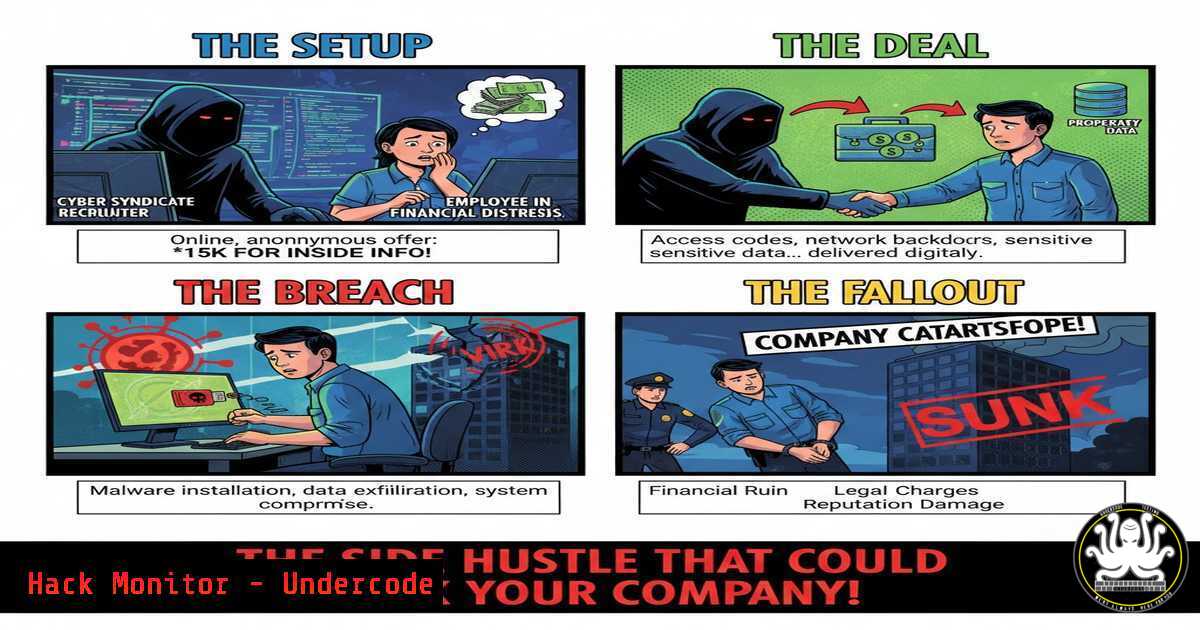
The cybersecurity landscape is witnessing a sinister evolution, shifting from external brute-force attacks to a more insidious, human-centric approach. Criminal syndicates are now systematically recruiting employees within critical sectors—finance, telecom, and tech—to act as malicious insiders, offering substantial bounties for network access and sensitive data. This trend marks a fundamental change in threat actor strategy, exploiting human vulnerability over digital flaws and posing a grave risk to organizational integrity.
Learning Objectives:
- Understand the mechanics of insider recruitment on darknet forums and encrypted channels.
- Learn to identify technical and behavioral indicators of a compromised insider.
- Implement layered technical controls and monitoring to mitigate insider threat risks.
You Should Know:
- The Darknet Recruitment Pipeline: How Insiders Are Sought and Vetted
Threat actors operate recruitment campaigns on hidden darknet marketplaces and channels within encrypted messaging apps like Telegram or Signal. Advertisements specify the target company, the type of access required (e.g., domain admin credentials, customer databases, network diagrams), and the bounty offered.
Step-by-step guide explaining what this does and how to use it:
Step 1: Actor Setup. Criminals create professional-looking posts on forums, often using cryptocurrency escrow services to build trust. They outline desired roles (e.g., “Need an employee at [Major Bank] with VPN + Active Directory access”).
Step 2: Vetting Process. Initial contact is made via encrypted email or messaging. To prove legitimacy, the insider might be asked to provide non-public but verifiable information, like an internal office phone number or a screenshot of an HR portal (with sensitive data redacted). This proves their employment without immediate compromise.
Step 3: Agreement & Payment Structure. Terms are set: a partial upfront payment in cryptocurrency, with the bulk paid upon delivery of data or persistent access. Communication follows a strict OPSEC (Operational Security) protocol using PGP encryption for all data transfers.
2. Technical Indicators of a Compromised Insider Account
Once an insider is active, their account behavior deviates from the norm. Security teams must hunt for these anomalies.
Step-by-step guide explaining what this does and how to use it:
Step 1: Audit Log Aggregation. Centralize logs from Active Directory (Windows Event IDs 4624/4625 for logon/logoff, 4662 for object access) and Linux (/var/log/auth.log, `last` command). Use a SIEM (Security Information and Event Management) tool.
Linux command to check recent logins: `last -ai` or review sudo history: `sudo cat /var/log/auth.log | grep -i “failed\|accepted”`
Windows PowerShell to query specific event logs: `Get-WinEvent -FilterHashtable @{LogName=’Security’; ID=4662} -MaxEvents 50`
Step 2: Baseline Normal Activity. Establish a baseline for each user: typical login times, data accessed, and volume of data transfer.
Step 3: Set Alerts for Deviations. Configure alerts for: after-hours logins, access to unfamiliar databases or file shares, and abnormally large data egress (e.g., rsync, scp, or RDP file transfers exceeding 1GB).
3. Hardening Perimeter and Internal Access Controls
Limit the potential damage an insider can cause by enforcing the principle of least privilege and segmenting the network.
Step-by-step guide explaining what this does and how to use it:
Step 1: Implement Zero Trust Network Access (ZTNA). Move beyond VPNs. Require continuous authentication and authorization for every access request to applications, regardless of network location.
Step 2: Enforce Privileged Access Management (PAM). All privileged accounts (Domain Admins, root) must be vaulted. Sessions are brokered through the PAM solution, recorded, and require approval.
Example: For Linux, use `sudo` with restrictive rules. A rule in `/etc/sudoers.d/` could be: `%developers ALL=(ALL) /usr/bin/systemctl restart nginx` (only allows restarting nginx, not full root).
Step 3: Network Micro-Segmentation. Use internal firewalls and VLANs to prevent lateral movement. A compromised user in the HR segment should not be able to initiate connections to the R&D or financial databases.
4. Proactive Threat Hunting for Data Exfiltration
Assume a breach and proactively search for data staging and exfiltration techniques.
Step-by-step guide explaining what this does and how to use it:
Step 1: Monitor for Archive Creation. Insiders often compress data before exfiltration. Hunt for command-line usage of zip, rar, tar, and `7z` on servers.
Linux: Use auditd rules to log specific commands. Example rule: `-a always,exit -F arch=b64 -S execve -F exe=/usr/bin/zip -k data_archive`
Step 2: Analyze Outbound Connections. Use network monitoring tools (like Zeek or Suricata) to detect connections to suspicious external IPs or known cloud storage domains not used by the company.
Step 3: Deploy Data Loss Prevention (DLP). Configure DLP rules on email and web gateways to block or quarantine outbound transfers of files containing patterns like credit card numbers (PCI), source code, or internal project codenames.
- Building a Culture of Awareness and Anonymous Reporting
Technical controls fail without human vigilance. Foster an environment where employees are the first line of defense.
Step-by-step guide explaining what this does and how to use it:
Step 1: Conduct Realistic Training. Move beyond generic modules. Use simulated phishing campaigns that mimic darknet recruiter tactics and gamified training.
Step 2: Establish Clear, Anonymous Reporting Channels. Publicize an easy-to-use, anonymous hotline or web portal (e.g., using third-party services) for reporting suspicious solicitations or colleague behavior. Ensure non-punitive reporting for good-faith concerns.
Step 3: Leadership Communication. Executives and managers must openly discuss the insider threat, emphasizing that the company’s survival is at stake and that reporting is an act of loyalty.
What Undercode Say:
- The Insider Threat is Now a Commodity. This isn’t about disgruntled employees; it’s a formalized, for-profit marketplace. Defenses must now account for financially motivated insiders who may otherwise seem like model employees.
- Your SOC Must Hunt for “Normal.” Traditional alerts look for malware. This threat requires behavioral analytics that profile legitimate user activity to spot the subtle anomalies that indicate an insider is working for a foreign actor.
The shift to insider recruitment represents a mature, cost-effective strategy for advanced threat actors. It bypasses millions spent on firewalls and endpoint detection. The technical counterplay is twofold: implement ruthless access control and logging to shrink the attack surface, and invest heavily in behavioral analytics to detect the human operative inside the machine. Companies that fail to elevate their internal monitoring to match their perimeter defenses are funding a new, devastating side hustle for their own staff.
Prediction:
Within the next 18-24 months, we will see the emergence of “Insider-as-a-Service” (IaaS) platforms on the darknet, where criminal groups broker access between insiders and other threat actors via standardized contracts and automated cryptocurrency payouts. This will lower the barrier to entry for ransomware groups, leading to a spike in highly targeted, devastating attacks that originate from inside the network, rendering many traditional breach detection systems obsolete. The focus of cybersecurity insurance and compliance frameworks will pivot sharply towards stringent insider threat program audits and verified technical controls for privileged access and data egress monitoring.
▶️ Related Video (74% Match):
🎯Let’s Practice For Free:
IT/Security Reporter URL:
Reported By: Wayne Shaw – Hackers Feeds
Extra Hub: Undercode MoN
Basic Verification: Pass ✅


