
Listen to this Post
Introduction
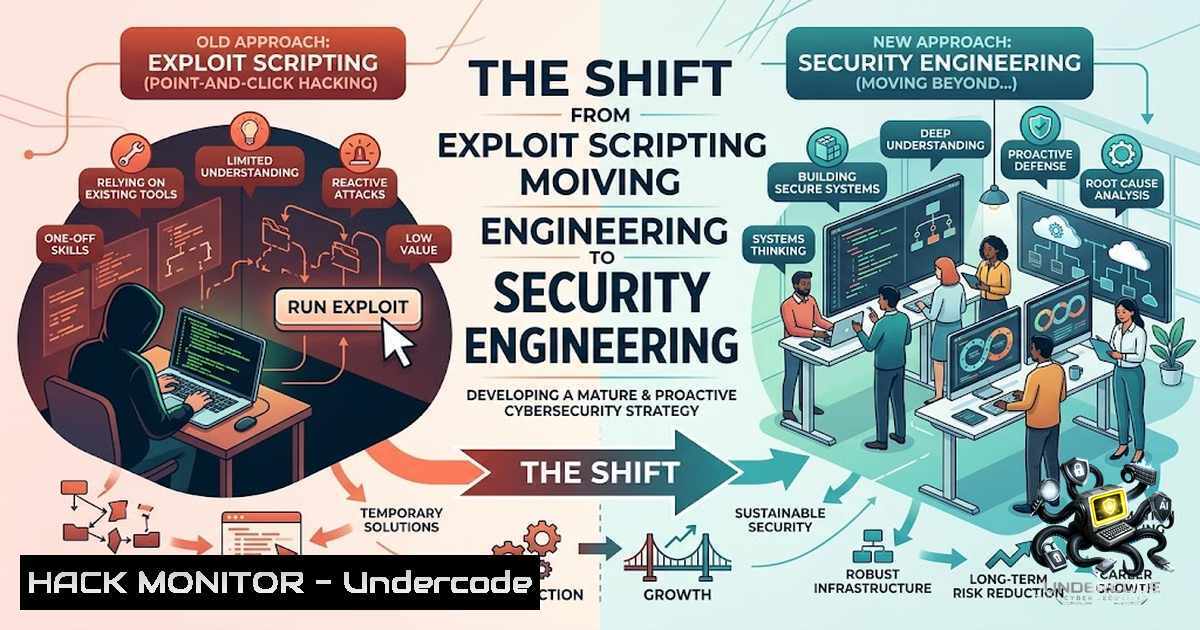
The cybersecurity industry faces a growing disconnect between the surge of readily available exploitation tools and the foundational engineering principles required for robust defense. While the ability to run a Proof of Concept (PoC) exploit or manipulate a web parameter is a valuable technical skill, it represents a surface-level engagement with security. True security engineering transcends this, requiring an understanding of systemic interactions, process boundaries, and architectural weaknesses that allow attackers to chain minor flaws into catastrophic breaches. This article explores the critical transition from a tool-centric mindset to a system-centric approach, bridging the gap between simply identifying bugs and architecting resilient infrastructure against continuous threats.
Learning Objectives & Secrets
- Objective 1: Differentiate between basic vulnerability exploitation and architectural security analysis by understanding underlying system processes.
- Objective 2 (Secret Tips): Master telemetry and process behavior monitoring to detect lateral movement, rather than relying solely on static vulnerability scanners.
- Objective 3 (Secret Tips): Implement dynamic credential rotation and Zero Trust segmentation to invalidate stolen keys, effectively breaking the attacker’s attack chain.
You Should Know
1. Understanding the Attack Chain vs. Isolated Vulnerabilities
While a single buffer overflow or SQL injection may grant initial access, the reality of modern cyber warfare lies in the attack chain. Attackers utilize the MITRE ATT&CK framework to map entry points, privilege escalations, and lateral movement. The difference between a script runner and an engineer is the ability to map data flows.
How to approach it:
- Map your Data Flow: Identify how data moves from a web application to internal databases. Use tools like Wireshark or tcpdump to trace packet flows.
- Identify Trust Boundaries: Determine where untrusted data becomes trusted.
- Apply the Principle of Least Privilege: Ensure service accounts lack administrative rights.
Linux/Windows Commands for Mapping:
- Linux: `ss -tulpn` (List active listening ports and services) to understand exposed services.
- Linux: `lsof -i -P -1` (List open files and network connections) to identify process communication.
- Windows: `netstat -abn` (Show active connections and associated executables).
- Windows: `Get-1etTCPConnection -State Established` (PowerShell) for detailed connection states.
2. Telemetry: Detecting Anomalies Before the Breach
The post emphasizes “Smart Telemetry.” This involves setting up monitoring that looks at behavior, not just signatures. Instead of waiting for an exploit signature to trigger an alert (which is easily bypassed), we monitor for abnormal process behaviors.
Step-by-step Guide:
- Enable Process Auditing: On Linux, use `auditd` to monitor specific system calls. On Windows, enable Sysmon (System Monitor).
- Define Normal Baselines: Understand standard CPU/memory usage for your applications.
- Write Detection Rules: Alert on processes that attempt to read shadow files (
/etc/shadow) or specific registry keys likeHKLM\SAM. - Centralize Logs: Use SIEM (Security Information and Event Management) tools like Splunk or Elastic to correlate logs.
Example Audit Rule (Linux):
auditctl -a always,exit -S open -F path=/etc/shadow -k shadow_access
This logs every attempt to access the shadow file, alerting you to potential privilege escalation attempts.
Example Sysmon Config (Windows):
<Sysmon>
<EventFiltering>
<ProcessAccess onmatch="exclude">
<!-- Monitor lsass.exe access -->
<TargetImage condition="end with">lsass.exe</TargetImage>
</ProcessAccess>
</EventFiltering>
</Sysmon>
- Shrinking the Blast Radius with Zero Trust Containers
One of the most effective ways to mitigate the risk of a successful exploit is to segment the environment. If an attacker compromises a vulnerable web application, they should be placed in a “silenced” environment with minimal access.
Implementation Steps:
- Containerization: Use Docker or Kubernetes to isolate applications.
- Network Policies: In Kubernetes, implement Network Policies to restrict pod-to-pod communication.
- Zero Trust Micro-segmentation: Use service meshes like Istio to enforce mutual TLS (mTLS) and strict identity verification.
- Hardening the Container: Run containers as a non-root user.
Dockerfile Hardening Example:
 Use a specific base image version
FROM alpine:3.19
 Create a user with limited privileges
RUN addgroup -g 1001 -S appuser && adduser -S appuser -G appuser
 Set non-root user
USER appuser
This ensures that even if an attacker escapes the application context, they do not have root privileges on the host.
4. Automated Resilience: Dynamic Credential Rotation
Credentials are a primary target. Static passwords are dangerous. Automating the rotation of keys and passwords ensures that even if an attacker steals them, they have a limited window of usefulness.
Implementation Strategies:
- Hashicorp Vault: Use Vault to dynamically generate database credentials.
- AWS Secrets Manager / Azure Key Vault: Rotate secrets automatically.
- Application Integration: Configure applications to fetch credentials from the vault at startup and periodically refresh them.
Example Vault Command:
vault kv rotate -path=secret/database
Windows/Script Approach:
Use PowerShell to reset service account passwords in Active Directory:
$SecurePassword = ConvertTo-SecureString "NewPassword123!" -AsPlainText -Force
Set-ADAccountPassword -Identity "ServiceAccount01" -1ewPassword $SecurePassword
5. Exploitation Mitigation: The Memory Corruption Context
The post mentions understanding “how the kernel handles process threads.” This refers to memory corruption vulnerabilities (e.g., Use-After-Free). While disabling ASLR or DEP is a classic exploit technique, engineering mitigation requires deploying compiler-level protections.
Step-by-step Mitigation:
- Compiler Hardening: Compile binaries with Position Independent Execution (PIE) and stack canaries.
- Enable ASLR: On Linux, ensure randomize_va_space is set to 2 (
sysctl -w kernel.randomize_va_space=2). On Windows, ASLR is standard for modern executables but ensure flags are set during compilation. - Control Flow Guard (CFG): Enforce CFG on Windows applications.
6. Cloud API Hardening
Attack chains often target cloud APIs. If a developer leaves an API key in a plain-text `.env` file (as mentioned in the post), it’s game over.
How to secure:
- Secrets Scanning: Implement pre-commit hooks like `trufflehog` to scan for secrets before they hit the repository.
- AWS IAM Roles: Instead of creating long-term access keys, use IAM Instance Profiles or Service Accounts (in Kubernetes).
- API Rate Limiting: Implement rate limiting and strict CORS policies to prevent misconfigurations.
Example AWS CLI hardening:
 Ensure IAM users have MFA enabled
aws iam list-users | jq '.Users[] | .UserName'
What Undercode Say
- Key Takeaway 1: Cybersecurity is architecture, not just exploitation. Relying on scripts creates a false sense of security and ignores the systemic vulnerabilities that allow persistence.
- Key Takeaway 2: Investment in telemetry and detection is more valuable than increasing the frequency of vulnerability scans, as detection catches the “unknown” threats that scans miss.
Analysis
The text criticizes the current trend of “point-and-click” hacking, arguing that it fails to produce engineers who understand the complexities of modern infrastructure. This is a critical distinction for enterprises that need resilience, not just compliance. An engineer who understands memory corruption can implement effective compiler protections and system configurations, whereas a “script runner” is limited to executing pre-built tools that may not work in custom environments. The recommendation to focus on telemetry and credential rotation is a direct response to the reality that most successful breaches involve credential theft and lateral movement, not zero-days. This shift from reactionary patching to proactive architecture reduces the attack surface significantly.
Prediction
- +1: The industry will see a rise in “Security Engineering” certifications that focus heavily on infrastructure-as-code and system design, bridging the gap between developers and security teams.
- +1: We will witness increased integration of AI in telemetry, allowing for real-time detection of attack paths based on system architecture graphs, making zero-day exploits significantly less effective.
- -1: However, as Agentic AI becomes more integrated into systems, attackers will exploit the AI’s logic itself, creating “adversarial AI” that manipulates the decision-making process of defenses, requiring further engineering safeguards.
- -1: The gap between “cyber tool operators” and “security engineers” will widen, causing a severe talent shortage in the engineering sector of cybersecurity until educational systems adapt.
▶️ Related Video (84% Match):
🎯Let’s Practice For Free:
🎓 Live Courses & Certifications:
Join Undercode Academy for Verified Certifications
🚀 Request a Custom Project:
Secure, high-velocity infrastructure and disruptive technological engineering. Contact our engineering team for high-tier development and proprietary systems:
[email protected]
💎 Smart Architecture | 🛡️ Secure by Design | ⭐ Trusted by Thousands
IT/Security Reporter URL:
Reported By: https://lnkd.in/p/ev-ZdjeX – Hackers Feeds
Extra Hub: Undercode MoN
Basic Verification: Pass ✅


