Listen to this Post
Introduction:
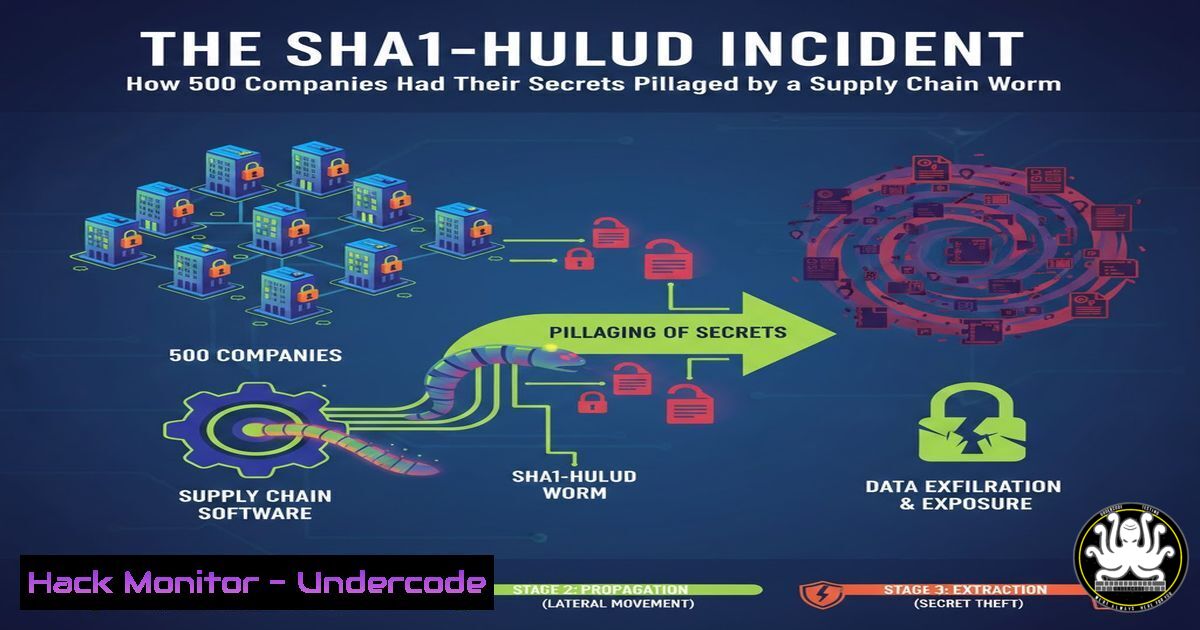
A massive software supply chain attack, dubbed “Sha1-Hulud,” has compromised over 450 critical npm packages, including popular tools like Zapier SDK and Postman. The embedded malware operates like a worm, automatically exfiltrating AWS tokens, database credentials, and API keys, then publishing them to public GitHub repositories. This incident underscores a brutal reality: modern cybersecurity can no longer rely solely on perimeter defenses when attackers are being invited inside via trusted third-party dependencies.
Learning Objectives:
- Understand the mechanics of the “Sha1-Hulud” software supply chain attack and its worm-like propagation.
- Learn immediate steps to identify compromised dependencies and perform emergency credential rotation.
- Implement long-term architectural shifts, including Zero Trust and proactive secret detection, to mitigate future supply chain risks.
You Should Know:
1. Immediate Triage: Identifying Compromised Dependencies
The first critical step is determining if your environment is infected. The attacker has published a list of known compromised packages, which is being updated as the incident evolves.
Step-by-step guide explaining what this does and how to use it:
Step 1: Check your project’s direct and transitive dependencies. In a Node.js project, you can generate a list and cross-reference it with the official threat intelligence feeds.
Command: `npm list –all` > dependencies.txt
Step 2: Manually review the `dependencies.txt` file against the compromised package list published on Pastebin (https://pastebin.com/z3Ue2gmN) and other community resources like OpenSourceMalware.com (https://opensourcemalware.com/).
Step 3: Automate this check using security scanning tools. For example, using `grep` to check your list against a locally saved copy of the malicious package list.
Command: `grep -f suspected_packages_list.txt dependencies.txt`
Step 4: Do not rely solely on these initial lists. The attack is expanding as newly compromised maintainers infect their own projects, meaning continuous monitoring is essential.
2. Emergency Response: Rotating All Exposed Credentials
Assume breach. Even if your dependency scan comes back clean, the automated nature of the credential exfiltration means any secret could be publicly available and indexed by search engines.
Step-by-step guide explaining what this does and how to use it:
Step 1: Inventory all credentials and secrets stored in your application environment. This includes:
Cloud Provider Keys (AWS, GCP, Azure)
Database Connection Strings
API Keys for third-party services (Twilio, SendGrid, Stripe, etc.)
Encryption Keys and Certificates
Step 2: Utilize cloud provider CLI tools to identify and deactivate old keys before creating new ones. For example, in AWS:
Command: `aws iam list-access-keys` (to list keys)
Command: `aws iam delete-access-key –access-key-id AKIA…` (to delete a compromised key)
Command: `aws iam create-access-key –user-name
Step 3: Systematically rotate every identified secret, starting with the most critical (e.g., production database and cloud infrastructure keys). Maintain a log of all rotations to ensure no service is missed.
3. Proactive Defense: Implementing Secrets Detection and Hygiene
Preventing secret leakage into code is a foundational control. This involves scanning codebases pre-commit and in CI/CD pipelines to catch mistakes before they become public.
Step-by-step guide explaining what this does and how to use it:
Step 1: Integrate a secrets detection tool like TruffleHog, Gitleaks, or GitGuardian into your development workflow.
Step 2: Run a one-off scan of your Git history to find any existing secrets that may have been committed in the past.
Command (using Gitleaks): `gitleaks detect –source /path/to/your/repo -v`
Step 3: Integrate the scanner into your CI/CD pipeline (e.g., GitHub Actions, GitLab CI) to block commits containing new secrets.
Example GitHub Action step:
- name: Scan for Secrets
uses: gitleaks/gitleaks-action@v2
env:
GITHUB_TOKEN: ${{ secrets.GITHUB_TOKEN }}
Step 4: Never hardcode secrets. Use environment variables or a dedicated secrets management service like HashiCorp Vault, AWS Secrets Manager, or Azure Key Vault.
4. Architectural Shift: Embracing a Zero Trust Model
Zero Trust security mandates “never trust, always verify.” It operates on the assumption that the attacker is already inside the network, which aligns perfectly with the lesson from this attack.
Step-by-step guide explaining what this does and how to use it:
Step 1: Micro-Segmentation: Divide your network into smaller, isolated zones. This prevents lateral movement, meaning a compromised application server cannot easily access the production database.
Implementation: Use cloud security groups or firewalls to enforce strict inbound/outbound rules. For instance, a web server security group should only allow inbound traffic on ports 80/443 and outbound traffic only to specific dependencies.
Step 2: Least Privilege Access: Apply the principle of least privilege to all identities (users, services, applications). An npm package should not require, nor have, broad access to your cloud environment.
Implementation: In AWS, create fine-grained IAM roles for EC2 instances or Lambda functions instead of using broad, administrator-level policies.
Step 3: Continuous Authentication and Authorization: Implement mechanisms that continuously validate the security posture of devices and users, not just at login.
5. Advanced Threat Detection: Deploying Deception Technology
Deception technology, like the Beelzebub platform mentioned in the source post, places baits and traps inside your network. When an intruder interacts with these decoys, it triggers an immediate alert.
Step-by-step guide explaining what this does and how to use it:
Step 1: Identify critical assets in your network (e.g., database servers, API endpoints, sensitive file shares).
Step 2: Deploy honeytokens—fake API keys, database credentials, or files—in your environment. These look real but have no legitimate use.
Step 3: Monitor these honeytokens 24/7. Any attempt to use them is a high-fidelity alert indicating an active intruder.
Example: Place a fake `.aws/credentials` file in a developer environment. Any attempt by any system to use those keys is an immediate red flag.
Step 4: Integrate these alerts into your SIEM and SOAR platforms for automated investigation and response, enabling you to contain a breach in seconds, not days.
- Supply Chain Hardening: Creating a Software Bill of Materials (SBOM)
An SBOM is a nested inventory of all components in your software. It is critical for rapidly assessing the impact of a new vulnerability or attack, like Sha1-Hulud, on your products.
Step-by-step guide explaining what this does and how to use it:
Step 1: Generate an SBOM for your application. Tools like Syft can automatically create this.
Command: `syft packages /path/to/your/app -o spdx-json > sbom.json`
Step 2: Store and manage your SBOMs in a central system. This allows you to quickly query which applications use a specific compromised package.
Step 3: Integrate SBOM generation into your CI/CD pipeline so every build has a corresponding, up-to-date software inventory. This turns a days-long forensic investigation into a simple database query.
What Undercode Say:
- The perimeter is dead. Security investment must pivot from solely building higher walls to actively hunting for threats that are already inside the environment, carried in by the trusted supply chain.
- Speed of response is the new metric for survival. When secrets are exfiltrated and published automatically, the race is not to prevent the leak but to rotate credentials and contain the attack before they can be used.
This incident is not an anomaly but a blueprint for future attacks. The “Sha1-Hulud” campaign demonstrates a maturation in the adversary’s approach: they are no longer just sneaking in through a backdoor; they are weaponizing the very foundation of modern development—open source packages—to create self-propagating worms. The automation of both the compromise and the exfiltration-to-public-repo process signifies a terrifying escalation. Companies that fail to internalize the “assume breach” mentality and implement the layered defense-in-depth strategies outlined here are simply waiting for their turn to be the next headline. The supply chain is now the primary battlefield.
Prediction:
The success and scale of the Sha1-Hulud attack will catalyze a new wave of software supply chain assaults focused on automated, worm-like propagation and immediate public doxing of secrets. This will force a industry-wide reckoning, making practices like mandatory SBOMs, automated secrets rotation, and widespread adoption of deception technology standard within the next 18-24 months. Regulatory bodies will likely intervene, imposing stricter security requirements on open-source maintainers and the enterprises that depend on them, fundamentally reshaping the economics and responsibilities of open-source software stewardship.
🎯Let’s Practice For Free:
IT/Security Reporter URL:
Reported By: Mario Candela – Hackers Feeds
Extra Hub: Undercode MoN
Basic Verification: Pass ✅


