Listen to this Post
Introduction:
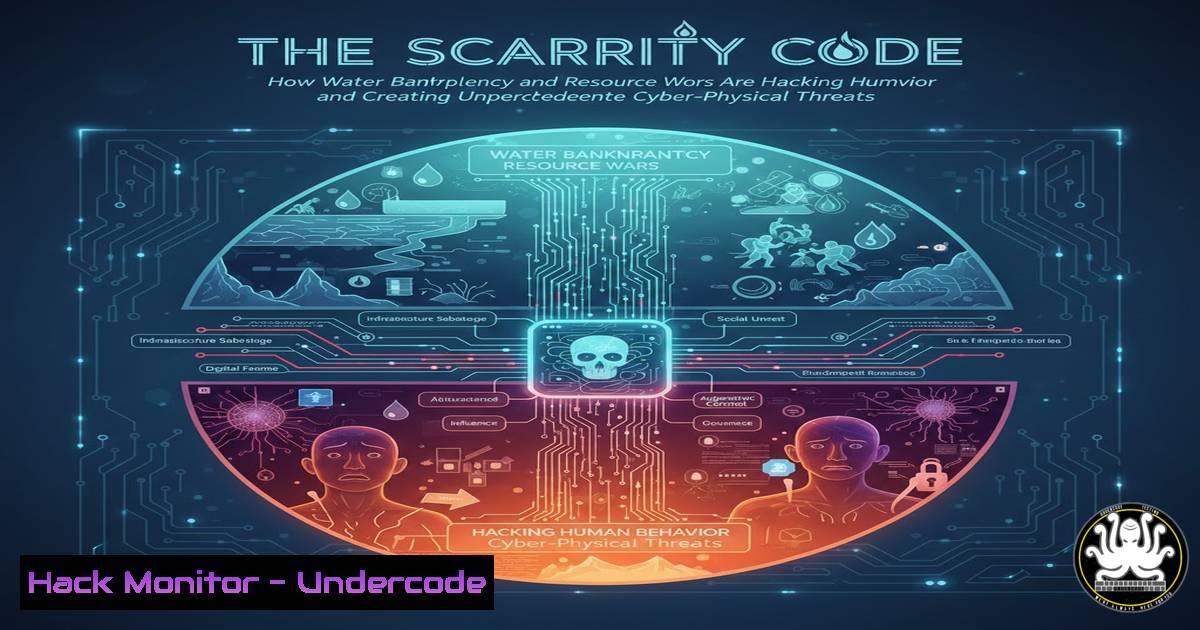
The world has officially entered an era of “Global Water Bankruptcy,” a post-crisis state where natural water systems are depleted beyond recovery. This fundamental resource scarcity, alongside shortages in critical elements like phosphorus, is not just an environmental issue—it is a powerful psychological and societal stressor that is actively rewriting the global threat landscape. For cybersecurity and IT professionals, this translates into a surge in both digital and physical threats, from attacks on critical infrastructure and supply chains to increased insider risks and fraud driven by desperation, requiring a radical shift from reactive technology fixes to systemic, human-centric security strategies.
Learning Objectives:
- Understand the concept of “Global Water Bankruptcy” and its technical definition as an irreversible state of resource depletion.
- Identify the emerging cyber-physical threat vectors stemming from resource scarcity, including critical infrastructure attacks, supply chain compromise, and behavioral threats.
- Implement practical technical defenses to harden water management systems, cloud infrastructure, and organizational perimeters against scarcity-driven threats.
- Securing Critical Infrastructure: The SCADA and OT Frontline
The UN report states that 70% of the world’s major aquifers show long-term decline, and systems managing this scarce resource are prime targets. Industrial Control Systems (ICS), Supervisory Control and Data Acquisition (SCADA) systems, and Operational Technology (OT) that manage water treatment, agricultural irrigation, and distribution networks are now critical national infrastructure. These systems, often running on legacy software with known vulnerabilities, are being rapidly connected to corporate IT networks and the internet for efficiency, creating a vast attack surface.
A step-by-step guide to initial OT/SCADA hardening:
- Network Segmentation & Inventory: Physically and logically separate OT networks from corporate IT. Use tools like `nmap` to perform passive asset discovery from the IT side to build an inventory without impacting OT operations.
Example: Passive discovery scan (adjust IP range)
sudo nmap -sn 192.168.1.0/24
- Protocol Hardening: Disable unused industrial protocols (e.g., Modbus, DNP3) on endpoints. Where possible, encrypt protocol communications using secure gateways that can translate legacy protocols to encrypted tunnels.
- Patch Management: Implement a rigorous, tested patching schedule for Windows-based HMI and engineering workstations. For systems that cannot be patched, deploy virtual patching solutions like Intrusion Prevention Systems (IPS) with rules specific to ICS vulnerabilities.
- Default Credential Elimination: Use a credential management tool to find and change all default passwords on PLCs, RTUs, and HMI systems. This is a low-tech but highly effective step.
2. Cloud Hardening for Resource-Intensive AI and Analytics
As organizations use AI and big data analytics to manage scarce resources (e.g., predicting crop yields, modeling water usage), the cloud workloads hosting these models become high-value targets. Adversaries may seek to steal data, poison AI training sets, or hijack compute resources for crypto-mining—itself a drain on energy and water.
A step-by-step guide to securing analytics environments in AWS/Azure:
1. Identity and Access Management (IAM): Enforce the principle of least privilege. Use role-based access control (RBAC) and avoid using root accounts. Enable Multi-Factor Authentication (MFA) for all users.
 AWS CLI example: Create an IAM user with no permissions by default
aws iam create-user --user-name data-scientist-01
2. Data Encryption: Ensure all data at rest (in S3, EBS, RDS) and in transit is encrypted. Use customer-managed keys (CMKs) in AWS KMS or Azure Key Vault for greater control.
3. Network Security: Place analytics clusters in private subnets. Use security groups and network access control lists (NACLs) to restrict traffic. Implement a bastion host or AWS Systems Manager Session Manager for secure administrative access.
4. Monitoring and Logging: Enable comprehensive logging (AWS CloudTrail, Azure Activity Log, VPC Flow Logs). Use SIEM tools like Splunk or AWS Security Hub to detect anomalous activity, such as unusually large data exports or unauthorized API calls from new regions.
3. Behavioral Analytics and Insider Threat Mitigation
The LinkedIn post correctly identifies that scarcity can push individuals with a “predisposition to unethical behavior” to act. In security terms, this elevates the insider threat risk. Financial pressure from economic instability driven by resource scarcity can motivate employees to steal data, commit fraud, or sabotage systems.
A step-by-step guide to implementing behavioral monitoring:
- Define Baseline Behavior: Use tools like Microsoft Purview Compliance (for 365) or open-source SIEMs to establish normal patterns of access for users—typical login times, data volumes accessed, regular destination IPs.
- Deploy User and Entity Behavior Analytics (UEBA): Integrate UEBA capabilities into your SIEM. Tools like Elastic Security, Splunk UBA, or Exabeam can model behavior and flag anomalies.
- Investigate Anomalies: Create playbooks for investigating common anomaly types. For example, a sequence alert for “employee downloads sensitive R&D files → connects to personal cloud storage → accesses job sites” warrants immediate HR and security review.
- Combine Technical and Human Controls: Technical monitoring must be paired with strong organizational culture, clear policies, and confidential reporting channels (e.g., an ethics hotline) to address the root causes of behavioral shifts.
4. API Security for Interconnected Supply Chains
The global food system is interconnected; water scarcity in one region disrupts supply chains worldwide. The digital systems connecting these chains—APIs for logistics, inventory, and procurement—are vulnerable. Attackers may target APIs to cause deliberate disruptions, falsify data on resource availability, or inflate prices.
A step-by-step guide to foundational API security:
- Inventory and Discovery: Use tools like `OWASP Amass` or commercial API gateways to discover all external and internal APIs, including shadow IT.
Example using amass for passive enumeration
amass enum -passive -d yourcompanyapi.com
- Implement Strong Authentication and Authorization: Move beyond simple API keys. Use OAuth 2.0 with short-lived tokens. Implement granular scope-based permissions (e.g.,
read:inventory,write:order). - Validate Input and Limit Resources: Enforce strict schema validation for all API requests. Implement rate limiting to prevent denial-of-service attacks and data scraping. For example, use the `express-rate-limit` middleware in a Node.js API.
- Continuous Testing and Monitoring: Run dynamic API security tests (DAST) and static analysis (SAST) as part of CI/CD pipelines. Monitor API traffic for abnormal patterns, such as a surge in failed authentication attempts or unusual geographic origins.
5. Vulnerability Management for a Shrinking Surface
With 4 billion people facing severe water scarcity annually, the instability this creates can lead to more frequent and severe cyber-physical attacks. A proactive, intelligence-driven vulnerability management program is essential to prioritize patches for systems that, if compromised, could exacerbate physical scarcity (e.g., dam controls) or lead to mass fraud.
A step-by-step guide to threat-informed vulnerability management:
- Asset Criticality Tagging: In your vulnerability scanner (e.g., Tenable, Qualys), tag assets based on their function. “Critical – Water Plant SCADA” should be weighted higher than “General – HR Laptop.”
- Integrate Threat Intelligence: Subscribe to feeds (e.g., CISA’s Automated Indicator Sharing) that provide context on which vulnerabilities are being actively exploited in attacks against water/energy sectors.
- Prioritize Using a Risk Formula: Don’t just rely on CVSS scores. Use a formula like:
Risk = (Exploitability + Threat Intel Activity) x Asset Criticality. Automate this prioritization in your vulnerability management platform. - Measure and Report: Track metrics like “mean time to remediate (MTTR) for critical assets” vs. general assets. This demonstrates a risk-based approach to management and justifies resource allocation for patching.
What Undercode Say:
- Systemic Risks Demand Systemic Defenses: The age of “point solution” security is over. Defending against scarcity-driven threats requires integrating security across IT, OT, cloud, and human factors, moving from siloed tools to a unified security architecture.
- From Reactive to Predictive: The future of security lies in anticipation. Using threat intelligence, behavioral analytics, and scenario planning to model and mitigate disruptions before they are fully weaponized by threat actors will be the key differentiator for resilient organizations.
Prediction:
The convergence of verified physical resource depletion (“water bankruptcy”) and the psychology of scarcity will force a fundamental evolution in cybersecurity over the next 5-10 years. We will see the rise of “Resource Security” as a dedicated discipline, merging elements of critical infrastructure protection, supply chain risk management, and behavioral economics. Security teams will employ advanced AI not just for threat detection, but to simulate cascading failure scenarios stemming from resource shocks. Furthermore, nation-state and cybercriminal attacks will increasingly target control systems for leverage in geopolitical disputes over water, minerals, and arable land. Organizations that fail to expand their security mindset beyond digital perimeters to encompass these systemic, human-driven risks will find themselves critically vulnerable in an increasingly contested and resource-constrained world.
▶️ Related Video (72% Match):
🎯Let’s Practice For Free:
IT/Security Reporter URL:
Reported By: Trustedsecurityadvisor Security – Hackers Feeds
Extra Hub: Undercode MoN
Basic Verification: Pass ✅


