
Listen to this Post
Introduction:
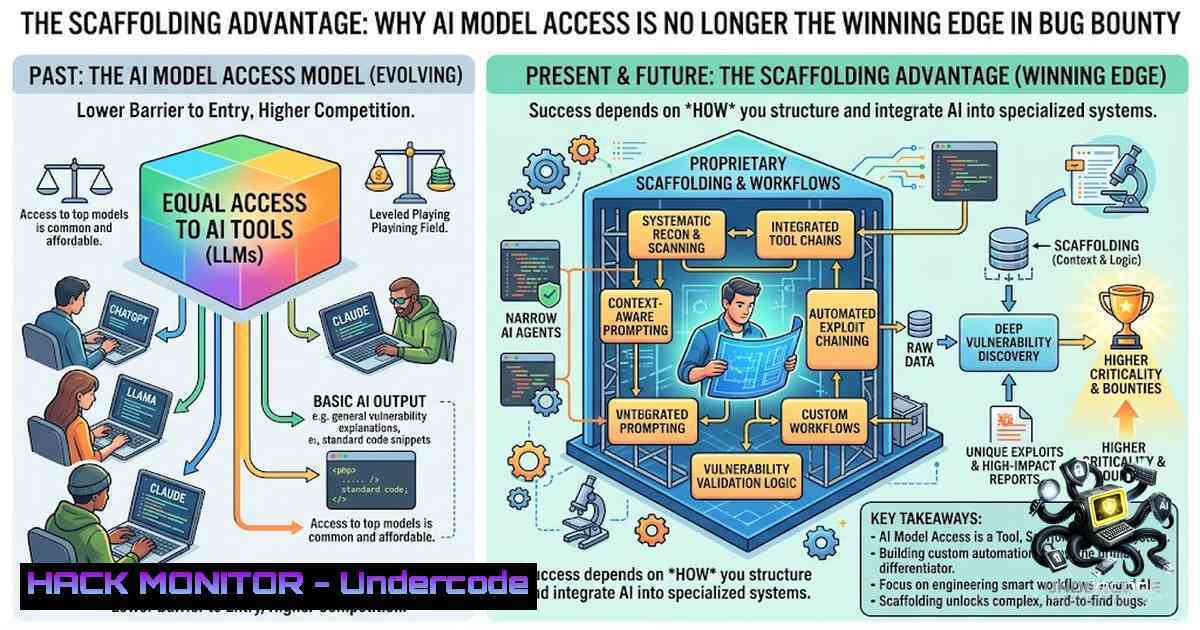
The democratization of frontier AI models has effectively neutralized the technological advantage they once conferred. When every security researcher and threat actor can access the same GPT-5, Claude, or Gemini models, the model itself ceases to be the differentiator. The competitive edge in vulnerability discovery has shifted decisively to the scaffolding—the agents you build, the tools you connect, the workflows you design, and the skills you sharpen around the model. As AI-powered penetration testing frameworks like HexStrike AI and Strix demonstrate, the real battleground is no longer the model’s raw capability but the orchestration layer that translates intent into autonomous, scalable action.
Learning Objectives & Secrets:
- Objective 1: Master Multi-Agent Orchestration – Understand how to deploy specialized AI agents (reconnaissance, exploitation, reporting) that collaborate in parallel, mimicking a team of human pentesters. Secret: The power lies not in a single agent but in a swarm where each agent has a distinct role and handoff protocol.
-
Objective 2: Build a Duplicate-Aware Workflow – Duplicate submissions are the silent killer of bug bounty productivity. Secret tip: Integrate AI-powered deduplication tools like `dup-scout` or HackerOne’s Deduplication Agent into your pre-reporting pipeline to scan GitHub PRs, issues, and commits for prior art before you invest time in writing a report.
-
Objective 3: Implement Deterministic Guardrails – AI agents are creative but prone to scope creep and dangerous actions. Secret tip: Use engineering constraints—IAM permissions boundaries, Bedrock Guardrails, and explicit authorization flags—to constrain agent freedom while preserving its reasoning capabilities.
You Should Know:
- The Duplicate Trap: Why Speed Alone Isn’t Enough
The post’s core revelation—that the author found valid bugs but was beaten by others who found them first—encapsulates the modern bug bounty dilemma. When multiple researchers deploy similar AI agents against the same target, duplicate findings become inevitable. HackerOne and Synack treat duplicates on a first-come, first-served basis, meaning the researcher who reports first—not the one who finds the vulnerability most elegantly—receives the bounty.
To combat this, integrate a pre-submission duplicate check into your workflow. The `dup-scout` npm package exemplifies this approach: point it at a target’s GitHub repository, describe your finding, and it scans PRs (open/closed/merged), issues, commits, and releases to estimate whether your finding will be flagged as a duplicate.
 Install dup-scout
npm install -g dup-scout

Check for duplicates before writing your report
dup-scout acme/vault \
--title "Reentrancy in claim lets attacker drain" \
--desc "claim() reenters via _settle before state update" \
--file src/Vault.sol --function claim \
--scope-tag v1.2.0

Output verdict: DUPLICATE, KNOWN-ISSUE, SILENTLY-FIXED, or NOVEL
For enterprises managing multiple AI agents, the ArbiterAgent provides an open-source AI-powered triage system that aggregates, deduplicates, and assigns severity to vulnerability findings from multiple agents simultaneously.
2. The Scaffolding Stack: Building Your Multi-Agent System
The post’s assertion that “the agents you build, the tools you connect, the harnesses and workflows you design” constitute the real advantage is validated by the architecture of modern AI penetration testing frameworks. HexStrike AI MCP v6.0, for instance, features a multi-agent architecture with:
– 12+ autonomous AI agents (BugBounty Agent, CTF Solver, CVE Intelligence, Exploit Generator)
– 150+ security tools across network, web app, cloud, binary, CTF, and OSINT categories
– Intelligent Decision Engine for tool selection, parameter optimization, and attack chain discovery
The Model Context Protocol (MCP) serves as the critical integration layer, enabling AI agents like Claude, GPT, and Copilot to interact programmatically with security tools. This architecture transforms vague commands like “exploit NetScaler” into precise, sequenced technical steps—a capability that Check Point warns is already being abused by threat actors to accelerate zero-day exploitation from weeks to under 10 minutes.
3. Cloud Security Hardening: Defending Against Agentic Attacks
As AI agents increasingly target cloud infrastructure, the attack surface expands dramatically. AWS Security Agent, now generally available, operates like a human penetration tester—identifying vulnerabilities and attack chains across cloud environments. Simultaneously, researchers have demonstrated how AI agents can be exploited through social engineering to achieve AWS account compromise.
To harden your cloud environment against agentic attacks:
AWS IAM Permissions Boundaries:
{
"Version": "2012-10-17",
"Statement": [
{
"Effect": "Allow",
"Action": "s3:GetObject",
"Resource": "arn:aws:s3:::your-bucket/"
},
{
"Effect": "Deny",
"Action": "iam:",
"Resource": ""
}
]
}
Bedrock Guardrails for AI Agent Constraints:
 Create a guardrail to prevent privileged actions
aws bedrock put-guardrail \
--guardrail-id "your-guardrail-id" \
--content-policy-config '{"filtersConfig": [{"type": "PRIVILEGED_ACTION", "inputStrength": "HIGH", "outputStrength": "HIGH"}]}'
Azure/GCP Cloud Penetration Module (Cain Agent):
 Install Cain - real-world AI penetration testing engineer
git clone https://github.com/cdxiaodong/cain-agent
cd cain-agent
pip install -e .

Run against an authorized target with explicit authorization
cain-agent run \
--target https://app.example.com \
--i-have-authorization \
--total-budget 1800
Cain’s deterministic architecture enforces scope with engineering constraints (not AI self-discipline) and covers AWS, Azure, GCP, and Chinese clouds.
4. CI/CD Integration: Shifting Left with AI
The most effective use of AI security agents is not reactive bug bounty hunting but proactive vulnerability prevention. Strix, an autonomous AI penetration testing agent, integrates seamlessly with GitHub Actions and CI/CD pipelines, automatically scanning for vulnerabilities on every pull request and blocking insecure code before it reaches production.
 Install Strix
curl -sSL https://strix.ai/install | bash

Configure AI provider
export STRIX_LLM="openai/gpt-5.4"
export LLM_API_KEY="your-api-key"

Run security assessment against your codebase
strix --target ./app-directory

Results include validated findings with working PoCs
For agent-to-agent integration, Strix provides SKILL.md-compatible skills that enable Claude Code, Cursor, or Codex to run pentests, fix findings, and set up CI scanning.
5. The Human-in-the-Loop Paradox
Despite the autonomy of AI agents, human oversight remains essential. OpenAI’s Aardvark, an agentic security researcher powered by GPT-5, exemplifies this design principle: it continuously analyzes source code repositories, identifies vulnerabilities, attempts to trigger them in sandboxed environments, and proposes patches—but every vulnerability and patch passes through human review. OpenAI reports a 92% recall rate against known vulnerabilities, but human context is critical to avoid false positives and prevent the AI from introducing new bugs.
This creates a feedback loop: as AI agents identify and validate vulnerabilities, they generate training data that improves the learning engine, which in turn generates more sophisticated payloads and detection patterns. The operator who spends the most time building and refining this scaffolding—not the one with the newest model—wins.
What Undercode Say:
- Key Takeaway 1: Model access is commoditized. The competitive advantage in AI-powered security testing now lies entirely in the scaffolding—the agents, tools, workflows, and skills you build around the model. Organizations that treat AI as a plug-and-play solution will fall behind those that invest in custom orchestration layers.
-
Key Takeaway 2: Duplicate detection is the new frontier. As more researchers deploy AI agents against the same targets, the ability to quickly identify prior art before submitting a report becomes as valuable as the ability to find vulnerabilities. Integrate tools like `dup-scout` and ArbiterAgent into your pre-reporting workflow to avoid wasting time on duplicate submissions.
Analysis: The post’s insight that “the gap was never the model” reflects a broader trend in AI adoption across cybersecurity. The barrier to entry for AI-powered security testing has collapsed—anyone can access GPT-5 or Claude. The new barrier is engineering excellence: the ability to design multi-agent systems that collaborate efficiently, integrate with existing toolchains, enforce safety constraints, and continuously learn from past findings. Threat actors are already abusing these same frameworks to accelerate zero-day exploitation, shifting the window between disclosure and mass exploitation from weeks to hours. For defenders, this means the response must be equally automated and adaptive—investing in AI-powered detection, patch validation, and autonomous response capabilities. The winners in this new landscape will be those who treat AI agents not as magic bullets but as components in a larger, carefully engineered system.
Prediction:
- +1 The commoditization of AI models will accelerate the development of open-source security agent frameworks, democratizing access to advanced penetration testing capabilities and reducing the cost of security auditing for small organizations.
-
-1 Threat actors will increasingly abuse agentic AI frameworks like HexStrike-AI to automate zero-day exploitation at scale, compressing the window between patch release and mass exploitation to under 24 hours. Organizations that fail to implement automated patch validation and adaptive detection will face unprecedented breach velocity.
-
+1 The rise of AI-powered deduplication and triage systems will improve the efficiency of bug bounty platforms, reducing the burden on human triagers and enabling faster reward payouts for valid, novel findings.
-
-1 As AI agents become more autonomous, the risk of unintended privilege escalation and cloud account takeover will increase, particularly in organizations that deploy agents with overly permissive IAM policies. The attack chain—social engineering → privilege escalation → account takeover—will become a standard vector for agent compromise.
-
+1 The integration of AI security agents into CI/CD pipelines will significantly reduce the number of vulnerabilities reaching production, shifting the industry from reactive bug bounty hunting to proactive, continuous security validation.
▶️ Related Video (76% Match):
https://www.youtube.com/watch?v=-ibRc98Ndy0
🎯Let’s Practice For Free:
🎓 Live Courses & Certifications:
Join Undercode Academy for Verified Certifications
🚀 Request a Custom Project:
Secure, high-velocity infrastructure and disruptive technological engineering. Contact our engineering team for high-tier development and proprietary systems:
[email protected]
💎 Smart Architecture | 🛡️ Secure by Design | ⭐ Trusted by Thousands
IT/Security Reporter URL:
Reported By: https://lnkd.in/p/enxJy9m2 – Hackers Feeds
Extra Hub: Undercode MoN
Basic Verification: Pass ✅


