Listen to this Post
Introduction:
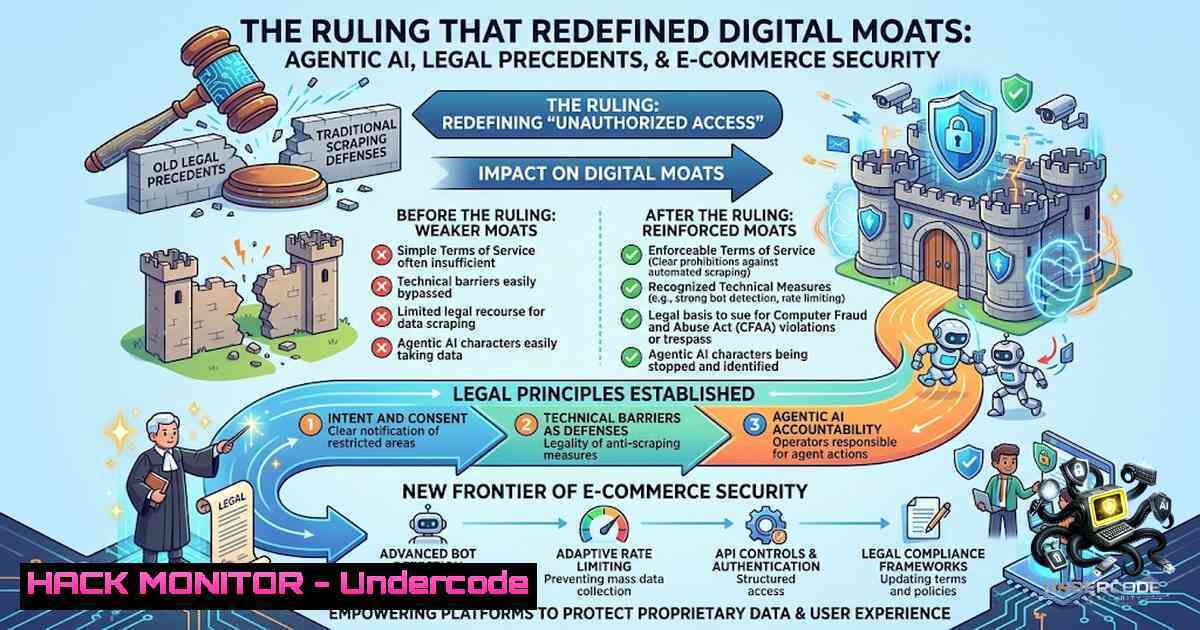
The recent US federal appeals court ruling overturning the temporary ban on Perplexity’s AI shopping agents from accessing Amazon has established a pivotal legal precedent: AI agents acting as direct consumer proxies are not classified as malicious hackers. This decision fundamentally challenges the traditional “digital moat” that large retail platforms have relied upon to protect their data, mandating that security teams now must reassess their perimeter defenses and access control models to account for autonomous, consumer-directed agents that are legally permitted to scrape and interact with their platforms.
Learning Objectives:
- Understand the legal distinction between unauthorized “hacking” and consumer-authorized agentic access in the context of web scraping and API interactions.
- Analyze the technical implementation of AI shopping agents and enterprise-level solutions like AWS’s Agentic Shopping Assistant.
- Identify new attack vectors and implement robust security controls (rate limiting, bot mitigation, and anomaly detection) to protect commercial platforms from malicious exploitation masquerading as legitimate agentic traffic.
You Should Know:
- Defending Against the Agentic Proxy: API Hardening and Traffic Analysis
The court’s decision hinges on the concept of the AI agent acting as a consumer proxy. This means that traditional defenses like IP blocking or simple CAPTCHAs are no longer sufficient, as the traffic originates from AI engines that can mimic human browsing patterns while acting on behalf of a user. To maintain security, organizations must shift from blocking all automated traffic to differentiating between benign consumer-authorized agents and malicious scrapers.
Step-by-step guide to implementing an AI-agents detection and management strategy:
- Step 1: Implement Behavioral Analytics. Deploy a Web Application Firewall (WAF) or a bot management solution (e.g., Cloudflare Bot Management or AWS WAF Bot Control) that analyzes session metadata, including mouse movements, click patterns, and navigation paths. While agents are sophisticated, their interaction sequences often lack the micro-variations of human input.
- Step 2: Enforce Strict API Governance. Since agents often interact via APIs, harden your API gateways. Implement API keys and OAuth 2.0 with strict scope limitations. If an agent is acting on behalf of a specific user, force it to use a user-specific token that ties the session to an authenticated account.
Command Example (Linux – Nginx Rate Limiting for API endpoints):
To mitigate aggressive scraping by unintended agents, configure Nginx to limit requests:
http {
limit_req_zone $binary_remote_addr zone=mylimit:10m rate=10r/s;
location /api/v1/ {
limit_req zone=mylimit burst=20 nodelay;
proxy_pass http://backend_server;
}
}
- Step 3: Analyze Headers and Fingerprinting. While agents often mimic standard User-Agents, they usually forget to include specific JavaScript-rendered fingerprinting tokens. Inject a JavaScript challenge that requires the client to execute a lightweight crypto calculation; simple scrapers will fail this, while sophisticated agents adhering to browser standards may pass, allowing you to tag them for monitoring.
- Securing the Enterprise AI Shopping Assistant (AWS Implementation)
In response to the ruling, Amazon launched its own enterprise Agentic Shopping Assistant via AWS. This creates a dual-edged sword: retailers are empowered to use AI to enhance conversions, but they must secure the underlying data pipelines and Large Language Model (LLM) integrations to prevent prompt injection attacks and data leakage. The security model here revolves around the principle of least privilege for the AI.
Step-by-step guide to hardening an AWS-hosted AI Shopping Assistant:
- Step 1: Configure IAM Roles for the Agent. Ensure the agentic service (likely running on Amazon Bedrock or SageMaker) uses an IAM role with the minimum required permissions. For instance, if the agent queries a product database, its role should only allow `GetItem` on specific DynamoDB tables, not `Scan` or
Delete.{ "Version": "2012-10-17", "Statement": [ { "Effect": "Allow", "Action": "dynamodb:GetItem", "Resource": "arn:aws:dynamodb:region:account-id:table/products" } ] } -
Step 2: Implement Guardrails for Prompt Injection. AI assistants are vulnerable to indirect prompt injection where an attacker could maliciously alter product descriptions or user queries to extract sensitive data. Deploy AWS Bedrock Guardrails to define denied topics and filter outputs. Use a content filter to redact personally identifiable information (PII) before the LLM processes the request.
- Step 3: Secure the Knowledge Base. If using a RAG (Retrieval-Augmented Generation) architecture, encrypt the vector database (e.g., Pinecone or OpenSearch) using AWS KMS. Ensure that the retrieval mechanism includes a metadata filter so the agent only fetches products relevant to the authenticated user (e.g., filtering by
client_id).
3. Network-Level Threat Mitigation for E-Commerce Surges
The rise of agentic commerce will lead to sudden spikes in traffic, which can be exploited for Denial-of-Service (DoS) attacks disguised as legitimate consumer agents. Defenders must implement dynamic scaling and anomaly detection to distinguish between a flash sale of agents and a coordinated cyberattack.
Step-by-step guide to network hardening:
- Step 1: Use a CDN with Edge Compute. Implement CloudFront with Lambda@Edge to inspect incoming requests at the edge before they hit your origin. The Lambda can check for specific cookies or JWT tokens that only the official AI agent (or the user’s browser) possesses.
- Step 2: Monitor for Sequential Data Hoarding. A malicious agent might use the “proxy” status to systematically download your entire product catalog (price lists, inventory). Implement server-side thresholds that detect when a single user session is making an unusually high number of distinct requests for different product IDs.
- Step 3: Deploy Surge Protection. Configure AWS Auto Scaling groups with a maximum limit, and use WAF rate-based rules to automatically block IP addresses or User-Agent strings that exceed an acceptable request rate, even if they claim to be acting on behalf of a user.
- The Ethical and Legal Hacking Nexus: Red Teaming Agentic Systems
For security professionals, the court ruling signals a need to update Red Team playbooks to include “Agentic Proxy Attacks.” The goal is to test if an AI agent can be manipulated to perform actions it shouldn’t, such as bypassing payment gates or accessing restricted user data.
Step-by-step guide to testing agentic security:
- Step 1: Simulate the Agent. Use Python scripts with the `requests` library and Selenium to mimic the behavior of Perplexity’s Comet browser, sending the same `User-Agent` and authentication headers.
- Step 2: Test for Authorization Bypass. Try to use the token of a low-privileged user (guest) to ask the agent to access product metadata usually reserved for logged-in accounts. If the backend system does not validate permissions on each API call, the agent will leak data.
- Step 3: Cross-User Data Leakage. Attempt to create a session where Agent A acts for User 1, but you inject User 2’s session ID into the headers. If the system relies solely on the agent’s identity and not the user’s context, this constitutes a critical broken access control vulnerability.
What Undercode Say:
- Key Takeaway 1: The legalization of consumer-proxy agents forces a shift from perimeter-based security to identity and behavioral-based security. Platforms can no longer block all bots; they must authenticate and scrutinize the intent behind the requests, effectively redefining “authorized access” in cybersecurity law.
- Key Takeaway 2: Amazon’s launch of its own enterprise AI assistant alongside this lawsuit demonstrates a strategic pivot from defensive isolation to offensive enablement. The security focus must now include protecting the LLM itself from direct and indirect injection attacks, as the AI model is now the primary interface for millions of users, creating a massive new attack surface.
Analysis: This ruling essentially creates a new “gray zone” for cybersecurity teams. Traditionally, data scraping was a cat-and-mouse game of IP bans and legal cease-and-desists. Now, the barrier to entry for scraping is legally lowered, provided the agent is consumer-driven. This necessitates a radical overhaul of how we classify traffic. We must invest heavily in Context-Aware Security—interpreting the why behind the request, not just the what or the who. For retailers, the risk is not just data loss but data poisoning; malicious actors could feed biased data to these agents to manipulate market dynamics. The economic impact is significant: if every user has a powerful AI assistant that can price-check across stores in real-time, the pricing power of retailers collapses. Security strategies must evolve to include “Economic Mitigation,” such as offering exclusive deals via the agent that aren’t visible to the public, thereby encouraging legitimate use and simplifying detection of anomalies. The success of this model will depend on how well AWS and other cloud providers can build security guardrails directly into the LLM frameworks.
Prediction:
- -1: Retailers who fail to adapt their API security and implement robust agentic traffic monitoring will suffer severe data extrusion, losing their competitive price and inventory intelligence to competitors operating through legitimate consumer proxies, leading to a significant market share erosion.
- +1: AWS’s move will accelerate the adoption of secure, enterprise-grade AI agents, spawning a new market for “AI Security Firewalls” and specialized Guardrail services, creating multi-million dollar opportunities for cybersecurity vendors.
- -1: We will witness the first major “Agent-Phishing” campaign within 12 months, where a malicious agent impersonates a legitimate consumer proxy to steal authentication tokens from other users, bypassing MFA by exploiting the trust placed in the agentic browser.
- +1: The precedent forces Amazon and others to open their platforms via transparent, official APIs, ultimately democratizing e-commerce data, promoting better consumer choice, and forcing platforms to compete on service quality rather than exclusive data hoarding.
▶️ Related Video (74% Match):
🎯Let’s Practice For Free:
🎓 Live Courses & Certifications:
Join Undercode Academy for Verified Certifications
🚀 Request a Custom Project:
Secure, high-velocity infrastructure and disruptive technological engineering. Contact our engineering team for high-tier development and proprietary systems:
[email protected]
💎 Smart Architecture | 🛡️ Secure by Design | ⭐ Trusted by Thousands
IT/Security Reporter URL:
Reported By: https://lnkd.in/p/euVZz-qn – Hackers Feeds
Extra Hub: Undercode MoN
Basic Verification: Pass ✅


