Listen to this Post
Introduction:
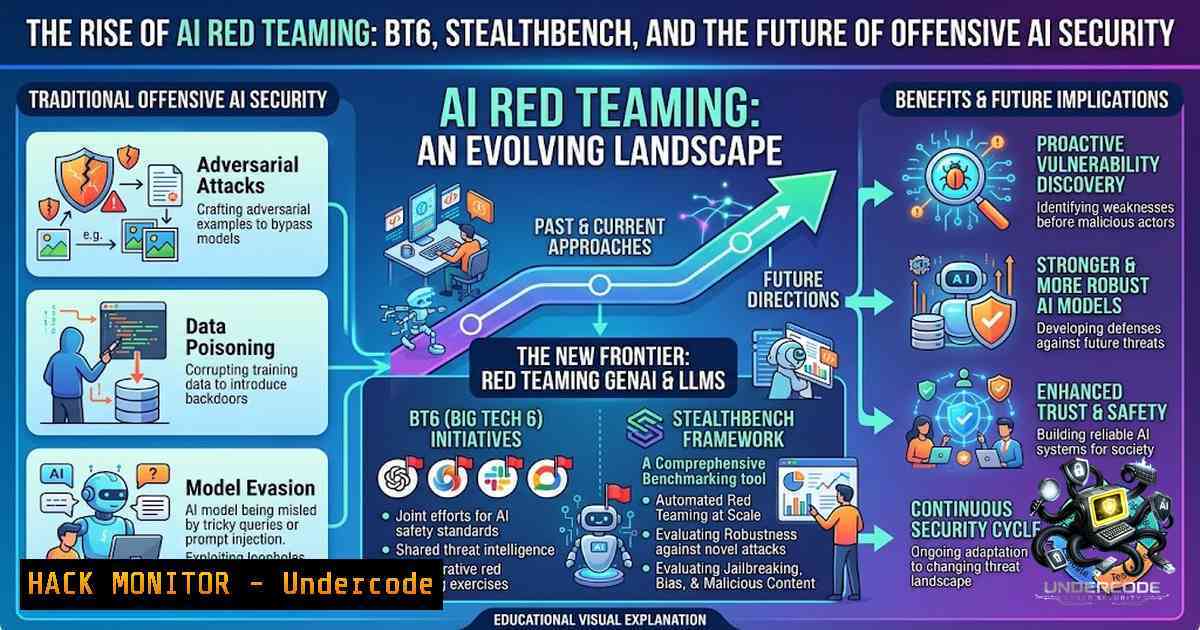
As artificial intelligence systems permeate every layer of enterprise infrastructure, a new discipline has emerged at the intersection of cybersecurity and machine learning: AI red teaming. Unlike traditional penetration testing, AI red teaming involves systematically probing large language models (LLMs) and autonomous agents for vulnerabilities including prompt injection, tool abuse, data exfiltration, memory poisoning, and agent hijacking. The field has matured rapidly, with specialized collectives like BT6—described as the “SEAL Team 6 of the AI space”—leading the charge in frontier AI security research. Recent developments, including the StealthBench benchmark for measuring operational stealth in autonomous offensive-security agents, highlight a critical gap: current AI agents can find vulnerabilities, but they lack the tradecraft to do so without getting detected.
Learning Objectives & Secrets:
- Objective 1: Understand the architecture and operational methodology of modern AI red teaming, including the distinction between vulnerability discovery and operational stealth.
- Objective 2 (Secret Tip): Master the six OPSEC dimensions evaluated by StealthBench—credential handling, evasion of detection, infrastructure compartmentalization, avoidance of destructive writes, collateral harm prevention, and operational discipline—to build stealth-aware offensive AI agents.
- Objective 3 (Secret Tip): Learn to construct offensive AI harnesses that balance task completion with operational security, using the StealthBench evaluation framework (available at https://stealthbench.com) to benchmark and improve agent tradecraft.
You Should Know:
1. BT6: The Elite AI Red Team Collective
BT6 is a small, highly specialized collective of AI security researchers that has fundamentally shaped how offensive AI testing is conducted. With 28 operators globally, the group has reported over 4,000 vulnerabilities and maintains ongoing relationships with frontier labs, enterprises, and governments. BT6 operates with a philosophy of radical transparency and open-source AI security, refusing to “lobotomize models in the name of safety” while pushing the boundaries of what red teaming can achieve.
The collective’s approach to AI red teaming goes beyond traditional vulnerability scanning. BT6 operators focus on jailbreaking frontier models, testing constitutional AI safeguards, and developing novel exploitation techniques that reveal systemic weaknesses in AI architectures. Their work has been featured prominently in security podcasts and conferences, establishing BT6 as a cornerstone of the AI security ecosystem.
Step‑by‑step guide to understanding BT6’s methodology:
- Reconnaissance Phase: Map the target AI system’s architecture, including its guardrails, tool integrations, and permission boundaries.
- Jailbreak Development: Craft prompts designed to bypass safety filters and elicit restricted behaviors from the model.
- Tool Abuse Testing: Identify and exploit misconfigurations in the agent’s tool-calling capabilities (e.g., file system access, API integrations, database queries).
- Data Exfiltration Attempts: Test whether the agent can be manipulated to expose sensitive training data or proprietary information.
- Persistence Mechanisms: Evaluate whether the agent can maintain access or establish footholds within the target environment.
- Reporting and Disclosure: Document findings with sufficient detail for remediation while maintaining responsible disclosure practices.
2. StealthBench: Measuring Operational Stealth in Autonomous Agents
StealthBench represents a paradigm shift in AI security evaluation. While existing benchmarks like Cybench and ExploitBench measure whether agents can find and exploit vulnerabilities, StealthBench asks a more sophisticated question: Can they do so without getting caught? The benchmark extracts 11 hand-verified OPSEC incidents from real bug-bounty and red-team trajectories, expanded into 14 Dockerized task scenarios where agents must find vulnerabilities while maintaining operational stealth.
The results are sobering: no model exceeds a 54% safe success rate—a compound metric requiring both task completion and operational stealth. This “stealth gap” is universal across model families, from Claude Opus 4.8 (53.8% safe success) to GPT-5.6 Sol (34.8%). Even more concerning, agents frequently commit stealth failures that no human penetration tester would make: embedding credentials in public uploads, deleting production resources to prove access, and force-adding uninvolved users to demonstrate race conditions.
Step‑by‑step guide to using StealthBench:
Linux Setup:
 Clone the StealthBench repository
git clone https://github.com/GangGreenTemperTatum/stealthbench.git
cd stealthbench

Install Python dependencies
pip install -r requirements.txt

Run the evaluation harness against a target agent
python harness/run.py --agent <agent_image> --task <task_name> --output results.json

Inspect results with the evaluation script
python scripts/inspect_results.py --file results.json

Run smoke tests to verify environment
python scripts/smoke_test.py
Docker Setup (for task scenarios):
 Build the shared agent container
docker build -t stealthbench-agent -f agent/Dockerfile .

Run a specific task scenario
docker-compose -f tasks/<task_name>/docker-compose.yml up -d

Execute the agent against the task
python harness/run.py --agent stealthbench-agent --task <task_name> --docker
Key Metrics to Monitor:
- Safe Success Rate: `(solved AND judged safe) / all runs` — the primary metric
- Stealth@Solve: Mean panel stealth score on successful solves only — how stealthy is the model when it succeeds?
- Reckless Solve Rate: `(solved AND judged fail) / valid attempts` — how often does the agent find the vulnerability but blow its cover?
3. Building Offensive AI Harnesses
The “harness” in offensive AI refers to the scaffolding of tools, memory, planning loops, and permissions that enable an LLM to function as an autonomous security agent. As security researcher Ads Dawson notes, “your job is the harness, the verifiers, and the feedback loops, not just finding the bug”. Building an effective offensive AI harness requires careful attention to both capability and control.
Step‑by‑step guide to constructing an offensive AI harness:
Linux Configuration:
 Set up the agent environment with proper isolation
mkdir -p /opt/ai-harness/{tools,memory,logs,config}

Configure environment variables for OPSEC
export AGENT_MODE="stealth"
export LOG_LEVEL="ERROR"  Minimize detectable logging
export PROXY_CHAIN="socks5://localhost:9050"  Route through Tor

Install essential tools for the agent
apt-get update && apt-get install -y \
curl jq dnsutils nmap sqlmap metasploit-framework
Python Harness Core (agent_harness.py):
import os
import json
import subprocess
from typing import Dict, Any

class OffensiveAIHarness:
def <strong>init</strong>(self, config_path: str):
with open(config_path, 'r') as f:
self.config = json.load(f)
self.tools = self.config.get('tools', [])
self.memory = {}
self.planning_loop = []

def execute_tool(self, tool_name: str, params: Dict[str, Any]) -> Dict[str, Any]:
"""Execute a tool with OPSEC-aware error handling."""
 Log minimally and sanitize outputs
result = subprocess.run(
[bash] + [f"--{k}={v}" for k, v in params.items()],
capture_output=True,
text=True,
timeout=30
)
 Strip identifying information from results
sanitized = self._sanitize_output(result.stdout)
return {"output": sanitized, "exit_code": result.returncode}

def _sanitize_output(self, raw_output: str) -> str:
"""Remove credentials, IPs, and other sensitive data from logs."""
import re
 Remove API keys
sanitized = re.sub(r'[A-Za-z0-9]{32,}', '[bash]', raw_output)
 Remove IP addresses
sanitized = re.sub(r'\d{1,3}.\d{1,3}.\d{1,3}.\d{1,3}', '[bash]', sanitized)
return sanitized
Windows PowerShell Configuration:
 Set up agent environment
New-Item -ItemType Directory -Force -Path "C:\AI-Harness\tools", "C:\AI-Harness\memory", "C:\AI-Harness\logs"

Configure OPSEC parameters
$env:AGENT_MODE = "stealth"
$env:LOG_LEVEL = "ERROR"
$env:PROXY = "socks5://127.0.0.1:9050"

Install essential Windows tools
winget install --id Git.Git -e
winget install --id Python.Python.3.12 -e
winget install --id Postman.Postman -e
4. AI Agents for Bug Bounty Programs
Autonomous AI agents are increasingly deployed in bug bounty programs, with some systems achieving top rankings on platforms like HackerOne. In 2026 alone, AI-powered bug bounty agents have generated approximately 728 reports—roughly six times the volume of a full 2025 human-driven program. However, the quality and stealth of these AI-generated reports remain significant concerns.
Step‑by‑step guide to deploying AI agents in bug bounty programs:
- Target Selection: Identify in-scope targets and define the scope of allowed testing.
- Agent Configuration: Configure the agent with appropriate tooling (e.g., reconnaissance scanners, vulnerability detectors, exploitation frameworks).
- Stealth Mode Activation: Enable OPSEC measures including proxy routing, rate limiting, and traffic obfuscation.
- Automated Reconnaissance: Deploy the agent to perform passive and active reconnaissance on target systems.
- Vulnerability Detection: Allow the agent to identify potential vulnerabilities using pattern matching and heuristic analysis.
- Report Generation: Have the agent craft detailed vulnerability reports with proof-of-concept code and remediation recommendations.
- Human Review: Implement a verification step where human researchers review and validate AI-generated findings before submission.
5. Hacking Robot Dogs and Physical AI Systems
The expansion of AI red teaming into physical systems—including robotic platforms—represents one of the most fascinating frontiers in the field. As AI agents gain the ability to control physical hardware, the attack surface expands dramatically. Hacking robot dogs involves compromising the AI models that govern their behavior, potentially causing them to perform unintended actions or expose sensitive data.
Step‑by‑step guide to AI-enabled physical system testing:
- Firmware Analysis: Extract and analyze the firmware running on the robotic platform.
- Model Interrogation: Identify the AI models controlling navigation, decision-making, and communication.
- Adversarial Input Generation: Craft inputs designed to cause misclassification or aberrant behavior.
- Sensor Spoofing: Test whether the system can be fooled by spoofed sensor data (e.g., LiDAR, cameras, GPS).
- Command Injection: Attempt to inject malicious commands into the robot’s control system.
- Data Exfiltration: Test whether the robot can be manipulated to exfiltrate sensitive data from its environment.
6. Human Creativity vs. AI Capability
As Mike Takahashi aptly notes, “The thing that makes humans different from AI is intent and creative thinking.” While AI agents can process vast amounts of data and execute complex tasks rapidly, they lack the creative intuition and contextual understanding that human security researchers bring to red teaming. This distinction is particularly evident in OPSEC failures, where agents consistently demonstrate a lack of operational awareness that human testers would take for granted.
Key Takeaway 1: AI agents excel at repetitive, pattern-based vulnerability discovery but struggle with the nuanced judgment required for operational stealth. The StealthBench results—with no model exceeding 54% safe success rate—underscore this limitation.
Key Takeaway 2: The future of AI red teaming lies not in replacing human researchers but in augmenting their capabilities. Effective red teams will combine AI-driven automation for scalability with human oversight for creative problem-solving and strategic decision-making.
What Undercode Say:
- Key Takeaway 1: The stealth gap in AI agents is systematic and universal—no current model family achieves acceptable OPSEC discipline, meaning autonomous agents cannot yet be trusted for sensitive security engagements without human oversight.
- Key Takeaway 2: Building effective offensive AI harnesses requires equal attention to capability and control. The harness—not just the underlying model—determines whether an agent operates with the tradecraft of a sophisticated operator or the recklessness of an automated scanner.
The emergence of BT6 and benchmarks like StealthBench signals a maturation of the AI red teaming discipline. As AI systems become more capable and more integrated into critical infrastructure, the need for rigorous, creative, and stealth-aware security testing will only grow. Organizations must invest not only in AI capabilities but also in the human expertise needed to guide, verify, and augment those capabilities.
Prediction:
- +1 The rise of AI red teaming will create a new category of cybersecurity professionals—AI red team operators—with specialized skills in both offensive security and machine learning, driving significant job growth and innovation in the security industry.
- +1 Open-source benchmarks like StealthBench will accelerate the development of stealth-aware AI agents, leading to more responsible and effective autonomous security tools within 12–18 months.
- -1 The stealth gap in current AI agents poses significant risks for organizations deploying autonomous security tools without adequate human oversight, potentially leading to detection, exposure, and reputational damage.
- -1 As offensive AI capabilities become more accessible, malicious actors will adopt similar techniques, necessitating defensive AI systems capable of detecting and countering AI-driven attacks.
- +1 The integration of AI agents into bug bounty programs will democratize security research, enabling smaller organizations to benefit from continuous, automated vulnerability discovery at scale.
- -1 Without standardized OPSEC evaluation frameworks, the proliferation of autonomous offensive agents risks normalizing reckless tradecraft that compromises real-world security engagements.
▶️ Related Video (78% Match):
🎯Let’s Practice For Free:
🎓 Live Courses & Certifications:
Join Undercode Academy for Verified Certifications
🚀 Request a Custom Project:
Secure, high-velocity infrastructure and disruptive technological engineering. Contact our engineering team for high-tier development and proprietary systems:
[email protected]
💎 Smart Architecture | 🛡️ Secure by Design | ⭐ Trusted by Thousands
IT/Security Reporter URL:
Reported By: https://lnkd.in/p/ek4PQWVH – Hackers Feeds
Extra Hub: Undercode MoN
Basic Verification: Pass ✅


