Listen to this Post
Introduction
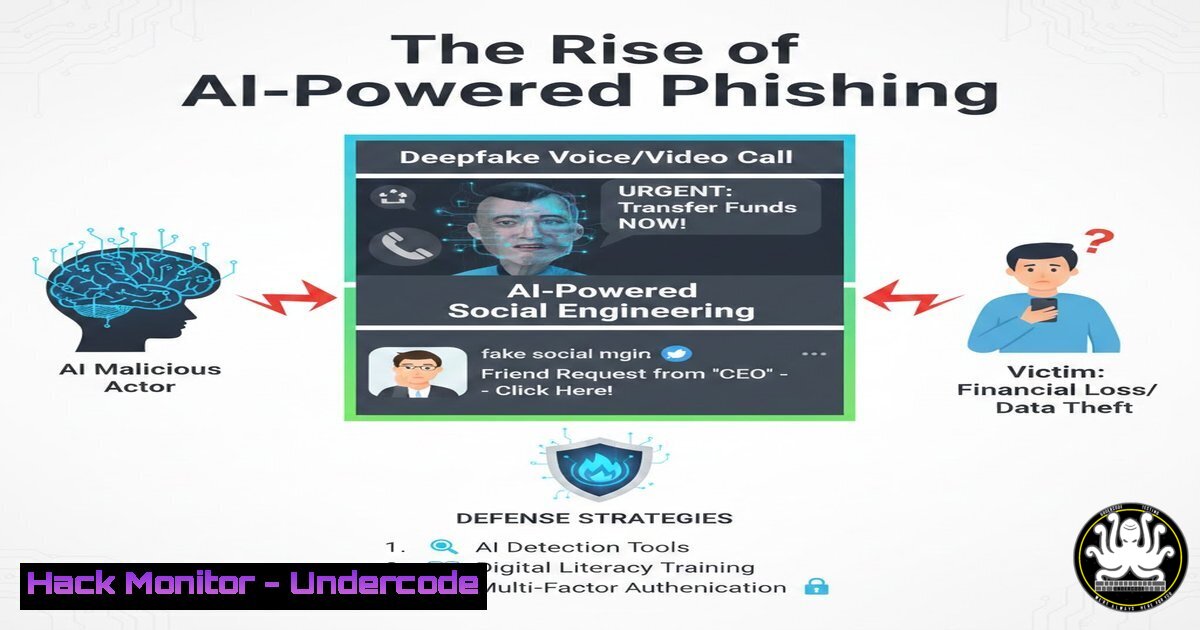
Artificial intelligence is revolutionizing cyber threats, with attackers leveraging generative AI to craft highly convincing phishing campaigns. These AI-driven attacks use deepfake audio, video, and personalized text to bypass traditional security awareness training. Understanding the mechanics of these threats and implementing multi-layered defenses is critical for organizations to protect sensitive data and maintain trust in an era of synthetic media.
Learning Objectives
- Understand how generative AI is used to create sophisticated phishing and social engineering attacks.
- Learn to identify deepfake indicators and implement technical controls to detect AI-generated content.
- Develop a response strategy combining user education, email filtering, and endpoint detection for AI-powered threats.
You Should Know
1. Anatomy of an AI-Generated Phishing Campaign
Attackers now use tools like ChatGPT, voice cloning software, and deepfake video generators to impersonate executives or trusted partners. A typical campaign begins with reconnaissance using OSINT (Open Source Intelligence) to gather public data about the target. Then, AI crafts personalized emails with perfect grammar and context, often accompanied by a deepfake audio call to “verify” the request. This combination dramatically increases success rates.
Step-by-step guide to analyzing a suspicious email:
- Linux/macOS: Use `eml2txt` or `cat email.eml` to view raw headers. Extract IP addresses with
grep -E -o "([0-9]{1,3}\.){3}[0-9]{1,3}" email.eml. - Windows PowerShell: `Get-Content email.eml | Select-String -Pattern “\b\d{1,3}\.\d{1,3}\.\d{1,3}\.\d{1,3}\b”` to find sender IPs.
- Check SPF/DKIM/DMARC records using `nslookup -type=txt domain.com` or online tools.
- Analyze attachments in a sandbox: Use `Cuckoo` or `ANY.RUN` to execute suspicious files safely.
2. Detecting Deepfake Audio in Vishing Attacks
Vishing (voice phishing) now employs AI voice cloning with as little as three seconds of audio. To detect fakes, look for unnatural pauses, lack of breathing sounds, or robotic intonation. Technical detection involves analyzing audio spectrograms.
Command-line analysis with Python:
pip install librosa matplotlib numpy
python -c "
import librosa
import matplotlib.pyplot as plt
y, sr = librosa.load('suspicious_call.wav')
plt.figure(figsize=(10, 4))
librosa.display.waveshow(y, sr=sr)
plt.title('Waveform - Look for unnatural repetition')
plt.show()
"
Compare with a known sample of the person’s voice. Inconsistent frequency patterns may indicate synthesis.
3. Hardening Email Gateways Against AI-Enhanced BEC
Business Email Compromise (BEC) attacks now use AI to mimic writing style. Traditional rule-based filters fail; instead, deploy machine learning-based email security.
Configuration tips for Microsoft 365 Defender:
- Enable Anti-phishing policies → Impersonation protection for executives.
- Set Advanced Delivery to quarantine messages with suspicious header patterns.
- Use Transport Rules to add a warning banner for external emails containing payment requests.
Linux-based SPF/DKIM verification script:
!/bin/bash
domain="example.com"
echo "SPF record:"
dig TXT $domain | grep -i "v=spf1"
echo "DKIM selector (usually mail):"
dig TXT mail._domainkey.$domain
4. Implementing Zero Trust for Identity Verification
In an AI-phishing world, never trust audio/video alone. Mandate out-of-band verification for sensitive requests.
Step-by-step zero trust workflow:
- Use FIDO2 security keys (YubiKey) for MFA.
- Configure conditional access policies requiring device compliance for finance transactions.
- Deploy Microsoft Authenticator with number matching to prevent MFA fatigue attacks.
Windows command to check if MFA is enforced:
Get-MsolUser -All | Where-Object {$_.StrongAuthenticationMethods -ne $null} | Select-Object UserPrincipalName
5. Training Users with Simulated AI Attacks
Security awareness must evolve to include AI-generated content. Use phishing simulation platforms that leverage AI to create realistic templates.
Open-source simulation with Gophish:
- Install Gophish on a Linux server.
- Create a landing page mimicking Office 365 login.
- Import targets and launch a campaign using an AI-written lure about “updated vacation policy.”
- Analyze results to identify high-risk users.
Command to monitor failed logins after simulation:
sudo grep "Failed password" /var/log/auth.log | awk '{print $9}' | sort | uniq -c
6. Cloud Hardening Against AI-Driven Recon
Attackers use AI to scan public cloud misconfigurations. Use tools to continuously audit.
AWS CLI command to check for public S3 buckets:
aws s3api list-buckets --query "Buckets[].Name" --output text | xargs -I {} aws s3api get-bucket-acl --bucket {} | grep -B 1 "AllUsers"
Azure PowerShell to find exposed storage:
Get-AzStorageAccount | Where-Object {$_.PrimaryEndpoints.Blob -like "https://"} | Select-Object StorageAccountName, PrimaryEndpoints
7. Incident Response for AI-Phishing Breaches
If a user falls victim, contain quickly. Assume credentials and session tokens are compromised.
Linux incident response commands:
– `last -i` to see recent logins.
– `ss -tulpn` to check for reverse shells.
– `clamscan -r /home` to scan for malware.
Windows equivalent:
netstat -ano
wevtutil qe Security /f:text /q:"[System[(EventID=4625)]]"
What Undercode Say
- Key Takeaway 1: AI-generated phishing is no longer a future threat—it’s here. Defenses must shift from relying solely on user awareness to technical controls like DMARC, MFA, and anomaly detection.
- Key Takeaway 2: The convergence of deepfake audio/video with traditional email attacks creates a new attack surface that requires cross-layer verification. Organizations must adopt a “trust but verify” mindset with out-of-band confirmation for high-risk transactions.
Analysis: The democratization of AI tools lowers the barrier for attackers, making sophisticated social engineering accessible to anyone. While defenders can use similar AI to detect anomalies, the asymmetry favors the attacker due to the speed of iteration. The most effective strategy combines continuous user education with hardened technical controls and assumes that any communication could be synthetic. Future defenses may include cryptographic signing of media and real-time deepfake detection APIs integrated into communication platforms.
Prediction
Within the next two years, we will see a major data breach caused by a deepfake video conference call impersonating a C-level executive, leading to a fraudulent transfer of funds. This will accelerate the adoption of biometric liveness detection and blockchain-based identity verification for corporate communications. Regulatory bodies will begin mandating specific AI-phishing resilience measures for financial and healthcare sectors.
▶️ Related Video (88% Match):
🎯Let’s Practice For Free:
IT/Security Reporter URL:
Reported By: Victoria Repa – Hackers Feeds
Extra Hub: Undercode MoN
Basic Verification: Pass ✅


