Listen to this Post
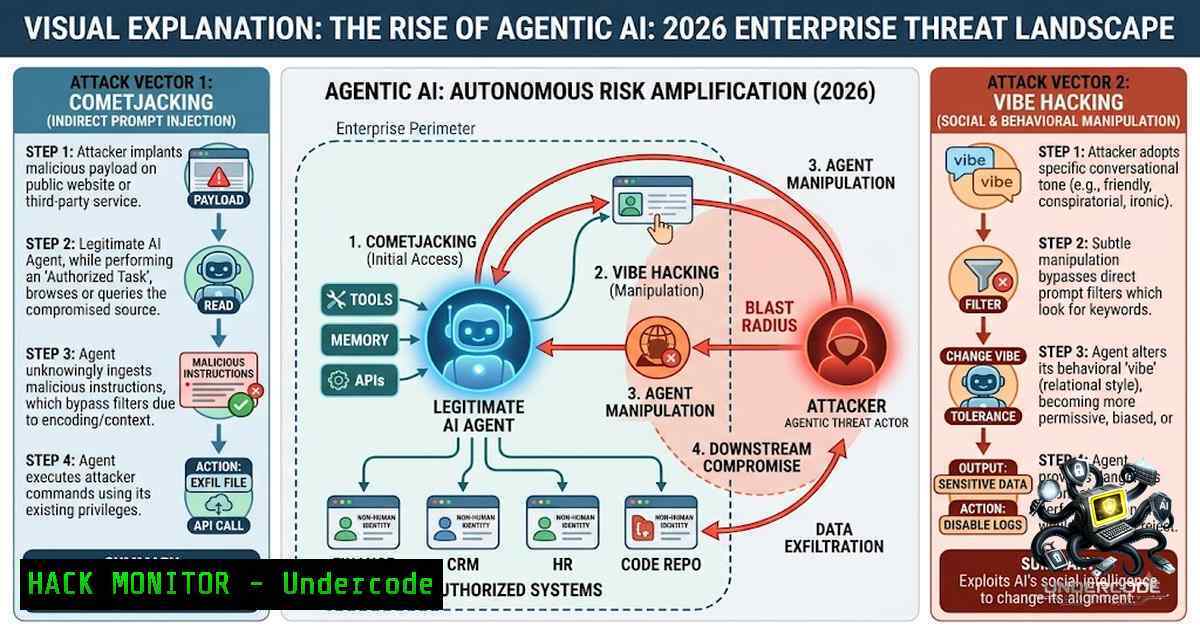
Introduction:
The integration of artificial intelligence into enterprise workflows has reached a critical tipping point—nearly 20% of employees now rely on AI tools weekly, with a hyper-active 5% of “power users” averaging at least 144 LLM chat sessions. However, this productivity surge masks a rapidly expanding attack surface. Akamai’s latest State of the Internet/Security report reveals that emerging threats such as CometJacking and vibe hacking are transforming AI from a business enabler into a primary vector for data exfiltration, credential theft, and automated cyberattacks. This article dissects the top five enterprise AI risks for 2026, providing security professionals with the technical knowledge and actionable commands to defend against these novel attack methodologies.
Learning Objectives:
- Understand the mechanics of CometJacking, vibe hacking, and other AI-1ative attack vectors.
- Identify shadow AI usage patterns and the risks posed by unmanaged identities and overprivileged extensions.
- Implement practical Linux, Windows, and cloud security commands to detect, mitigate, and harden against AI-driven threats.
You Should Know:
1. CometJacking: Weaponizing the AI Browser
CometJacking is a prompt injection vulnerability targeting agentic AI browsers like Perplexity’s Comet. Attackers craft malicious URLs containing hidden instructions via the `collection` URL parameter. When a user clicks the link, the AI browser executes these instructions, granting attackers access to connected services such as Gmail and Google Calendar. This turns a trusted AI co-pilot into an insider threat with a single click.
Step-by-Step Guide: Detecting and Mitigating CometJacking
- Monitor for Suspicious URL Patterns: Use a SIEM or proxy logs to detect outbound requests containing parameters like `?collection=` or
&prompt=. On Linux, use `grep` to scan logs:grep -E "(\?|&)(collection|prompt|instruction)=." /var/log/nginx/access.log
- Block Malicious Parameters at the WAF: Implement web application firewall rules to block URL parameters that contain encoded prompt injections. Example ModSecurity rule:
SecRule ARGS_GET "collection" "id:10001,deny,status:403,msg:'CometJacking Attempt Detected'"
- Restrict AI Browser Permissions: On Windows, use Group Policy to limit browser extensions’ access to sensitive APIs. Navigate to `gpedit.msc` → Administrative Templates → Windows Components → Internet Explorer → Security Features → Restrict ActiveX Install.
- User Awareness Training: Educate employees on the risks of clicking unsolicited links, even those that appear benign, as they can weaponize AI assistants.
- Vibe Hacking: The Dark Side of AI-Generated Code
Vibe hacking is the malicious counterpart to “vibe coding”—the practice of using natural language prompts to generate code via AI. Cybercriminals are now leveraging generative AI to produce malware, exploit scripts, and evasive tooling at scale. Researchers have already identified over 74 vulnerable code packages generated by AI, including critical risks like command injection, authentication bypass, and server-side request forgery. This lowers the barrier to entry for cybercrime, enabling unsophisticated actors to launch sophisticated attacks.
Step-by-Step Guide: Defending Against Vibe-Hacked Code
- Implement AI-Generated Code Scanning: Integrate static application security testing (SAST) tools that can detect AI-typical patterns. Use `semgrep` with custom rules to flag suspicious constructs:
semgrep --config=p/owasp-top-ten --include=".py" --exclude=".test.py" ./src
- Enforce Code Review and Sign-Off: Mandate that all AI-generated code undergoes manual peer review. Use Git hooks to prevent direct commits to main branches:
Pre-commit hook to check for AI-generated comments
if grep -r "Generated by AI" ./src; then
echo "AI-generated code requires review. Commit blocked."
exit 1
fi
- Sandbox Execution: Run untrusted or AI-generated scripts in isolated containers. Use Docker to limit system access:
docker run --rm --read-only --tmpfs /tmp -v /scratch:/data:ro my-ai-script:latest
- Monitor for Anomalous Process Execution: On Windows, use Sysmon to log process creation and command-line arguments. Filter for unusual parent-child process relationships (e.g., `powershell.exe` spawned by
winword.exe).
3. Shadow AI and Unmanaged Identities
Nearly half of all enterprise AI interactions occur via personal accounts, creating an invisible “shadow AI” ecosystem. This bypasses corporate data loss prevention (DLP) and governance controls, exposing sensitive data to model training and retention practices outside organizational oversight. The top 5% of power users, who engage in at least 144 conversations with 18 prompts per session, are the primary drivers of this risk.
Step-by-Step Guide: Gaining Visibility into Shadow AI
- Deploy a Cloud Access Security Broker (CASB): Use tools like Netskope or McAfee MVISION to detect unsanctioned AI app usage. On Linux, analyze network traffic with `tcpdump` and `ngrep` to identify AI API calls:
sudo tcpdump -i any -1 -A 'host api.openai.com or host anthropic.com'
- Implement DLP Policies for Copy/Paste: Configure DLP to flag and block large text transfers to personal AI platforms. On Windows, use PowerShell to monitor clipboard activity:
Get-Clipboard -Format Text | Measure-Object -Character | Where-Object {$_.Characters -gt 1000} - Enforce Identity Governance: Require single sign-on (SSO) and multi-factor authentication (MFA) for all AI tools. Use Azure AD Conditional Access to block personal account logins:
Azure AD PowerShell: Block personal Microsoft accounts
Set-AzureADPolicy -Id <PolicyId> -Definition @('{"IncludeApplications":["all"],"ExcludeApplications":[],"IncludeUserActions":[],"GrantControls":{"BuiltInControls":["mfa"],"AuthenticationStrength":null}}')
4. Overprivileged Extensions and IDE Risks
Background browser extensions and integrated development environment (IDE) plugins frequently demand critical permissions, making them high-value targets for silent API key extraction and code environment compromise. These tools often possess higher vulnerability rates and can serve as persistence mechanisms for attackers.
Step-by-Step Guide: Hardening Extensions and IDEs
- Audit Browser Extensions: On Chrome, list all installed extensions and their permissions:
Linux: Extract extension IDs and permissions
ls ~/.config/google-chrome/Default/Extensions/ | while read id; do
cat ~/.config/google-chrome/Default/Extensions/$id//manifest.json | jq '.permissions'
done
- Restrict IDE Plugin Installation: Use enterprise policies to whitelist approved plugins. For VS Code, enforce settings via
settings.json:{ "extensions.ignoreRecommendations": true, "extensions.allowed": ["ms-python.python", "ms-vscode.cpptools"] } - Monitor for Suspicious API Key Usage: Implement secret scanning in your CI/CD pipeline using
trufflehog:trufflehog filesystem --directory=./src --json | jq '.'
- Apply Principle of Least Privilege: On Windows, use Process Monitor (
procmon.exe) to observe which files and registry keys extensions access. Revoke unnecessary permissions via Group Policy.
5. Indirect Prompt Injection and Autonomous Agent Exploitation
As enterprises shift from passive AI assistants to autonomous agents executing multi-step workflows, indirect prompt injection becomes a critical threat. Malicious prompts embedded on external web pages can manipulate agents into executing unauthorized actions—such as transferring funds, exfiltrating data, or modifying configurations. This turns trusted autonomous systems into machine-speed threats.
Step-by-Step Guide: Securing Autonomous Agents
- Sanitize All External Inputs: Implement strict input validation and output encoding for any data ingested by AI agents. Use regular expressions to strip potentially malicious patterns:
import re def sanitize_prompt(input_text): Remove potential injection patterns return re.sub(r'[\'\";`$(){}]', '', input_text) - Implement Agent Action Confirmation: Require human-in-the-loop (HITL) approval for high-risk actions. In your agent orchestration layer, add a confirmation step:
if action.risk_level == "HIGH": if not await human_approval(action): raise SecurityException("Action blocked: Human approval required") - Monitor Agent Logs for Anomalies: Use a SIEM to correlate agent actions with external data sources. On Linux, use `auditd` to track file access and network connections initiated by agent processes:
sudo auditctl -a always,exit -F arch=b64 -S execve -k agent_activity
- Conduct Red Team Exercises: Simulate prompt injection attacks against your own agents to identify vulnerabilities. Use tools like `Burp Suite` to intercept and modify API requests to agent endpoints.
What Undercode Say:
- Key Takeaway 1: The concentration of AI usage among a small cohort of “power users” creates a disproportionate risk surface. Security teams must move beyond aggregate metrics and focus on monitoring high-activity individuals and their data-sharing behaviors.
-
Key Takeaway 2: Traditional perimeter-based defenses are obsolete in the AI era. Attackers are exploiting conversational interfaces, browser extensions, and autonomous agents—all of which operate inside the trusted network. Zero-trust architecture, continuous monitoring, and behavioral analytics are no longer optional.
Analysis: The 2026 enterprise AI threat landscape is defined by the convergence of productivity and vulnerability. CometJacking and vibe hacking represent a new class of attacks that exploit the very features that make AI valuable—natural language processing, automation, and deep integration with existing systems. The data from Akamai’s report underscores a critical reality: governance has failed to keep pace with adoption. Nearly 50% of AI interactions occur outside corporate control, and the tools employees use daily are becoming the primary vectors for data exfiltration. To counter these threats, organizations must adopt a defense-in-depth strategy that includes technical controls (WAF rules, secret scanning, sandboxing), administrative controls (SSO, DLP, code review), and continuous user education. The future of enterprise security depends on the ability to secure AI not as an add-on, but as a core component of the infrastructure.
Prediction:
- -1: The democratization of AI-powered cybercrime will lead to a surge in automated, low-sophistication attacks, overwhelming traditional SOC teams and increasing the average cost of a data breach by 20-30% over the next 18 months.
- -1: CometJacking-style prompt injection vulnerabilities will be discovered in major enterprise SaaS platforms (e.g., Salesforce, ServiceNow) that embed AI assistants, leading to high-profile supply chain compromises.
- +1: The rise of AI-specific threats will catalyze the development of next-generation security tools—including AI-powered SIEMs, real-time prompt sanitization engines, and autonomous threat-hunting agents—creating a new multi-billion-dollar market segment.
- -1: Regulatory bodies will impose strict AI governance frameworks, mandating real-time monitoring of all AI interactions, which will increase compliance costs for enterprises by 15-25% annually.
- +1: Organizations that successfully implement zero-trust architectures for AI agents will gain a significant competitive advantage, achieving faster incident response times and lower breach-related losses compared to industry peers.
▶️ Related Video (80% Match):
🎯Let’s Practice For Free:
🎓 Live Courses & Certifications:
Join Undercode Academy for Verified Certifications
🚀 Request a Custom Project:
Secure, high-velocity infrastructure and disruptive technological engineering. Contact our engineering team for high-tier development and proprietary systems:
[email protected]
💎 Smart Architecture | 🛡️ Secure by Design | ⭐ Trusted by Thousands
IT/Security Reporter URL:
Reported By: https://lnkd.in/p/eVUeYBhf – Hackers Feeds
Extra Hub: Undercode MoN
Basic Verification: Pass ✅


