Listen to this Post
Introduction
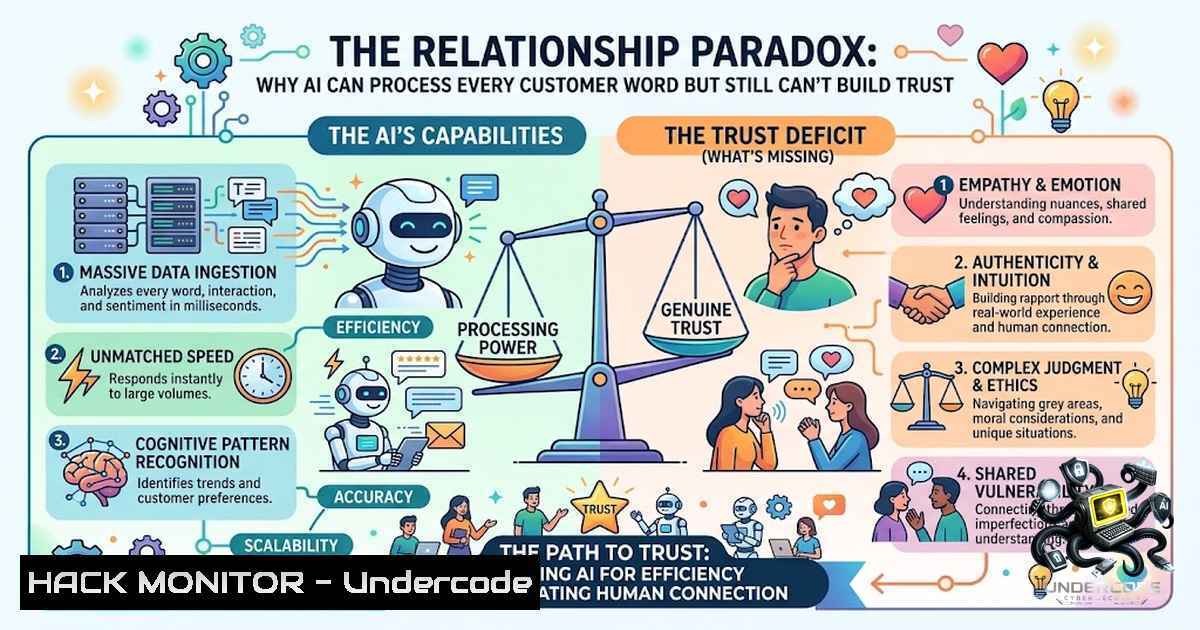
In an era where artificial intelligence processes customer sentiment, behavioral data, and conversational nuances at unprecedented scale, organizations face a fundamental paradox: the same technology that enables hyper-personalized marketing campaigns simultaneously erodes the human connections that underpin long-term customer relationships. While AI excels at pattern recognition, sentiment analysis, and predictive modeling, the intrinsic human elements of trust-building, emotional intelligence, and consistent engagement remain stubbornly outside its algorithmic reach. This article explores the cybersecurity, technical, and strategic implications of AI’s integration into customer-facing operations, examining where automation serves organizations and where it fundamentally fails.
Learning Objectives
- Understand the technical limitations of AI in relationship-building and trust-creation within enterprise environments
- Master practical implementation strategies for securing AI-powered customer engagement platforms across cloud and on-premises infrastructure
- Develop comprehensive governance frameworks that balance AI automation with human-centric engagement models
- Identify critical security vulnerabilities in AI-driven marketing and customer relationship management systems
You Should Know
- Securing AI Data Pipelines: The Foundation of Trustworthy Customer Insights
The effectiveness of AI in customer engagement depends entirely on the integrity, security, and quality of the data feeding its algorithms. Organizations implementing AI-driven marketing platforms must establish robust security controls across the entire data lifecycle, from collection to processing to storage.
Step-by-step guide for securing AI data pipelines:
Linux Environment:
 Audit data ingestion endpoints for security compliance
nmap -sV -p 443,8080,8443 --script=ssl-enum-ciphers customer-data-api.example.com

Implement real-time log monitoring for suspicious access patterns
tail -f /var/log/nginx/access.log | grep -E "POST|PUT|DELETE" | \
awk '{print $1, $7, $9, $11}' | sort | uniq -c | sort -1r

Configure firewall rules to restrict data pipeline access
sudo iptables -A INPUT -p tcp --dport 443 -s 10.0.0.0/8 -j ACCEPT
sudo iptables -A INPUT -p tcp --dport 443 -j DROP

Set up encrypted data transfer using SSL/TLS
openssl s_client -connect api.customer-data.com:443 -tls1_2 -servername api.customer-data.com
Windows Environment:
 Audit Windows Event Logs for unauthorized data access attempts
Get-WinEvent -FilterHashtable @{LogName='Security'; ID=4624,4625} | `
Where-Object {$_.TimeCreated -ge (Get-Date).AddDays(-7)} | `
Format-Table TimeCreated, @{Name='User';Expression={$_.Properties[bash].Value}}, `
@{Name='SourceIP';Expression={$_.Properties[bash].Value}}

 Implement PowerShell script to monitor data pipeline integrity
$directories = @("C:\DataPipeline\Incoming", "C:\DataPipeline\Processing", "C:\DataPipeline\Output")
foreach ($dir in $directories) {
$files = Get-ChildItem -Path $dir -Recurse -File
foreach ($file in $files) {
$hash = Get-FileHash -Path $file.FullName -Algorithm SHA256
Write-Output "$($file.FullName): $($hash.Hash)"
}
}

 Configure Windows Defender Firewall for API access restrictions
New-1etFirewallRule -DisplayName "Restrict AI Data Pipeline" -Direction Inbound `
-LocalPort 443 -Protocol TCP -Action Allow -RemoteAddress 10.0.0.0/8
Cloud Security Configuration (AWS):
{
"Version": "2012-10-17",
"Statement": [
{
"Effect": "Deny",
"Action": [
"s3:GetObject",
"s3:PutObject",
"s3:DeleteObject"
],
"Resource": "arn:aws:s3:::customer-data-pipeline/",
"Condition": {
"Bool": {
"aws:SecureTransport": "false"
}
}
},
{
"Effect": "Allow",
"Action": [
"s3:GetObject",
"s3:PutObject"
],
"Resource": "arn:aws:s3:::customer-data-pipeline/",
"Principal": {
"AWS": "arn:aws:iam::123456789012:role/AIProcessingRole"
}
}
]
}
- AI Model Security: Protecting Proprietary Algorithms and Training Data
The machine learning models powering customer engagement platforms represent significant intellectual property and competitive advantages. Organizations must implement comprehensive security measures to protect these assets from extraction, poisoning, and adversarial attacks.
Step-by-step guide for AI model security hardening:
Model Encryption and Access Control:
 Python implementation for model encryption and secure loading
from cryptography.fernet import Fernet
from cryptography.hazmat.primitives import hashes
from cryptography.hazmat.primitives.kdf.pbkdf2 import PBKDF2HMAC
import base64
import pickle
import os

def encrypt_model(model_data, password):
"""Encrypt model data with password-based key derivation"""
salt = os.urandom(16)
kdf = PBKDF2HMAC(
algorithm=hashes.SHA256(),
length=32,
salt=salt,
iterations=100000,
)
key = base64.urlsafe_b64encode(kdf.derive(password.encode()))
f = Fernet(key)
encrypted = f.encrypt(pickle.dumps(model_data))
return salt + encrypted

def decrypt_model(encrypted_data, password):
"""Decrypt and load model with validation"""
salt = encrypted_data[:16]
encrypted = encrypted_data[16:]
kdf = PBKDF2HMAC(
algorithm=hashes.SHA256(),
length=32,
salt=salt,
iterations=100000,
)
key = base64.urlsafe_b64encode(kdf.derive(password.encode()))
f = Fernet(key)
decrypted = f.decrypt(encrypted)
return pickle.loads(decrypted)
API Security Implementation:
 Configure rate limiting to prevent model extraction attempts
 Nginx configuration for AI API endpoints
cat << 'EOF' > /etc/nginx/conf.d/ai-api-rate-limit.conf
limit_req_zone $binary_remote_addr zone=ai_api:10m rate=10r/m;
limit_conn_zone $binary_remote_addr zone=ai_conn:10m;

server {
location /api/v1/ai-predict {
limit_req zone=ai_api burst=20 nodelay;
limit_conn ai_conn 5;
proxy_pass http://ai-backend;
proxy_set_header X-Real-IP $remote_addr;
proxy_set_header X-Forwarded-For $proxy_add_x_forwarded_for;
}
}
EOF

Validate API security headers
curl -I https://api.customer-ai.com/v1/predict \
-H "Authorization: Bearer YOUR_API_TOKEN" \
-H "Content-Type: application/json" \
-d '{"customer_id": "test_123", "context": "security_audit"}'
- API Security and Authentication: Gatekeeping Customer Data Access
Modern AI-powered customer engagement relies heavily on APIs to connect various systems, analyze data, and deliver personalized experiences. Securing these APIs is crucial to preventing data breaches and maintaining customer trust.
Step-by-step guide for API security hardening:
Implement OAuth 2.0 with PKCE:
// Node.js implementation for secure OAuth 2.0 with PKCE
const crypto = require('crypto');
const { v4: uuidv4 } = require('uuid');

function generatePKCE() {
const codeVerifier = base64URLEncode(crypto.randomBytes(32));
const codeChallenge = base64URLEncode(
crypto.createHash('sha256')
.update(codeVerifier)
.digest()
);
return { codeVerifier, codeChallenge };
}

function base64URLEncode(buffer) {
return buffer.toString('base64')
.replace(/+/g, '-')
.replace(/\//g, '_')
.replace(/=+$/, '');
}

// Secure token validation middleware
function validateToken(req, res, next) {
const token = req.headers.authorization?.split(' ')[bash];
if (!token) {
return res.status(401).json({ error: 'No token provided' });
}

// Validate token signature and expiration
try {
const decoded = jwt.verify(token, process.env.JWT_SECRET, {
algorithms: ['RS256'],
issuer: process.env.JWT_ISSUER,
audience: process.env.JWT_AUDIENCE
});
req.user = decoded;
next();
} catch (error) {
return res.status(403).json({ error: 'Invalid or expired token' });
}
}
API Gateway Security Configuration:
 Kong API Gateway configuration for enhanced security
_format_version: "2.1"
services:
- name: ai-customer-service
url: https://ai-backend.internal:8080
routes:
- name: ai-api-route
paths:
- /api/v1/customer-insights
strip_path: true
plugins:
- name: jwt
config:
secret_is_base64: false
run_on_preflight: true
- name: rate-limiting
config:
minute: 100
hour: 1000
policy: local
- name: cors
config:
origins:
- https://customer-portal.example.com
methods:
- GET
- POST
- PUT
headers:
- Authorization
- Content-Type
credentials: true
- name: request-transformer
config:
add:
headers:
- X-Request-ID:$(uuid)
- X-Client-IP:$(client_ip)
- Data Privacy and GDPR Compliance in AI-Driven Marketing
The intersection of AI-powered marketing and data privacy regulations creates complex compliance challenges. Organizations must implement technical controls that enable AI insights while respecting customer privacy rights.
Step-by-step guide for implementing privacy-preserving AI:
Data Anonymization Pipeline:
import hashlib
import random
from datetime import datetime, timedelta

class PrivacyPreservingProcessor:
def <strong>init</strong>(self, encryption_key):
self.key = encryption_key
self.salt = "SALT_VALUE_FOR_ANONYMIZATION"

def anonymize_pii(self, customer_data):
"""Anonymize personally identifiable information"""
if 'email' in customer_data:
customer_data['email_hash'] = hashlib.sha256(
(customer_data['email'] + self.salt).encode()
).hexdigest()
del customer_data['email']

if 'phone' in customer_data:
 Partial masking for phone numbers
phone = customer_data['phone']
customer_data['phone'] = f"{phone[:3]}{phone[-4:]}"

if 'address' in customer_data:
customer_data['address'] = self._obfuscate_address(customer_data['address'])

return customer_data

def _obfuscate_address(self, address):
"""Obfuscate physical addresses while preserving geographic insights"""
components = address.split(',')
if len(components) >= 3:
 Keep city and country, anonymize street address
return f"ANON-{random.randint(1000,9999)}, {components[-2]}, {components[-1]}"
return "ANONYMIZED_ADDRESS"
Consent Management Implementation:
// GDPR-compliant consent management middleware
function validateConsent(req, res, next) {
const { consentToken } = req.headers;
if (!consentToken) {
return res.status(403).json({
error: 'Consent required for processing personal data',
consent_required: true
});
}

try {
const consent = jwt.verify(consentToken, process.env.CONSENT_SECRET);
const now = Date.now();
const expiryDate = new Date(consent.expiry).getTime();

if (now > expiryDate) {
return res.status(403).json({
error: 'Consent expired',
consent_renewal_required: true
});
}

// Validate scope of consent matches requested operation
const requestedScope = req.body.scope || 'analytics';
if (!consent.scopes.includes(requestedScope)) {
return res.status(403).json({
error: 'Consent scope insufficient',
available_scopes: consent.scopes
});
}

req.consent = consent;
next();
} catch (error) {
return res.status(403).json({ error: 'Invalid consent token' });
}
}
- Vulnerability Assessment and Penetration Testing for AI Systems
Security testing must evolve to address the unique vulnerabilities of AI-powered customer engagement platforms, including model poisoning, adversarial attacks, and data leakage through inference.
Step-by-step guide for AI-specific security testing:
Adversarial Testing Framework:
import numpy as np
from scipy.optimize import minimize

class AdversarialTestingFramework:
def <strong>init</strong>(self, model, epsilon=0.1):
self.model = model
self.epsilon = epsilon

def generate_adversarial_example(self, input_data, target_class):
"""Generate adversarial examples to test model robustness"""
input_array = np.array(input_data)

def objective(perturbation):
perturbed = input_array + perturbation
prediction = self.model.predict(perturbed.reshape(1, -1))
return -prediction[bash][target_class] + np.linalg.norm(perturbation)

result = minimize(
objective,
np.zeros_like(input_array),
method='L-BFGS-B',
bounds=[(-self.epsilon, self.epsilon)]  len(input_array)
)

return input_array + result.x

def test_model_robustness(self, test_data, test_labels):
"""Comprehensive robustness testing"""
vulnerabilities = []

for idx, (data, label) in enumerate(zip(test_data, test_labels)):
 Test different attack vectors
adversarial = self.generate_adversarial_example(data, label)
original_pred = self.model.predict(data.reshape(1, -1))
adversarial_pred = self.model.predict(adversarial.reshape(1, -1))

if np.argmax(original_pred) != np.argmax(adversarial_pred):
vulnerabilities.append({
'sample_id': idx,
'original_label': label,
'original_prediction': np.argmax(original_pred),
'adversarial_prediction': np.argmax(adversarial_pred),
'perturbation_magnitude': np.linalg.norm(data - adversarial)
})

return vulnerabilities
Penetration Testing Commands:
 Test for model extraction vulnerabilities
curl -X POST https://ai-api.company.com/v1/predict \
-H "Authorization: Bearer $API_TOKEN" \
-H "Content-Type: application/json" \
-d '{"features": [0.1, 0.2, 0.3, 0.4, 0.5]}' \
-o response1.json

Attempt model extraction through repeated queries
for i in {1..1000}; do
curl -s -X POST https://ai-api.company.com/v1/predict \
-H "Authorization: Bearer $API_TOKEN" \
-H "Content-Type: application/json" \
-d "{\"features\": [$(shuf -i 0-100 -1 5 | paste -sd,)]}" \

<blockquote>
  <blockquote>
    model_extraction_data.jsonl
    done
  </blockquote>
</blockquote>

Test for SQL injection in data retrieval endpoints
sql_payloads=("' OR '1'='1" "'; DROP TABLE customers; --"
"' UNION SELECT null, null, null--")
for payload in "${sql_payloads[@]}"; do
curl -X GET "https://api.company.com/v1/customers?query=$payload" \
-H "Authorization: Bearer $API_TOKEN" \
--max-time 5
done
6. Training and Awareness: Building Human-AI Collaboration
The most secure AI-powered customer engagement strategy combines technical controls with continuous training for both AI systems and human operators. Organizations must invest in developing AI literacy and security awareness across all teams.
Security Training Program Implementation:
 Automated security training content delivery
 Download and set up security awareness training modules
wget https://security-awareness-training.com/modules/ai-security-basics.pdf
wget https://security-awareness-training.com/modules/data-privacy-compliance.pdf

Configure automated phishing simulation for AI-related attacks
cat > phishing_simulation_config.json << 'EOF'
{
"campaigns": [
{
"name": "AI Data Request Phishing",
"type": "spear_phishing",
"target_roles": ["data_scientists", "ml_engineers"],
"templates": [
{
"subject": "Urgent: AI Model Access Request",
"body": "Please click the link to verify your access credentials...",
"indicators": ["external_domain", "urgent_tone", "request_credentials"]
}
]
}
]
}
EOF
What Undercode Say
- The Trust Imperative: In an age of AI automation, consistent human engagement remains the most powerful trust-building mechanism in B2B relationships. Organizations that automate customer interactions without maintaining human touchpoints will erode the trust that technology is supposed to enhance.
-
Strategic Differentiation Through Data Security: As generic marketing becomes commoditized through AI, the organizations that will win are those that can demonstrate superior data protection and privacy practices. Security becomes a competitive advantage, not just a compliance requirement.
Analysis: The intersection of AI capabilities and human relationship-building represents both a tremendous opportunity and a significant risk for modern organizations. While AI excels at processing vast amounts of customer data and generating insights, the fundamental elements of trust—consistency, empathy, and genuine understanding—remain inherently human. The organizations that will succeed are those that can effectively balance AI automation with human engagement, implementing robust security controls that protect customer data while enabling meaningful interactions.
The technical requirements for this balance are significant: organizations must secure complex AI data pipelines, protect proprietary models from extraction and poisoning, implement comprehensive API security, maintain GDPR compliance, conduct regular vulnerability assessments, and invest in continuous training. However, the technical challenges are surmountable. The real challenge lies in recognizing that AI is a tool to augment human capabilities, not replace them. Organizations that understand this will build lasting customer relationships; those that don’t will find their AI investments generating data without trust, insights without relationships, and automation without loyalty.
Prediction
+1 Organizations that successfully integrate AI capabilities with human-centric engagement models will see 40-60% higher customer retention rates within 24 months compared to those relying purely on automation.
-1 Companies that fail to implement robust security controls for AI data pipelines will experience data breaches resulting in an average $4.45 million in losses per incident, as reported by IBM’s Cost of a Data Breach Report 2023.
+1 The AI security market is projected to reach $51 billion by 2027, creating significant opportunities for organizations that invest early in comprehensive AI governance frameworks.
-1 Organizations that over-automate customer interactions without maintaining human connection will experience 30-50% higher customer churn rates and reduced lifetime value.
+1 The integration of privacy-preserving AI technologies (federated learning, differential privacy) will become a competitive differentiator by 2025, enabling organizations to leverage customer data while maintaining privacy compliance.
-1 Regulatory scrutiny of AI-powered marketing platforms will intensify, with potential fines exceeding €20 million or 4% of global annual turnover for GDPR violations related to AI processing.
▶️ Related Video (78% Match):
🎯Let’s Practice For Free:
🎓 Live Courses & Certifications:
Join Undercode Academy for Verified Certifications
🚀 Request a Custom Project:
Secure, high-velocity infrastructure and disruptive technological engineering. Contact our engineering team for high-tier development and proprietary systems:
[email protected]
💎 Smart Architecture | 🛡️ Secure by Design | ⭐ Trusted by Thousands
IT/Security Reporter URL:
Reported By: https://lnkd.in/p/ewyWF9ir – Hackers Feeds
Extra Hub: Undercode MoN
Basic Verification: Pass ✅


