Listen to this Post
Introduction:
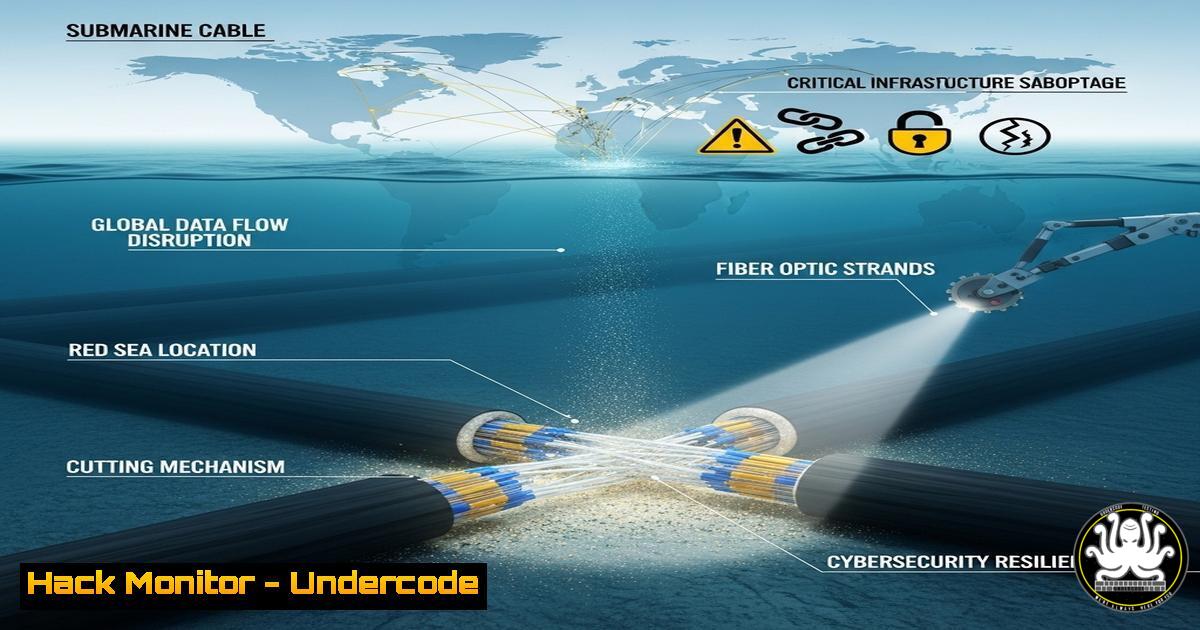
The recent sabotage of undersea communication cables in the Red Sea has exposed a critical vulnerability in the world’s digital backbone. This act of physical infrastructure attack, reportedly cutting up to 70% of internet traffic between Europe and Asia, underscores a stark reality: cybersecurity is not just about firewalls and encryption, but also about the physical protection of the global network’s arteries. This incident moves the threat landscape from pure data compromise to tangible, kinetic disruption with profound economic and security implications.
Learning Objectives:
- Understand the criticality of undersea cable infrastructure to global internet connectivity and the convergence of physical and cyber security domains.
- Learn immediate technical response strategies for network engineers during major outages, including traffic rerouting and diagnostic commands.
- Develop a long-term strategic mindset for building resilient, redundant network architectures capable of withstanding targeted physical attacks.
You Should Know:
1. Mapping Global Internet Chokepoints with Traceroute
The `traceroute` command is the first tool in a network engineer’s arsenal to diagnose connectivity issues and understand the physical path data takes.
Step-by-step guide:
On Linux/macOS:
traceroute -I 8.8.8.8  Using ICMP packets
traceroute -T google.com  Using TCP SYN packets (often less filtered)
On Windows:
tracert 8.8.8.8
How to use it: This command sends packets with increasing Time-To-Live (TTL) values, forcing each router along the path to send back an ICMP “Time Exceeded” message. The output lists each hop, its IP, and response times. A sudden series of timeouts () after a specific international gateway can indicate the precise location of a cable cut or major outage, confirming if your traffic is being affected by an event like the Red Sea disruption.
2. Leveraging BGP for Traffic Engineering and Rerouting
The Border Gateway Protocol (BGP) is the postal service of the internet, deciding the best path for traffic. During a cable cut, network operators manually influence BGP paths.
Verified BGP commands (Cisco IOS):
show ip bgp summary  Shows BGP neighbor status and routes learned
show ip bgp  Displays the entire BGP routing table
configure terminal
router bgp 65001
network 192.0.2.0 mask 255.255.255.0
neighbor 203.0.113.1 route-map PRIMARY_OUT out
Step-by-step guide: The above commands are used to view the state of BGP peers and the routing table. The `route-map` directive applied to a neighbor is key. Operators pre-configure route maps that prepend autonomous system (AS) numbers (e.g., 65530 65530 65530) to make a path through a specific peer look less desirable. During an outage on the primary path (e.g., via the Red Sea), they can remove this route map, making an alternative path (e.g., via the Pacific or terrestrial links) the new preferred route, effectively rerouting traffic around the damage.
3. Monitoring Network Performance with Continuous Diagnostics
When failovers occur, continuous monitoring is essential to ensure performance and stability.
Linux commands for network monitoring:
 Monitor bandwidth usage in real-time (install with 'apt install nload')
nload

Continuous ping with timestamping for latency logs
ping 8.8.8.8 | while read pong; do echo "$(date): $pong"; done > ping_log.txt

Check active connections and their states
ss -tuln
Step-by-step guide: `nload` provides a real-time visual of incoming and outgoing traffic, crucial for verifying if traffic is indeed flowing over the new, backup path. The timestamped `ping` command creates a log file that can be analyzed later to pinpoint exactly when the outage began and when connectivity was restored, providing valuable data for post-incident reports. The `ss` command quickly shows all listening ports and active connections, helping to ensure critical services remain reachable after the network changes.
4. Simulating Outages for Resilience Testing with `tc`
You can simulate the high latency and packet loss of a backup satellite link on your own Linux server to test application resilience.
Linux Traffic Control (`tc`) commands:
 Add 600ms of latency and 1% packet loss to eth0
sudo tc qdisc add dev eth0 root netem delay 600ms loss 1%

Show the current rules on the interface
sudo tc qdisc show dev eth0

Delete the added rule to return to normal
sudo tc qdisc del dev eth0 root
Step-by-step guide: This uses the `tc` (traffic control) utility with the `netem` (network emulator) module. The first command adds a queuing discipline to the root of the `eth0` interface, enforcing a constant 600-millisecond delay and 1% packet loss on all outgoing traffic. This harsh environment quickly reveals if your web applications, VoIP systems, or database replication can handle the degraded conditions of a transcontinental failover. Always remember to delete the rule after testing.
5. Verifying Data Integrity During Instability
High latency and packet loss can corrupt file transfers. Always verify checksums.
Commands to generate and verify checksums:
On Linux:
sha256sum large_file.iso > original.sha256  Generate hash
sha256sum -c original.sha256  Verify against the hash file
On Windows (PowerShell):
Get-FileHash C:\path\to\large_file.iso -Algorithm SHA256 | Export-Csv original_hashes.csv
Get-FileHash C:\path\to\large_file.iso -Algorithm SHA256 | Compare-Object (Import-Csv original_hashes.csv)
Step-by-step guide: After transferring a critical file over a degraded network link, do not assume its integrity. Generate a cryptographic hash (like SHA-256) of the file before transfer. After the transfer, generate a hash of the received file. If the hashes match, the file is intact. If they differ, the file was corrupted in transit due to packet loss and must be re-transferred. This is a critical step for deploying updates or transferring data during widespread outages.
6. Hardening Critical Infrastructure Monitoring
Ensure your monitoring systems themselves are resilient and secure.
Linux system hardening snippets:
 Configure and enable UFW (Uncomplicated Firewall) to only allow essential ports
sudo ufw allow 22/tcp comment 'SSH'
sudo ufw allow 9090/tcp comment 'Prometheus'
sudo ufw enable

Install and configure fail2ban to block brute force attacks on SSH
sudo apt install fail2ban
sudo systemctl enable fail2ban --now
Step-by-step guide: During a major internet disruption, threat actors often ramp up attacks, knowing defensive teams are distracted. These commands bolster your server’s security. UFW restricts access to only the ports necessary for management (SSH) and monitoring (Prometheus in this example). Fail2ban monitors log files for repeated failed login attempts and automatically modifies firewall rules to ban the offending IP addresses, protecting your critical infrastructure dashboards from compromise.
7. Cloud-Specific Resilience: Multi-Region Failover
For cloud-based services, resilience is achieved through geographic redundancy.
Example AWS CLI commands to check resource health:
 Describe the state of EC2 instances across regions
aws ec2 describe-instances --region us-west-1 --query 'Reservations[].Instances[].State.Name'
aws ec2 describe-instances --region eu-central-1 --query 'Reservations[].Instances[].State.Name'

For Route 53 DNS failover (conceptual)
 A pre-configured health check would fail, automatically updating the DNS record to point to the secondary region.
Step-by-step guide: Modern cloud architectures are built for this. The AWS CLI commands allow you to quickly check the status of your critical compute instances in different regions. The real resilience is designed beforehand using services like Amazon Route 53, which can be configured with health checks. If the health check to your primary region (e.g., Europe) fails due to a cable cut, Route 53 will automatically and globally re-route DNS queries to your healthy secondary region (e.g., North America), achieving a seamless failover for end-users without any manual intervention.
What Undercode Say:
- Physical Infrastructure is the Ultimate Attack Surface: This event is a paradigm shift. Defenders can no longer focus solely on logical attacks; the physical layer is now a primary target for state-level and terrorist actors seeking to cause maximum disruption without touching a keyboard.
- Redundancy is Not Optional: Organizations that treated multi-path, multi-continent redundancy as a costly luxury are now facing severe operational impact. This incident is the most potent business case for investing in resilient, geographically diverse cloud and network architectures.
The sabotage of the Red Sea cables is not a simple vandalism act; it is a strategic, asymmetric attack on global communications. It demonstrates a deep understanding of critical internet chokepoints and a willingness to exploit them. The immediate impact is economic disruption, but the long-term implication is a forced evolution in how we design global networks. We must move beyond simple redundancy within a region to true geo-political redundancy, where traffic can flow around multiple global crises simultaneously. This event will accelerate the development and deployment of new technologies like satellite internet constellations (e.g., Starlink) as complementary backup systems, but it also raises the specter of these physical attacks becoming a normalized tactic in geopolitical conflicts, making digital resilience a paramount concern of national security.
Prediction:
The Red Sea cable cuts will serve as a blueprint for future adversarial actions, leading to an increased frequency of targeted physical attacks on other global internet chokepoints, such as the Strait of Malacca or the Luzon Strait. This will force a massive re-architecting of the global internet, driving investment away from optimized, centralized pathways and towards a more meshed, resilient, and potentially higher-latency network model. Within five years, we predict the emergence of AI-driven, fully autonomous network orchestration systems capable of predicting traffic flow disruptions and executing complex, multi-provider BGP reroutes and cloud failovers in milliseconds without human intervention, fundamentally changing the role of the network engineer from operator to overseer.
🎯Let’s Practice For Free:
IT/Security Reporter URL:
Reported By: Mthomasson Microsoft – Hackers Feeds
Extra Hub: Undercode MoN
Basic Verification: Pass ✅


