Listen to this Post
Introduction:
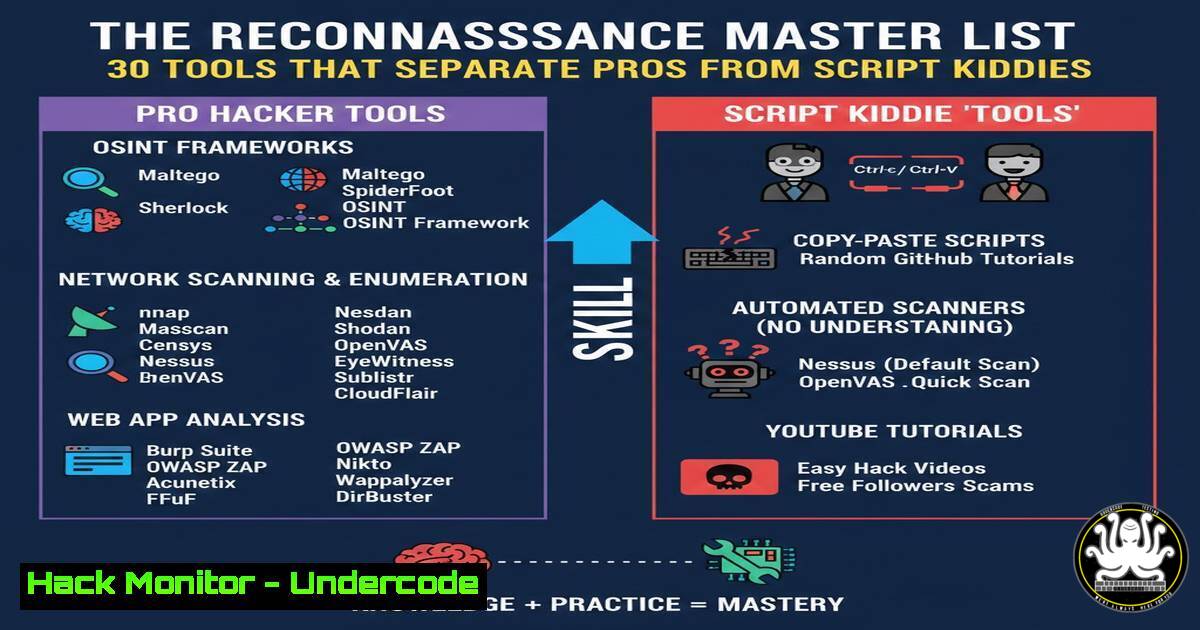
Reconnaissance is the foundational and most critical phase of any security assessment, acting as the strategic blueprint for a successful engagement. It involves systematically gathering intelligence on targets—including domains, IPs, cloud assets, APIs, and technologies—to identify potential attack vectors before exploitation begins. This phase transforms a blind attack into a precise, informed operation, dramatically increasing the chances of success while minimizing detection.
Learning Objectives:
- Understand the strategic importance of reconnaissance in the penetration testing lifecycle.
- Categorize and apply 30 essential tools for web, network, cloud, and internal reconnaissance.
- Develop a methodological approach to information gathering for comprehensive security mapping.
You Should Know:
- Network Discovery & Port Scanning: Mapping the Digital Battlefield
The first step is identifying live hosts and understanding what services they expose. This passive and active scanning lays the groundwork for all subsequent testing.
Step‑by‑step guide:
- Passive Discovery: Start with tools like `netdiscover` on a local network to find hosts without sending probes to the targets themselves. For example, to scan a local subnet:
sudo netdiscover -r 192.168.1.0/24. - Broad Sweep: Use
Masscan, the world’s fastest port scanner, for initial sweeping of large IP ranges to find open ports. A basic command is:masscan 10.0.0.0/8 -p80,443,22,3389 --rate=10000. - In-depth Analysis: Follow up with `Nmap` for detailed service and version detection on the identified hosts. A comprehensive scan might include:
nmap -sV -sC -O -p- <target_IP>. This reveals service banners, runs default scripts, attempts OS detection, and scans all 65535 ports. - Service-Specific Enumeration: For discovered services like SMB or Active Directory, use `NetExec` (the modern successor to CrackMapExec) to enumerate information: `netexec smb 192.168.1.0/24 –shares -u ” -p ”` to list accessible SMB shares.
2. Subdomain & Asset Enumeration: Finding Hidden Doors
Attack surfaces often extend far beyond the main website. Discovering subdomains and related digital assets is crucial for a complete assessment.
Step‑by‑step guide:
- Passive Enumeration: Use tools like
Subfinder,Assetfinder, and `Amass` in passive mode to collect subdomains from various online sources without directly querying the target. Run:subfinder -d example.com -o subs.txt. - Certificate Transparency Logs: Query certificate logs via `crt.sh` (a website) or its API to find subdomains for which SSL/TLS certificates have been issued. This often reveals development and internal assets.
- Active Enumeration & Verification: Combine all discovered subdomains and probe them with `HTTPX` to identify live web servers, their technologies, and titles:
cat all_subs.txt | httpx -title -tech-detect -status-code -o live_subs.txt. - Historical Analysis: Use `waybackurls` to fetch URLs from the Wayback Machine archive, which can uncover old, deprecated, and forgotten endpoints or parameters that may still be vulnerable:
echo example.com | waybackurls > urls_archive.txt.
3. Web Technology & Vulnerability Fingerprinting
Understanding the technology stack of a web application directly informs the choice of exploitation techniques and vulnerability scanners.
Step‑by‑step guide:
- Initial Fingerprinting: Use `Wappalyzer` (browser extension) or `WhatWeb` (command line) for a quick overview of technologies like CMS, frameworks, and server software: `whatweb -v https://example.com`.
- Automated Vulnerability Scanning: Leverage
Nuclei, a fast and customizable vulnerability scanner based on community-powered templates, to run thousands of checks against your target list:nuclei -l live_subs.txt -t ~/nuclei-templates/ -o nuclei_scan_results.txt. - Content Discovery: Discover hidden directories, files, and APIs using forced browsing tools. `Gobuster` with a common wordlist is a standard choice:
gobuster dir -u https://example.com -w /usr/share/wordlists/dirb/common.txt. For more speed and flexibility, useFFUF: `ffuf -w wordlist.txt -u https://example.com/FUZZ`.
4. Proxy & Manual Testing: Configure `Burp Suite` as your man-in-the-middle proxy. All browser traffic flows through it, allowing you to intercept, repeat, and fuzz requests manually, which is essential for complex logic flaws and API testing.
4. Cloud & External Infrastructure Reconnaissance
Modern infrastructure lives in the cloud. Attackers use specialized tools to find misconfigured or exposed assets in environments like AWS, Azure, and GCP.
Step‑by‑step guide:
- Passive Cloud Enumeration: Use
cloud_enum, a multi-cloud OSINT tool, to enumerate public resources from keyword lists. It checks for open storage buckets, Azure apps, and more:python3 cloud_enum.py -k examplecorp -l cloud_enum_output.txt. - Search Engine Recon: Leverage internet-wide scanners like `Shodan` and
Censys. Search for specific technologies, service banners, or default pages exposed on the public internet related to your target organization (e.g.,org:"Example Corp" http.favicon.hash:123456). - Historical DNS & IP Data: Use `SecurityTrails` and `DNSDumpster` to view historical DNS records, associated IP blocks, and network information, which can reveal forgotten assets and infrastructure changes over time.
- Secret Scanning: Scan public and internal code repositories for accidentally committed secrets (API keys, passwords) using `TruffleHog` or its fork
TruffleHog3:trufflehog3 filesystem --no-verification /path/to/git/repo. Also perform manual `GitHub Dorking` using search operators likeorg:companyname password.
5. Internal Network & Active Directory Mapping
Once inside a network, reconnaissance focuses on mapping relationships, privileges, and lateral movement paths, particularly in Windows/Active Directory environments.
Step‑by‑step guide:
- Local Privilege Escalation Checks: On a compromised host, immediately run automated scripts like `WinPEAS` for Windows or `LinPEAS` for Linux to identify misconfigurations, weak permissions, and cached credentials that could lead to privilege escalation.
- Active Directory Bloodhound: Use `BloodHound` to ingest data collected by the `SharpHound` ingestor. It graphically maps relationships between users, groups, and computers, revealing attack paths to Domain Admin that are not obvious. The collector is run on a domain-joined machine:
SharpHound.exe --CollectionMethods All. - LLMNR/NBT-NS Poisoning: Use `Responder` to listen for and respond to NetBIOS and LLMNR name resolution requests on the network. This can capture NTLMv2 password hashes from machines attempting to connect to fraudulent shares, which can then be cracked or relayed.
- Email & User Enumeration: From the outside, use `theHarvester` to gather emails, subdomains, hosts, and employee names from public sources like search engines, PGP key servers, and LinkedIn:
theHarvester -d example.com -b google,linkedin.
What Undercode Say:
- Foundations Win Fights: A meticulously executed reconnaissance phase, using the right tool for each specific task, uncovers more than 80% of the exploitable surface. Skipping depth here guarantees a superficial assessment.
- Automation is Mandatory, Not Optional: The difference between a junior and a senior tester is the senior’s curated toolkit of automated workflows—chaining `subfinder` -> `httpx` -> `nuclei` is a basic example. Mastery lies in building and refining these pipelines.
Analysis:
The curated list reflects a mature, multi-layered approach to reconnaissance that moves far beyond running a simple Nmap scan. It systematically addresses the modern, hybrid attack surface: from external cloud assets and web apps to internal network privilege structures. Tools like `Nuclei` and `BloodHound` represent the shift towards highly specialized, context-aware automation that can identify complex vulnerability chains. The inclusion of `cloud_enum` and secret scanners highlights the critical adaptation to cloud-centric infrastructure, where misconfigurations are the new buffer overflows. This toolkit isn’t just a collection of software; it’s a manifestation of a methodological mindset that treats information as the primary weapon.
Prediction:
The future of reconnaissance is the convergence of AI-enhanced automation and continuous, passive surveillance. We will see tools that not only automate scanning but also intelligently correlate data from disparate sources (code repos, certificate logs, exposed APIs, employee social media) to autonomously build and maintain a living “digital twin” of a target organization. This model will predict attack surfaces, simulate breach paths in real-time, and proactively identify shadow IT. Furthermore, as defenses improve at the perimeter, reconnaissance will delve deeper into the human layer—using AI to analyze communication patterns and organizational relationships for sophisticated social engineering campaigns, making the initial information-gathering phase more potent and stealthier than ever.
▶️ Related Video (84% Match):
🎯Let’s Practice For Free:
IT/Security Reporter URL:
Reported By: Michael Eru – Hackers Feeds
Extra Hub: Undercode MoN
Basic Verification: Pass ✅


