Listen to this Post
Introduction:
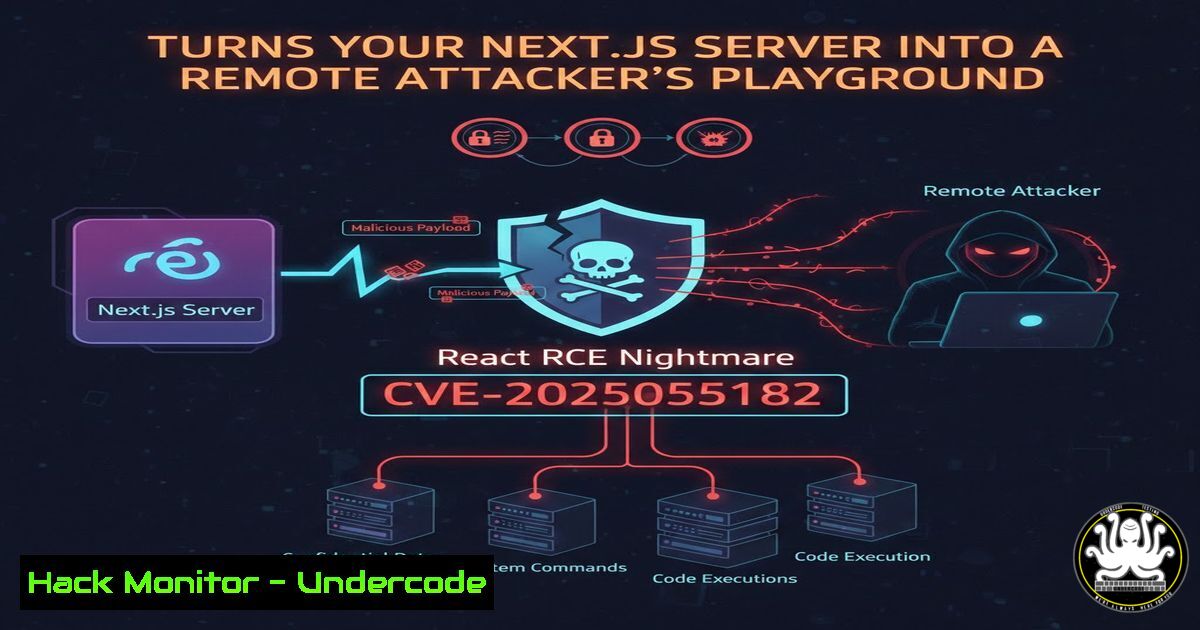
The React Team’s disclosure of CVE-2025055182 has sent shockwaves through the web development community, revealing a critical Remote Code Execution (RCE) flaw within React Server Components (RSCs) in modern Next.js environments. This vulnerability allows an unauthenticated attacker to execute arbitrary code on the server by sending a specially crafted HTTP request, effectively granting them full control over the affected application and its underlying infrastructure. As organizations scramble to patch, understanding the technical mechanics, exploitation paths, and immediate hardening steps is paramount for every developer, DevOps engineer, and security professional.
Learning Objectives:
- Understand the technical root cause of the RCE vulnerability in React Server Components and its impact on Next.js.
- Learn to identify vulnerable applications and apply immediate mitigation and patching strategies.
- Develop hands-on skills for testing server hardening and monitoring for exploitation attempts post-patch.
You Should Know:
- Anatomy of the Exploit: Deserialization and Server-Side Execution
The core of CVE-2025055182 lies in the insecure deserialization of untrusted data within the React Server Components payload processing mechanism. When a Next.js server with RSCs enabled receives a request, it deserializes data to reconstruct React elements on the server. A crafted payload can inject malicious code that is executed during this deserialization phase.
Step-by-step guide explaining what this does and how to use it:
Step 1: Understand the Attack Vector. The attacker sends a malicious HTTP POST request to a Next.js API route or page that processes RSC data. The payload is disguised as a legitimate serialized React element.
Step 2: Craft a Proof-of-Concept (PoC) Payload. While the exact exploit is withheld, the structure typically involves embedding a command execution sequence within the serialized object. In testing environments, security researchers might use a payload that triggers a simple command to demonstrate vulnerability.
Linux/Mac Test Command (for authorized testing only on your own asset): Use `curl` to send a suspected malformed payload to your local endpoint.
curl -X POST http://localhost:3000/api/your-rsc-route \
-H "Content-Type: application/json" \
-H "RSC-Action: my-action" \
--data-binary @malicious_payload.json
Step 3: Server-Side Execution. The vulnerable React/Next.js server, upon deserializing the payload, fails to properly sanitize or validate the content, leading to the execution of the embedded code on the host operating system.
2. Immediate Mitigation: Patching and Environment Hardening
The primary mitigation is immediate patching. The React and Next.js teams have released security updates.
Step-by-step guide explaining what this does and how to use it:
Step 1: Identify Your Versions. Check your `package.json` for React (react, react-dom) and Next.js (next) versions.
grep -E '"react"|"react-dom"|"next"' package.json
Step 2: Apply Security Patches. Upgrade to the patched versions as specified in the security advisories. Use your package manager.
 Using npm
npm update react react-dom next

Using yarn
yarn upgrade react react-dom next --latest
Step 3: Verify the Update. Confirm the new, secure versions are installed.
npm list react react-dom next
3. Network-Level Containment: WAF Rule Configuration
While patches are applied, deploy virtual patches via Web Application Firewall (WAF) rules to block malicious requests attempting to exploit this RCE.
Step-by-step guide explaining what this does and how to use it:
Step 1: Pattern Identification. The exploit relies on specific patterns in the serialized RSC data. Look for abnormal structures in the `RSC-Action` header or the POST body.
Step 2: Deploy a WAF Rule (Example for AWS WAF/ModSecurity). Create a rule to inspect and block requests containing known malicious patterns associated with this CVE.
 Example ModSecurity Rule (conceptual)
SecRule REQUEST_HEADERS:RSC-Action "@rx malicious_pattern" \
"id:1001,phase:1,deny,status:403,msg:'Block React RCE CVE-2025055182 Attempt'"
SecRule REQUEST_BODY "@rx \\x00|malicious_js_code" \
"id:1002,phase:2,deny,status:403,msg:'Block React RCE Deserialization Payload'"
Step 3: Test the Rule. Use your patched PoC or a scanner to ensure the WAF rule effectively blocks the attack without disrupting legitimate traffic.
4. Post-Exploitation Detection: Hunting for Compromise
Assume compromise if your application was exposed before patching. Hunt for indicators.
Step-by-step guide explaining what this does and how to use it:
Step 1: Audit Server Logs. Look for anomalous POST requests to RSC-related endpoints around the time of disclosure.
 Linux (NGINX/Access Logs)
grep -E "POST.(/_next|/api)" /var/log/nginx/access.log | awk '{print $1, $4, $7}' | tail -50

Check for processes spawned by the Node.js user
ps aux | grep -E "(node|sh|bash|curl|wget)" | grep -v grep
Step 2: Examine Network Connections. Identify unexpected outbound connections from your Node.js process.
 Linux netstat/lsof
netstat -tunap | grep node
 or
lsof -i -P -n | grep node
Step 3: File Integrity Monitoring. Check for newly created or modified suspicious files in the application directory.
find /path/to/your/app -type f -newermt "2025-02-13" -ls | grep -v node_modules
5. Cloud Environment Hardening for Next.js Applications
Harden the underlying infrastructure running your Next.js application to limit the blast radius of any future vulnerability.
Step-by-step guide explaining what this does and how to use it:
Step 1: Implement Least-Privilege IAM Roles. Ensure your application’s cloud compute instance (EC2, GCE, Container) runs with an IAM role that has only the permissions it absolutely needs—no administrative access to S3, RDS, etc.
Step 2: Run Node.js as a Non-Root User. In your Dockerfile or systemd service file, always specify a non-root user.
 Example in Dockerfile
FROM node:18-alpine
RUN addgroup -g 1001 -S nodejs
RUN adduser -S nextjs -u 1001
USER nextjs
COPY --chown=nextjs:nodejs . .
EXPOSE 3000
CMD ["npm", "start"]
Step 3: Apply Network Security Groups (NSG/Firewall). Restrict inbound traffic to only port 443 (HTTPS) and potentially SSH from a management jump box. Deny all other inbound traffic by default.
What Undercode Say:
- Patch Velocity is Non-Negotiable: This vulnerability is a stark reminder that the speed of your patch management lifecycle directly correlates with your attack surface. Automated dependency scanning and CI/CD pipeline integration for security updates are no longer “nice-to-haves” but critical infrastructure.
- The Shared Responsibility Model in Action: While React/Next.js provided a vulnerable component, the responsibility for secure deployment (least privilege, network segmentation, WAF) falls squarely on the deploying organization. A vulnerability becomes a breach due to layered security failures.
The analysis suggests that CVE-2025055182, while critical, has a somewhat contained exposure due to its specificity to React Server Components in modern Next.js setups. However, it perfectly illustrates the evolving attack surface of the modern “serverful” JavaScript stack. As more application logic moves back to the server with RSCs and server actions, the attack profile of a Next.js application begins to resemble that of a traditional web application server, inheriting classic threats like insecure deserialization. This incident will likely accelerate the adoption of more rigorous security reviews within the React/Next.js framework’s own development process and push the community towards safer serialization protocols.
Prediction:
This vulnerability marks a pivotal moment for the meta-framework ecosystem. We predict a surge in security-focused static analysis tools specifically designed to audit React Server Component code and data flow. Furthermore, cloud providers will likely introduce curated, hardened templates and security blueprints for deploying Next.js applications, integrating mandatory security controls like runtime application self-protection (RASP) for Node.js environments. In the longer term, we may see a push towards memory-safe languages for critical parts of the React server-side rendering engine or the adoption of more sandboxed execution environments (e.g., WebAssembly isolates) for processing untrusted component data, fundamentally changing how server components are rendered.
🎯Let’s Practice For Free:
IT/Security Reporter URL:
Reported By: Bugcrowd The – Hackers Feeds
Extra Hub: Undercode MoN
Basic Verification: Pass ✅


